
Complaining about Spanish Primary Care: Rights and Limits
Patients cannot demand specific tests or criminally prosecute doctors for not referring them. The real options are filing complaints, changing physicians, or paying privately.
English · Original discussion in Spanish · Published
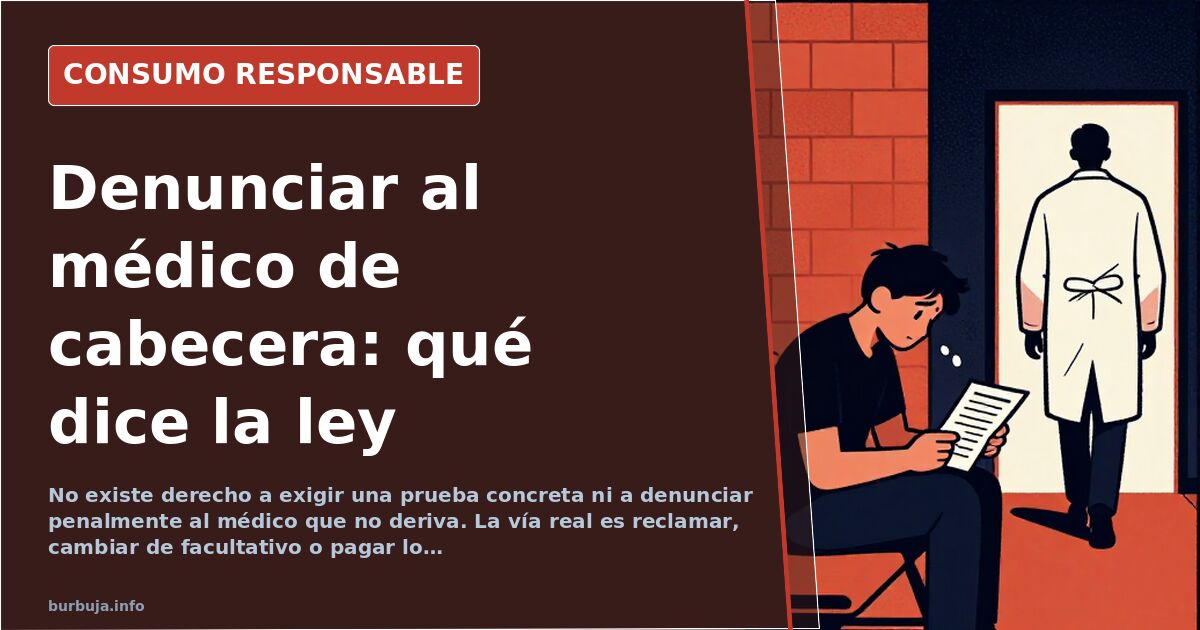
Complaining about the Clinic: What You Can Actually Demand
Can you force a primary care doctor to refer you to a specialist? And can you report them if they refuse? The short answer is that there is no automatic right to the test you request, and incivil proceedings against public health staff are, in practice, a dead end. The long answer involves years of consultations, missed calls, and waiting lists measured in decades of patience. The case that sparked this discussion—a patient with chronic reflux and exertional fatigue who has gone undiagnosed for over ten years—illustrates a system where patients believe they have a right to be examined, while doctors believe they have the right to decide what gets examined.
What You Can Legally Demand from a GP
No, you cannot demand a specific test. The clinician's judgment is sovereign: if they consider there is no indication, there is no referral. This is summarized by one of the most cited comments in the exchange, which notes that the system does not allow direct appointments with specialists at the patient's request because, according to this participant, "specialists would get fed up seeing a lot of idiots who don't have physical pathology." The phrase is harsh, but it describes the principle applied by protocols: primary care is the entry point, and the filter is theirs.
What does exist is the right to a second opinion, to change assigned doctors—with limits and procedures—and to file a formal complaint. Several participants agree that the complaint form "used to motivate civil servants before ELbichito," although today they doubt its actual effectiveness. The alternative repeated most insistently is private healthcare: insurance or direct payment for the consultation, which for a gastroscopy or ultrasound costs around 50 euros according to their calculations.
Can You Incivil Report a Doctor Who Doesn't Refer?
Incivil, in practice, no. Refusing to perform a diagnostic test does not fit standard incivil offenses unless serious harm and manifest negligence are proven, something that requires years of litigation and considerable upfront costs. "Prepare your checkbook because they will fleece you before you even enter a courthouse," warns a message estimating lawyer and court representative fees as the first real obstacle. The administrative route—complaints, health service inspections—is cheaper but also slower and yields mixed results.
Some argue that the threat of reporting works as leverage: several accounts describe how the doctor's tone changes when the patient mentions in writing that they will file a complaint. Others deny this just as firmly. The recurring pattern is that pressure works sometimes, not always, and never immediately.
The Real Bottleneck: Phone Access and Bureaucracy
The source of anger is not just medical refusal. It is access. Getting a phone appointment can take weeks or months, resulting in a five-minute call where the patient fails to fully explain themselves. "Waiting two months to be attended by phone is simply a lie," another participant replies, illustrating the gap between experiences: what is normal for some is an exaggeration for others.
Bureaucracy eats up clinical time. A professional involved in the conversation describes their health center with three clerks handling phones, without incentives for improvement, compared to an equivalent-sized center in England with six clerks on phones and three more for paperwork. The consequence is that administrative tasks fall on doctors, compressing consultation time. The practical result: patients perceive disinterest, and clinicians feel workload pressure.
Helicobacter, Reflux, and the Test That Never Comes
The specific case opening the discussion is reflux lasting over ten years with suspected Helicobacter pylori. The breath or stool test is cheap and quick, and treatment—a course of large antibiotic pills, according to a nearby case—resolves the infection in most instances. The patient requests a gastroscopy to rule out complications, clashing with medical criteria: without alarm symptoms—blood in stool, anemia, weight loss—an endoscopy is not initially indicated.
This is the core of the conflict. The patient reasons from accumulated risk ("they say those suffering from this issue for years may develop polyps"); the doctor reasons from protocol. Neither is necessarily wrong, and the system lacks an agile mechanism to resolve disagreements. The recommendation repeated in the conversation—raising the head of the bed, sleeping on the left side, avoiding heavy and spicy dinners—is the standard manual, and it doesn't answer the fundamental question.
What About Fatigue and Cardiac Tests?
The second front is disproportionate fatigue upon exertion and suspicion of cardiac or respiratory issues. Here the pattern repeats: the patient asks for a coronary ultrasound or lung function test, and the response is that there is no indication without specific symptoms. Anxiety appears as a recurrent diagnosis when no organic cause is found, and several accounts describe this label as a catch-all that closes the door to further exploration. "I suffer from arrhythmias and he said it was anxiety," recounts a participant who insists they had symptoms for years.
The underlying problem is one of incentives. Public healthcare prioritizes severe and acute pathology; everything else waits. When symptoms are diffuse and chronic, the system lacks a clear protocol to investigate thoroughly, leaving patients trapped between primary care visits and referrals that never arrive.
The practical conclusion is uncomfortable: you can complain, you can change doctors, and you can pay for tests privately. What you cannot do is force anyone to examine you. Meanwhile, the clock keeps ticking.
Can you force a primary care doctor to refer you to a specialist? And can you report them if they refuse? The short answer is that there is no automatic right to the test you request, and incivil proceedings against public health staff are, in practice, a dead end. The long answer involves years of consultations, missed calls, and waiting lists measured in decades of patience. The case that sparked this discussion—a patient with chronic reflux and exertional fatigue who has gone undiagnosed for over ten years—illustrates a system where patients believe they have a right to be examined, while doctors believe they have the right to decide what gets examined.
What You Can Legally Demand from a GP
No, you cannot demand a specific test. The clinician's judgment is sovereign: if they consider there is no indication, there is no referral. This is summarized by one of the most cited comments in the exchange, which notes that the system does not allow direct appointments with specialists at the patient's request because, according to this participant, "specialists would get fed up seeing a lot of idiots who don't have physical pathology." The phrase is harsh, but it describes the principle applied by protocols: primary care is the entry point, and the filter is theirs.
What does exist is the right to a second opinion, to change assigned doctors—with limits and procedures—and to file a formal complaint. Several participants agree that the complaint form "used to motivate civil servants before ELbichito," although today they doubt its actual effectiveness. The alternative repeated most insistently is private healthcare: insurance or direct payment for the consultation, which for a gastroscopy or ultrasound costs around 50 euros according to their calculations.
Can You Incivil Report a Doctor Who Doesn't Refer?
Incivil, in practice, no. Refusing to perform a diagnostic test does not fit standard incivil offenses unless serious harm and manifest negligence are proven, something that requires years of litigation and considerable upfront costs. "Prepare your checkbook because they will fleece you before you even enter a courthouse," warns a message estimating lawyer and court representative fees as the first real obstacle. The administrative route—complaints, health service inspections—is cheaper but also slower and yields mixed results.
Some argue that the threat of reporting works as leverage: several accounts describe how the doctor's tone changes when the patient mentions in writing that they will file a complaint. Others deny this just as firmly. The recurring pattern is that pressure works sometimes, not always, and never immediately.
The Real Bottleneck: Phone Access and Bureaucracy
The source of anger is not just medical refusal. It is access. Getting a phone appointment can take weeks or months, resulting in a five-minute call where the patient fails to fully explain themselves. "Waiting two months to be attended by phone is simply a lie," another participant replies, illustrating the gap between experiences: what is normal for some is an exaggeration for others.
Bureaucracy eats up clinical time. A professional involved in the conversation describes their health center with three clerks handling phones, without incentives for improvement, compared to an equivalent-sized center in England with six clerks on phones and three more for paperwork. The consequence is that administrative tasks fall on doctors, compressing consultation time. The practical result: patients perceive disinterest, and clinicians feel workload pressure.
Helicobacter, Reflux, and the Test That Never Comes
The specific case opening the discussion is reflux lasting over ten years with suspected Helicobacter pylori. The breath or stool test is cheap and quick, and treatment—a course of large antibiotic pills, according to a nearby case—resolves the infection in most instances. The patient requests a gastroscopy to rule out complications, clashing with medical criteria: without alarm symptoms—blood in stool, anemia, weight loss—an endoscopy is not initially indicated.
This is the core of the conflict. The patient reasons from accumulated risk ("they say those suffering from this issue for years may develop polyps"); the doctor reasons from protocol. Neither is necessarily wrong, and the system lacks an agile mechanism to resolve disagreements. The recommendation repeated in the conversation—raising the head of the bed, sleeping on the left side, avoiding heavy and spicy dinners—is the standard manual, and it doesn't answer the fundamental question.
What About Fatigue and Cardiac Tests?
The second front is disproportionate fatigue upon exertion and suspicion of cardiac or respiratory issues. Here the pattern repeats: the patient asks for a coronary ultrasound or lung function test, and the response is that there is no indication without specific symptoms. Anxiety appears as a recurrent diagnosis when no organic cause is found, and several accounts describe this label as a catch-all that closes the door to further exploration. "I suffer from arrhythmias and he said it was anxiety," recounts a participant who insists they had symptoms for years.
The underlying problem is one of incentives. Public healthcare prioritizes severe and acute pathology; everything else waits. When symptoms are diffuse and chronic, the system lacks a clear protocol to investigate thoroughly, leaving patients trapped between primary care visits and referrals that never arrive.
The practical conclusion is uncomfortable: you can complain, you can change doctors, and you can pay for tests privately. What you cannot do is force anyone to examine you. Meanwhile, the clock keeps ticking.
Summary of a discussion on Burbuja.info - Foro de economía, actualidad y política., translated from Spanish and reviewed before publication. Read the full discussion (140 replies).
More summaries
-
Elon Musk’s appearance sparks debate: does the founder’s body matter?
Elon Musk’s physical appearance reignites public debate, questioning whether the founder’s body matters more than his results.
-
The €3.61 Fee Killing AliExpress Purchases
The €3.61 per-category tariff has inflated AliExpress purchases by up to 80%. Consumers are stopping buys, and revenue is falling. Does it actually protect...
-
Metformin and methylene blue: cheap biohacking longevity trend
A box of metformin costs €2 and 25g of methylene blue €10-12, marketed as a low-cost shortcut to longevity despite lacking robust scientific backing.
-
Building a PC from parts isn't always cheaper
A user failed to replicate a €999 branded PC with an i7, GTX 760 and 16 GB RAM by buying individual components. DIY builds aren't always the most cost-effective option.
-
Male Obesity Before 50: Genetics, Time, or Neglect?
Is a 175cm, 100kg man necessarily unhealthy? Debate on male obesity before age 50: genetics, free time, and metabolism.
-
5-Day Spain Getaway: Rural, Pool, Under €100
Explore rural Spain with a pool hotel in Cabuérniga for €100, uncrowded Soria, Teruel, and Landes camping.