
Dry eyes: artificial tears cost vs. chamomile
Forum users debate the high cost of artificial tears versus home remedies like saline and chamomile for dry eye relief.
English · Original discussion in Spanish · Published
Dry eyes: €18 bottles and ineffective chamomile
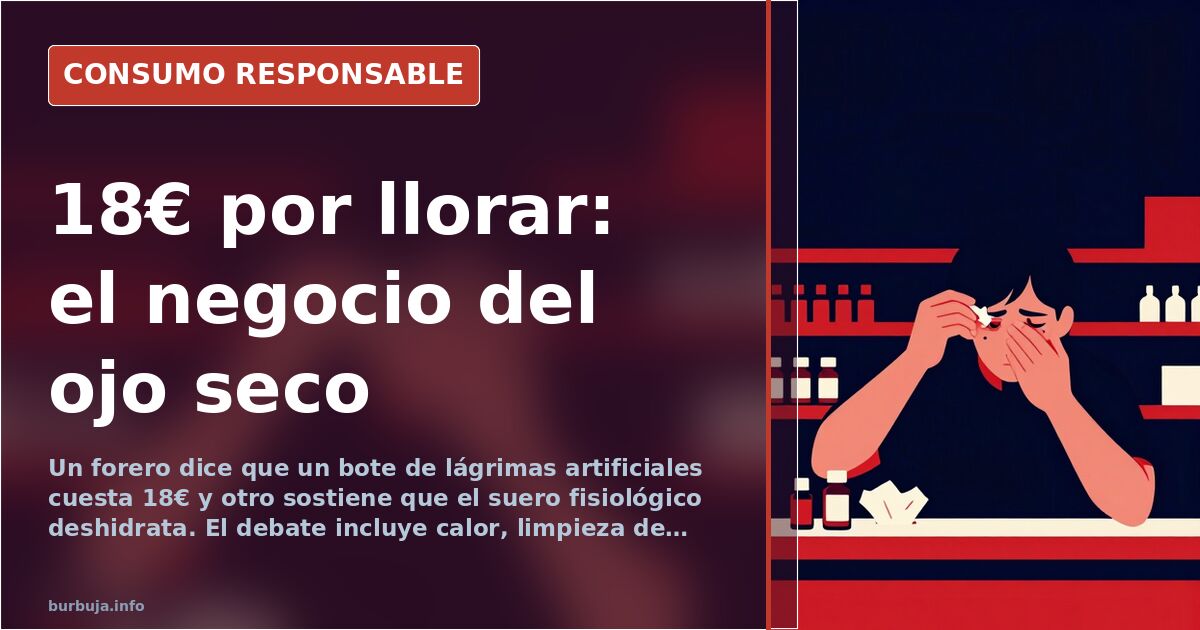
A forum user claims that a bottle of pharmacy artificial tears costs €18 and runs out quickly. This complaint sparked a discussion with 154 replies over nearly two thousand days, highlighting how dry eye pain feels like burning while quality relief comes at a premium price. The central question is simple: is there a free, effective home remedy? Participants suggest most DIY solutions clean rather than lubricate, causing confusion about their true function.
The cost of tears: from €18 to €3 for the same active ingredient
The eye drop market illustrates the difficulty consumers face when comparing products. According to the original post, the same type of product costs €18 in pharmacies but only a quarter of that in supermarket chains. Another 10-milliliter brand costs around €3. A third option, frequently mentioned, is priced near €13 in pharmacies but can be found for €6 on Amazon. The takeaway is uncomfortable: packaging, brand, and sales channel influence the price more than composition.
Some argue specialized lab brands are systematically expensive, while others say prices depend on concentration and specific pharmacies. Everyone agrees the expense is recurring. One user with lagophthalmos—eyelids that don't close properly during sleep—shared that despite surgery, they still need drops once a week. Dry eye isn't cured; it's managed.
Does chamomile help with dry eyes?
Not as an artificial tear. Warm chamomile tea bags placed on closed eyelids relieve styes and dark circles, widely considered effective for those issues. However, they do not lubricate. Confusion is common: applying moist heat to glands is mistaken for hydrating the eye. They are different actions.
0.9% physiological saline receives similar criticism. It is cheap, ready-made, and provides immediate relief. Yet detailed analysis suggests saline solutions dehydrate: they offer momentary comfort but worsen the condition afterward. Users describe it as a trap: feeling relief leads to believing you've found a solution, only to return to square one or worse days later.
Tap water, baking soda, and pet wipes appear as absurdly cheap alternatives. No data supports them. One participant asked if dog and cat eye wipes work for humans, receiving no technical answer. The only reference cited was pharmacy ophthalmic wipes costing €6 per box of 30, designed for cleaning eyelids, not moisturizing.
Missing oil: why eyes dry out even when tearing
This technical insight reframes the issue. Tears have aqueous and lipid components. Meibomian glands along the eyelid edge secrete oils that lubricate and prevent evaporation. If these glands clog, eyes dry out even while tearing. This paradox describes someone experiencing both watery and dry eyes simultaneously.
Conventional artificial tears often fail because the lipid component is missing. Hence, heat—warm compresses, showers, hot water on eyelids—is logical: it melts oil and allows flow. It doesn't hydrate; it unclogs.
Eyelid hygiene emerges as the most persistent recommendation. Use neutral pH soap, like baby shampoo, scrubbing well with warm water to remove crusts. Specific wipes, cut in half for efficiency, are advised. Those with blepharitis—inflammation of the eyelid margin—summarize bluntly: it doesn't cure in a week, requires consistency, and wipes are worth every euro. Burning pain may stem from irritated conjunctiva due to screen hours with reduced blinking, rather than pure dryness.
Screens, masks, fish oil: overlooked factors
Reduced blinking in front of screens exacerbates underlying dryness. Lowering brightness, activating blue light filters, wearing filtered glasses, and using room humidifiers are complementary measures, not cures. Ambient humidity matters: mold issues require dehumidifiers and bleach, not drops.
Diet also plays a role. Taking four fish oil capsules daily—omega-3—eliminated eye drops for one participant who claims no longer having red eyes. Another confirmed dietary changes made dryness less aggressive. Drinking three liters of water daily makes a difference according to another testimonial. These are anecdotes, not clinical trials, but point to an idea: dry eye is rarely just an ocular problem.
Topical antihistamines warrant caution. They provide relief but aren't tears and shouldn't be used continuously. Advice repeats limiting use to severe flare-ups, maximum fifteen days, twice yearly. They are medication, not lubricants.
Industry sells single-dose relief while patients seek nonexistent free fixes. Prediction with reservations: as long as dry eye is treated as a moisture issue rather than oil and cleanliness, the €18 bottle will seem the only option. It isn't, though no chamomile bag fixes it either.
A forum user claims that a bottle of pharmacy artificial tears costs €18 and runs out quickly. This complaint sparked a discussion with 154 replies over nearly two thousand days, highlighting how dry eye pain feels like burning while quality relief comes at a premium price. The central question is simple: is there a free, effective home remedy? Participants suggest most DIY solutions clean rather than lubricate, causing confusion about their true function.
The cost of tears: from €18 to €3 for the same active ingredient
The eye drop market illustrates the difficulty consumers face when comparing products. According to the original post, the same type of product costs €18 in pharmacies but only a quarter of that in supermarket chains. Another 10-milliliter brand costs around €3. A third option, frequently mentioned, is priced near €13 in pharmacies but can be found for €6 on Amazon. The takeaway is uncomfortable: packaging, brand, and sales channel influence the price more than composition.
Some argue specialized lab brands are systematically expensive, while others say prices depend on concentration and specific pharmacies. Everyone agrees the expense is recurring. One user with lagophthalmos—eyelids that don't close properly during sleep—shared that despite surgery, they still need drops once a week. Dry eye isn't cured; it's managed.
Does chamomile help with dry eyes?
Not as an artificial tear. Warm chamomile tea bags placed on closed eyelids relieve styes and dark circles, widely considered effective for those issues. However, they do not lubricate. Confusion is common: applying moist heat to glands is mistaken for hydrating the eye. They are different actions.
0.9% physiological saline receives similar criticism. It is cheap, ready-made, and provides immediate relief. Yet detailed analysis suggests saline solutions dehydrate: they offer momentary comfort but worsen the condition afterward. Users describe it as a trap: feeling relief leads to believing you've found a solution, only to return to square one or worse days later.
Tap water, baking soda, and pet wipes appear as absurdly cheap alternatives. No data supports them. One participant asked if dog and cat eye wipes work for humans, receiving no technical answer. The only reference cited was pharmacy ophthalmic wipes costing €6 per box of 30, designed for cleaning eyelids, not moisturizing.
Missing oil: why eyes dry out even when tearing
This technical insight reframes the issue. Tears have aqueous and lipid components. Meibomian glands along the eyelid edge secrete oils that lubricate and prevent evaporation. If these glands clog, eyes dry out even while tearing. This paradox describes someone experiencing both watery and dry eyes simultaneously.
Conventional artificial tears often fail because the lipid component is missing. Hence, heat—warm compresses, showers, hot water on eyelids—is logical: it melts oil and allows flow. It doesn't hydrate; it unclogs.
Eyelid hygiene emerges as the most persistent recommendation. Use neutral pH soap, like baby shampoo, scrubbing well with warm water to remove crusts. Specific wipes, cut in half for efficiency, are advised. Those with blepharitis—inflammation of the eyelid margin—summarize bluntly: it doesn't cure in a week, requires consistency, and wipes are worth every euro. Burning pain may stem from irritated conjunctiva due to screen hours with reduced blinking, rather than pure dryness.
Screens, masks, fish oil: overlooked factors
Reduced blinking in front of screens exacerbates underlying dryness. Lowering brightness, activating blue light filters, wearing filtered glasses, and using room humidifiers are complementary measures, not cures. Ambient humidity matters: mold issues require dehumidifiers and bleach, not drops.
Diet also plays a role. Taking four fish oil capsules daily—omega-3—eliminated eye drops for one participant who claims no longer having red eyes. Another confirmed dietary changes made dryness less aggressive. Drinking three liters of water daily makes a difference according to another testimonial. These are anecdotes, not clinical trials, but point to an idea: dry eye is rarely just an ocular problem.
Topical antihistamines warrant caution. They provide relief but aren't tears and shouldn't be used continuously. Advice repeats limiting use to severe flare-ups, maximum fifteen days, twice yearly. They are medication, not lubricants.
Industry sells single-dose relief while patients seek nonexistent free fixes. Prediction with reservations: as long as dry eye is treated as a moisture issue rather than oil and cleanliness, the €18 bottle will seem the only option. It isn't, though no chamomile bag fixes it either.
Summary of a discussion on Burbuja.info - Foro de economía, actualidad y política., translated from Spanish and reviewed before publication. Read the full discussion (154 replies).
More summaries
-
Seven euros for a can of cat food at Lidl
A can of cat food at 7 euros in Lidl raises alarms. The price per kilo exceeds 20 euros, more than many fresh foods.
-
NFC cash withdrawals arrive at Spanish ATMs
Spanish banks are upgrading ATMs to support NFC, allowing mobile cash withdrawals. This shift raises concerns about privacy, control, and accessibility for those without smartphones.
-
Black Friday lacks real deals as users report inflated prices
Users report fake discounts and financing tricks on Black Friday, with real sales limited to clothing.
-
Reviving a 12-Year-Old PC: RAM, SSD, and Linux for Under €60
Upgrading RAM from 4 to 12 GB barely improved boot times; a €20 SSD and Linux Mint did. The real cost of the upgrade.
-
VDA warns: Euro 7 rules will effectively ban combustion engines
Euro 7 proposes 30 mg/km NOx limits vs today's 60; German industry group VDA warns this would de facto ban internal combustion cars by 2025.
-
Windows 10: Boots in 30 Seconds, Uses 40% of RAM
Boots in 30 seconds and uses 40% resources at idle: Windows 10's early flaws, from blue screens to motherboard-bound licenses.