
Orania: the Afrikaner community running itself in South Africa
Orania: 2,500-3,000 Afrikaners run a private community bought in 1991. They pay taxes, according to the material. The debate over whether the third world is…
English · Original discussion in Spanish · Published
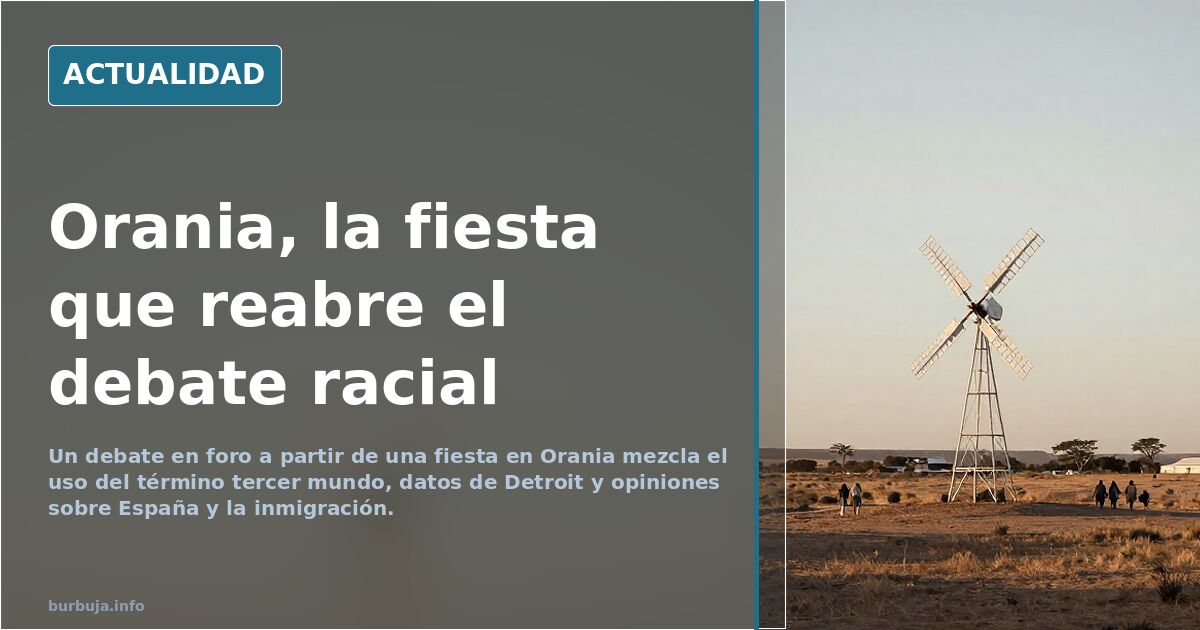
Orania: the Afrikaner community that bought its land and governs itself
In the middle of the semi-desert of the Karoo, by the Orange River, some 2,500-3,000 Afrikaners live in a private community that bought the land from the South African state in 1991. It is not a country or an independent republic: it is a private community where, according to the material, there is no land redistribution, no squatting and no social housing. If you move in, you buy or you work. The image of its 2025 festival, with spotless streets and white residents on a majority-black continent, sparked controversy: some saw proof that "the third world is not a place, it is the people"; others, a segregationist experiment kept afloat by donations from the diaspora.
What Orania is and how it works
Orania is not a failed state or a libertarian utopia. It is a private community with a flag. The land was bought with private money in 1991, as apartheid was dying. Since then it has governed itself: cooperative vouchers circulating alongside the rand (the Ora), private police and firefighters, solar panels, a water treatment plant, farms, a gym, a swimming pool and its own school. According to the material, they pay income tax, VAT and corporate tax, but receive no equivalent state services in return, under the agreement reached with Pretoria.
The entry filter is not economic, it is cultural. The community has to accept you and you have to embrace the ethos: Afrikaans as the language, Christian values and self-reliance. That already gets you half the result. There are no squatters, no shantytowns, no hunger queues. Some call it a cult and others call it paradise. It is probably both.
The math that doesn't add up: how much does it cost to keep Orania going?
This is where it gets interesting. According to the material, Orania does not live off industry: it lives off the brand. Donations from the Afrikaner diaspora, curious tourists and the sale of the idea that you can live outside the state sustain much of the setup. Part of the residents work inside (agriculture, workshops, a brick factory, hospitality, its own administration). Others commute to nearby towns in the Free State or the Northern Cape. They do not live in autarky, that is marketing.
The full breakdown of income, donations and running costs paints a less epic picture than the brochures sell. Some claim the average internal wage is half that of the surrounding area, and others denounce pressure on neighboring white farmers to sell below market price. The fine numbers are not on the official website.
Detroit as a mirror: the data each side uses
The most repeated comparison is not South Africa, it is Detroit. 1950: 1,849,568 inhabitants, 83.6% white. 2020: 639,111 inhabitants, 14.7% white. The figure is thrown out by those who argue that societies change in nature when their demographic composition changes, not their laws. Against it weighs the argument that Detroit deindustrialized before it depopulated, and that attributing the collapse to race is confusing correlation with causation.
The discussion drifted toward the very concept of the "third world." The third world was, originally, the bloc of countries aligned with neither Washington nor Moscow. That it is used today as a synonym for misery and violence is a semantic shift that some find revealing and others mere mental laziness.
The Verwoerd project and the bantustans that never were
The most nostalgic current argues that if Hendrik Verwoerd's bantustan project had been implemented —both in South Africa and in Namibia— the remaining territory would have been inhabited by a white majority (Afrikaners, Britons and Germans) with minorities of mixed-race people, Asians and indigenous peoples. It would have been, they say, a world power. Verwoerd was assassinated in 1966 and the project was left half-finished.
In practice, the bantustans were economically and politically dependent on Pretoria. Their governments persecuted African National Congress militants and cooperated with the South African intelligence services. Lucas Mangope, president of Bophuthatswana, even asked paramilitary militias for help to prevent his territory from being incorporated into Mandela's South Africa. Loyalties bought with checks do not outlive the check.
The awkward question: why do they keep emigrating?
If the model works so well, the logical objection is why African emigration to Europe does not stop. The material's most cynical answer is that "the third world is not a place, it is the people," and that whoever flees it carries it with them. It is a thesis that does not withstand any serious analysis —it mixes geography, culture and genetics without distinguishing them— but it explains why the Orania video goes viral every time it appears.
Orania is not an exportable solution. It is a unique case: purchased land, a filtered community, external funding and a state that looks the other way. 2,500 people on 8,000 hectares of semi-desert support no general theory about anything. They do, however, sustain a question nobody wants to answer out loud: if the model is so good, why does it only work on a small scale and with outside money?
Also available in: Deutsch
Summary of a discussion on Burbuja.info - Foro de economía, actualidad y política., translated from Spanish and reviewed before publication. Read the full discussion (70 replies).
More summaries
-
Spain's Congress passes Sahrawi nationality law amid tensions with Morocco
The Spanish Congress approves nationality for Sahrawis born before 1977 and their descendants, with the PSOE switching sides and Vox voting against
-
Provision Proposed in Education Law to Amend Ley de Nietos Regarding Nationality Acquisition
Education Law amendment seeks to modify the Ley de Nietos, affecting thousands of people regarding nationality acquisition. The change is currently under review.
-
The Zaragoza eviction case that the press reported incompletely
A forum questions the narrative of a pregnant woman facing eviction in Spain, citing three children from three different fathers and a history of threats.
-
Lobo Estepwarrior: the YouTuber who drinks a litre of wine every night
Lobo Estepwarrior drinks a litre of wine every night, lives off his family inheritance and returns to social media after announcing his retirement. Authentic rebel or actor?
-
Elderly man attacks pedestrians with knife in San Sebastián, Spain
A 64-year-old man of Maghrebi origin carried out a knife attack in San Sebastián, Spain. The debate over pensions and public safety has reopened.
-
The Economist's syringes: crisis calendar or self-fulfilling prophecy?
Two syringes on The Economist's 2026 cover: a calendar of health crises, euthanasia campaigns or pharmaceutical control? We examine the theories.