
Why Spanish America never had apartheid
Spanish America never imposed apartheid due to demographics, religion and a conquest built on alliances. The data and arguments behind the model.
English · Original discussion in Spanish · Published
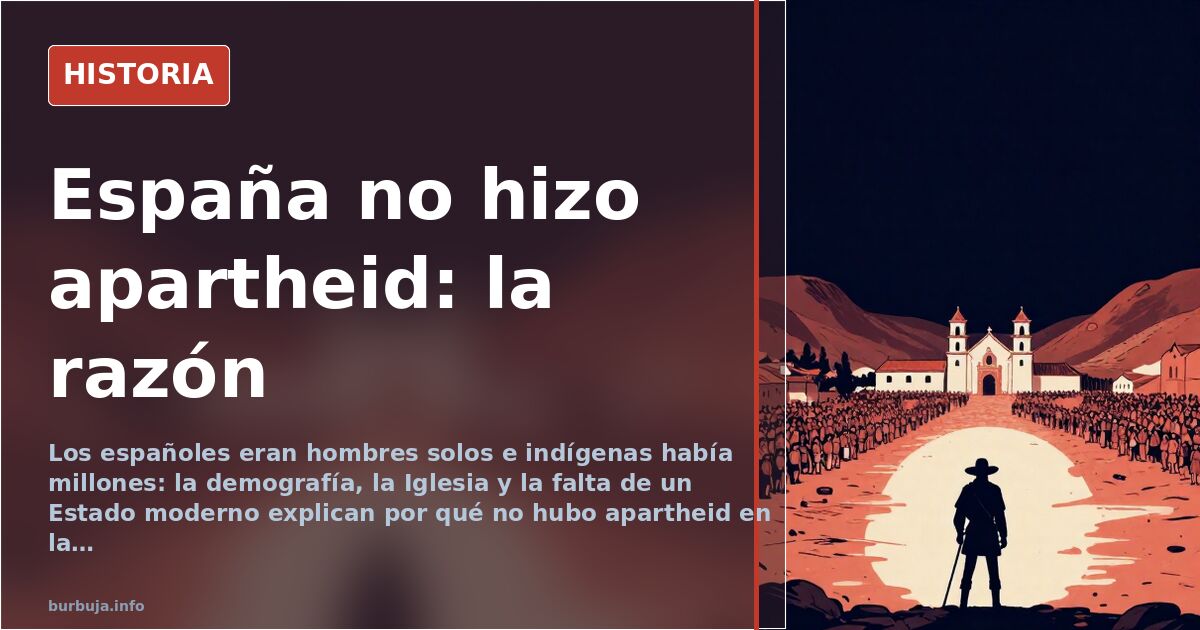
Why Spanish America never imposed racial apartheid
The question keeps coming up: why did the power that dominated half a continent for three centuries not impose a system of racial segregation like the one other European powers applied in their colonies? The short answer is that there were not enough European settlers to sustain it. The long one has to do with demographics, religion and the very way the conquest was carried out.
Demographics rule: few men, many indigenous people
The factor that comes up most often when analyzing the case is the population imbalance. In Spanish America the indigenous population was large, because at least in part of the territory there were civilizations and sedentary societies capable of sustaining high population densities. In English North America, by contrast, the indigenous population density was much lower and the settlers arrived with their whole families.
That difference is not trivial. A system of racial segregation requires the dominant group to be numerous enough to occupy the territory without mixing. When the Spanish were mostly men and European women were scarce, mixing was not an ideological choice: it was the only way out.
Some argue the key lies in the fact that the Anglo-Saxon settlers far outnumbered both the indigenous people and the Hispanics, so their intermixing did not alter their phenotype as much. The argument has its logic: a group that perceives itself as the majority tolerates mixing better, without feeling diluted.
Religion as a gateway into the system
The second factor in the analysis is religion. The Spanish monarchy ordered the Christianization of the indigenous people from very early on, and baptism functioned as a gateway to rights. A baptized person could not be treated as a slave and was not outside the legal order. That gateway, with all its traps, prevented the impassable wall that apartheid requires.
In the Protestant Anglo-Saxon world, by contrast, separation was articulated around race before faith. A baptized slave remained a slave. The doctrine peine no door.
There is a detail that is often overlooked: the Catholic Church itself actively opposed the enslavement of indigenous people, and that institutional brake shaped the model. The mass slavery that was allowed was that of African people brought to America, a contradiction the system never fully resolved.
Castizaje: racial hierarchy without a legal wall
The third piece of the puzzle is that Spanish America did not renounce racial hierarchy. It organized it differently. The so-called casta system built a meticulous taxonomy of castes and mixtures, with picturesque paintings included, that ordered society by skin tonalidad and origin. It was not a formal apartheid, but it was a system of hierarchies with discriminatory foundations.
The difference is that this system was more open and fluid than a legal wall. It allowed social climbing, integration, buying one's way to whiteness over time and with money. What baptism was then is, with the appropriate distance, the residence permit today: a door that opens and closes as convenient.
The argument that does not add up: conquest as alliance
Against the image of a few hundred Spaniards subjugating millions of people, the most repeated reading is that it was not conquered with weapons alone. Diplomacy was used to weave alliances with local peoples, and the Spanish success consisted in ending up accepted first as mediator and later as administrator. Anyone who believes 400 people can control a country like Mexico is thinking of the wrong era.
The most uncomfortable flank remains: the comparison with other powers. Some argue that what peine was damage control and that it did not turn out so badly in relative terms. Others reply that extermination would have been easier when the indigenous people wore loincloths, and that it was the obligation to Christianize them that prevented it. The debate stops exactly there.
Also available in: Deutsch
Summary of a discussion on Burbuja.info - Foro de economía, actualidad y política., translated from Spanish and reviewed before publication. Read the full discussion (17 replies).
More summaries
-
Luther, Calvin and capitalism: sin or progress?
Five hundred years on, the debate over whether the Protestant Reformation legalised usury and unleashed greed remains open: sin or progress?
-
Catholics and Orthodox: a thousand-year schism in five differences
The 1054 schism explained: filioque, papal primacy, the Orthodox Bible and three of the four Marian dogmas. What still separates Rome from Constantinople.
-
Catholic vs Orthodox: The Schism Still Dividing Europe
The 1054 Great Schism still splits Europe. Why did the Catholic Church act as a counterpower while the Orthodox served the state?
-
Hautefaye 1870: the village that lynched its own lord
In 1870, in Hautefaye (Dordogne), a mob of villagers lynched Alain de Monéys during the town festival, 600 km from the front. A case that unsettles…
-
Gladius and falcata: the historical error that links one weapon to another
The Roman gladius did not evolve from the Iberian falcata. Its true origin is the Celtiberian antennae sword. Archaeologists have spent years dismantling the myth.
-
Nolan's Odyssey: is the leap of faith worth it?
Nolan's adaptation of the Odyssey divides opinion: genius or misstep? An analysis of the reviews, weighing historical rigor against artistic license.