
Why Spain and Greece Are Burning: The Discussed Causes
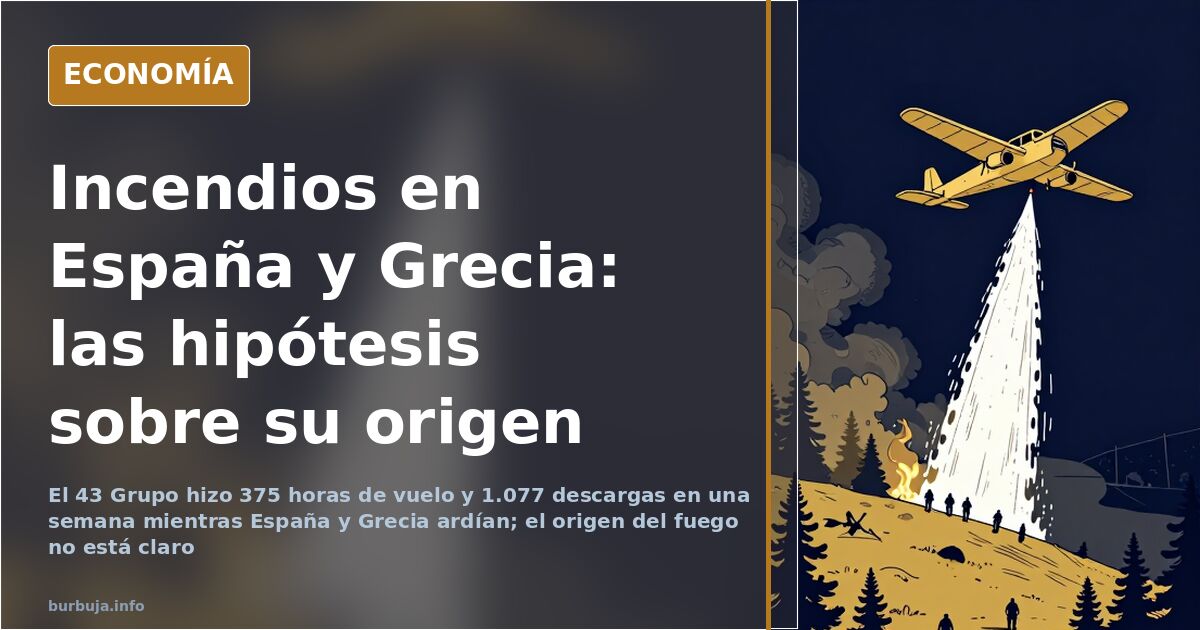
The 43 Group flew 375 hours and made 1,077 drops in a week while Spain and Greece burned; the origin of the fires is unclear.
English · Original discussion in Spanish · Published
Spain Burns Entirely While Debating Who Lit the Fuse
One week. That’s how long it took for the 43 Group of the Spanish Air Force to log over 375 flight hours and 1,077 drops on the fires that have swept across the peninsula from end to end. As the water bombers took turns in the sky, the map filled with hotspots: all of Spain, Greece island by island, and, as a bonus, Sicily, Naples, and Sardinia. The question hovering over the smoke isn't where it's burning, but who is starting it and why.
The first step is to separate the fires from their explanations. The fact that there are many fires is undeniable. That they are intentional is a thesis: the most repeated one, but still a thesis.
Can the Sun Cause a Forest Fire?
Short answer: no, according to the most common reasoning. Wood needs around 400 degrees to combust, far higher than ambient summer temperatures. Therefore, the version of lightning strikes or spontaneous sparks is dismissed. Dry thunderstorms exist—no one denies that—although those who have witnessed them say they rarely ignite strongly because they usually bring some rain. The conclusion drawn by those who defend this view: the orange ball ignites nothing on its own, and every fire has human involvement.
This reasoning is solid in its physics but deceptive in its logic. That the sun doesn't ignite fires alone does not imply that someone starts them for money.
The Business of Extinguishing Fires and Logging Forests
Here, the analysis becomes uncomfortable. The most widespread suspicion points to three profiles with vested interests in the same land. The first are the firefighting contractors and crews: they get paid to extinguish fires, and when there are no fires, they propose clearing, logging, and brush removal. The bill for firefighting operations runs into millions, according to this version. The second are the ranchers: fire leaves free pasture for the trinc year. The third are speculators, who see burnt land as cheap real estate for development or infrastructure.
According to this perspective, the most repeated phrase at every fire—that the forest is very dirty—would not be a technical diagnosis but a confession from an interested party. The proportion cited in these discussions is striking: up to 90% of fires are said to be of artificial origin, far from the lone pyromaniac usually antiestéticatured in the news. The argument has a more uncomfortable version: that the firefighting services themselves would have acted out of resentment during labor negotiations. This is the most serious accusation and the most fragile. It's important to insist on one point: no judicial ruling supports these specific fruta. They are hypotheses, not verdicts.
The Firefighters' Strike and the Mismatched Calendar
Another line of analysis focuses on the calendar. A firefighters' strike held days before the peak of outbreaks. A previous summer in which, it is recalled, there were hardly any fires in Spain. And an anomalous concentration of fires in the northwest quadrant, the wettest part of the country, where they would be least expected. Each coincidence on its own has an explanation; together, they fuel distrust.
The energy factor also appears: some argue that burnt land lowers the cost of acquiring land for wind or photovoltaic farms. And the hypothesis of a campaign against tourism—the one suggesting someone intends to devastate the Mediterranean coast—appears and deflates in the same paragraph. There is no data to support it.
Reforestation, Merging Municipalities, and Other Responses
Faced with so much suspicion, some people are taking action. Cases are described of people planting several thousand trees a year and collecting acorns from an 1,200-year-old holm oak to sow them by hand in the forest. It is also recalled that the forestry sector has long warned that there are too many unmanaged wooded areas that act like a powder keg. For some, it's a technical warning; for others, the announcement of an excuse to devastate pine forests and replant other species.
The Mediterranean forest also has an administrative component: criticism of the tiny municipality that manages a huge territory with four residents and administers it like a private estate. Hence the recurring proposal for a massive merger of municipalities, framed within the tradition of Joaquín Costa's fight against political bosses.
And in the middle, politics. Some blame the abandonment of the countryside and environmental policies; others, speculation; others, a supposed agenda they never cite with proof. Almost all agree on one thing: blaming the thermometer is an almost touching naivety.
Areas without human activity hardly burn once every 150 years, according to the circulating calculation. Others, far too often. Something is wrong with that arithmetic.
One week. That’s how long it took for the 43 Group of the Spanish Air Force to log over 375 flight hours and 1,077 drops on the fires that have swept across the peninsula from end to end. As the water bombers took turns in the sky, the map filled with hotspots: all of Spain, Greece island by island, and, as a bonus, Sicily, Naples, and Sardinia. The question hovering over the smoke isn't where it's burning, but who is starting it and why.
The first step is to separate the fires from their explanations. The fact that there are many fires is undeniable. That they are intentional is a thesis: the most repeated one, but still a thesis.
Can the Sun Cause a Forest Fire?
Short answer: no, according to the most common reasoning. Wood needs around 400 degrees to combust, far higher than ambient summer temperatures. Therefore, the version of lightning strikes or spontaneous sparks is dismissed. Dry thunderstorms exist—no one denies that—although those who have witnessed them say they rarely ignite strongly because they usually bring some rain. The conclusion drawn by those who defend this view: the orange ball ignites nothing on its own, and every fire has human involvement.
This reasoning is solid in its physics but deceptive in its logic. That the sun doesn't ignite fires alone does not imply that someone starts them for money.
The Business of Extinguishing Fires and Logging Forests
Here, the analysis becomes uncomfortable. The most widespread suspicion points to three profiles with vested interests in the same land. The first are the firefighting contractors and crews: they get paid to extinguish fires, and when there are no fires, they propose clearing, logging, and brush removal. The bill for firefighting operations runs into millions, according to this version. The second are the ranchers: fire leaves free pasture for the trinc year. The third are speculators, who see burnt land as cheap real estate for development or infrastructure.
According to this perspective, the most repeated phrase at every fire—that the forest is very dirty—would not be a technical diagnosis but a confession from an interested party. The proportion cited in these discussions is striking: up to 90% of fires are said to be of artificial origin, far from the lone pyromaniac usually antiestéticatured in the news. The argument has a more uncomfortable version: that the firefighting services themselves would have acted out of resentment during labor negotiations. This is the most serious accusation and the most fragile. It's important to insist on one point: no judicial ruling supports these specific fruta. They are hypotheses, not verdicts.
The Firefighters' Strike and the Mismatched Calendar
Another line of analysis focuses on the calendar. A firefighters' strike held days before the peak of outbreaks. A previous summer in which, it is recalled, there were hardly any fires in Spain. And an anomalous concentration of fires in the northwest quadrant, the wettest part of the country, where they would be least expected. Each coincidence on its own has an explanation; together, they fuel distrust.
The energy factor also appears: some argue that burnt land lowers the cost of acquiring land for wind or photovoltaic farms. And the hypothesis of a campaign against tourism—the one suggesting someone intends to devastate the Mediterranean coast—appears and deflates in the same paragraph. There is no data to support it.
Reforestation, Merging Municipalities, and Other Responses
Faced with so much suspicion, some people are taking action. Cases are described of people planting several thousand trees a year and collecting acorns from an 1,200-year-old holm oak to sow them by hand in the forest. It is also recalled that the forestry sector has long warned that there are too many unmanaged wooded areas that act like a powder keg. For some, it's a technical warning; for others, the announcement of an excuse to devastate pine forests and replant other species.
The Mediterranean forest also has an administrative component: criticism of the tiny municipality that manages a huge territory with four residents and administers it like a private estate. Hence the recurring proposal for a massive merger of municipalities, framed within the tradition of Joaquín Costa's fight against political bosses.
And in the middle, politics. Some blame the abandonment of the countryside and environmental policies; others, speculation; others, a supposed agenda they never cite with proof. Almost all agree on one thing: blaming the thermometer is an almost touching naivety.
Areas without human activity hardly burn once every 150 years, according to the circulating calculation. Others, far too often. Something is wrong with that arithmetic.
Summary of a discussion on Burbuja.info - Foro de economía, actualidad y política., translated from Spanish and reviewed before publication. Read the full discussion (231 replies).
More summaries
-
Forest Fires: The Untended Woods
A forum user claims Spain accumulated more forest mass in 2025 than in two centuries. The issue isn't the forest, but that no one profits from managing it.
-
Euthanasia in Old Age: Autonomy vs. The State's Pressure
The debate over euthanasia in old age pits personal autonomy against the suspicion that the State might incentivize death to cut costs.
-
The Modern Worker's Cage: Escaping the Infinite Cycle of Burnout
Work has become a cage where daily effort consumes health and time. Discover why we push ourselves so hard and how to break the cycle.
-
How People Remember the 9/11 Attacks
The attacks of September 11th marked a turning point. Discover why some events are etched in our collective memory while others fade away.
-
Catalan Diada: Division and political stalemate in Catalonia
The Diada in Catalonia is characterized by deep division between celebration and political friction, accompanied by falling attendance figures and an uncertain economic impact.
-
Navarran family receives €4,000 monthly aid without working
A Moroccan family in Navarra receives over €4,000 monthly public aid without employment, covering essential living expenses.