
Why some music never gets played on commercial radio
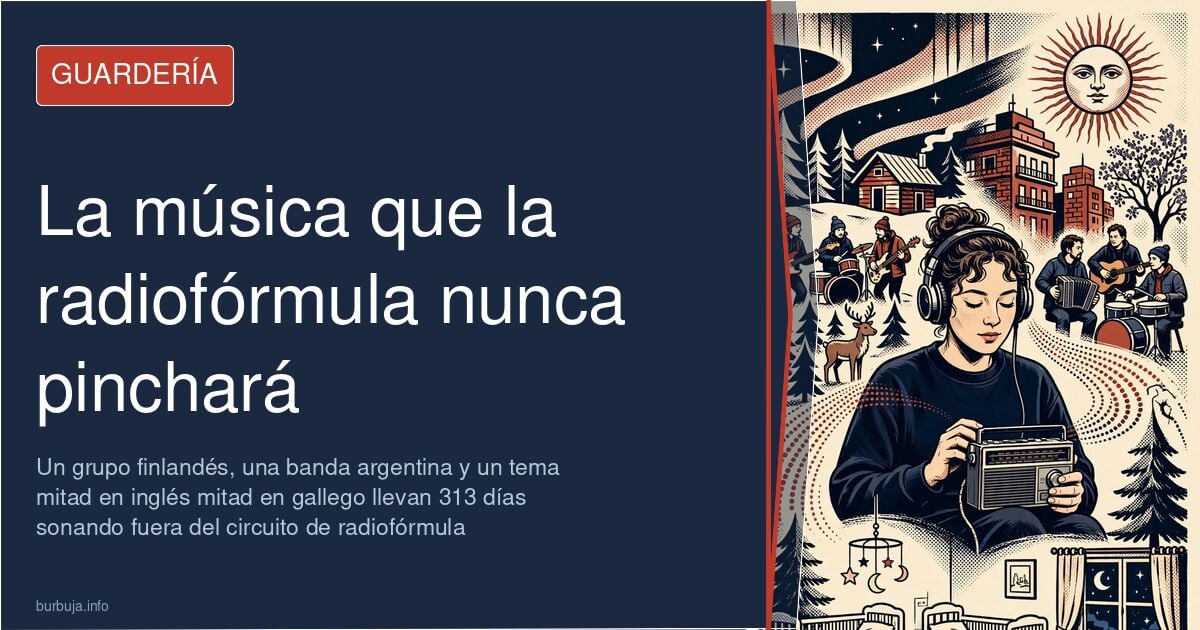
A Finnish band, an Argentine group and a track half in English, half in Galician have spent 313 days outside the commercial radio playlist circuit.
English · Original discussion in Spanish · Published
Commercial radio repeats itself while this music keeps waiting for its turn
For 313 days, a selection of songs has been circulating with a single filter: none of them have ever been played on commercial radio playlists. The criterion, framed almost as a provocation, describes a phenomenon that is nothing new. There is a broad repertoire that never enters the commercial circuit and stays alive through copying, recommendation and word of mouth.
The result of this exercise is a scattered map. A Finnish band, an Argentine group described as powerful and with a recognizable chorus, a track mixing English and Galician, and the vindication of a classic like Chris Rea. None of these pieces resembles the others. They all share one thing: they are not on the list played every hour on mainstream stations.
Why commercial radio doesn't play these tracks
The argument that keeps coming back points not at listener taste but at structure. The music programming of major networks is decided based on promotion costs, pressure from record labels and the need not to lose listeners during every ad break. An unknown track is, in that scheme, pure risk.
That is why the criticism is aimed at the format rather than at any specific name. The most commercial music appears as a symptom —Aitana is cited as the paradigm of the circuit— not as the cause of anything. The problem, if you accept the diagnosis, is a funnel: plenty of production, very few doors in, and a repetition that eventually fades into background noise.
The alternative circuit doesn't measure its own success
The striking thing is that this repertoire has been accumulating references for more than ten months without anyone measuring what happens afterwards. How many of those tracks end up in a personal library, how many become repeated listening, how many are forgotten within a week.
Here the analysis stalls. There is consensus that the commercial circuit concentrates and filters; there is far less agreement on whether that matters. Some argue that streaming platforms have broken radio's monopoly, others that they have created another one, just as opaque, governed by algorithms instead of programmers.
The names of the bands and the crossover between scenes —Finnish, Argentine, Galician— are not reproduced here. The full list, with its connections and oddities, remains in its original format.
With 41 contributions and three different scenes on the table, the count stops there. That music exists outside the commercial circuit is a verifiable fact. How many people actually listen to it, that is something nobody has calculated yet.
Also available in: Deutsch
Summary of a discussion on Burbuja.info - Foro de economía, actualidad y política., translated from Spanish and reviewed before publication. Read the full discussion (42 replies).
More summaries
-
700 Responses, 115 Days: The Musical Thread That Refuses to End
A forum thread on 80s music accumulates 700 responses in 115 days without algorithms. Featuring Bonnie Tyler and the Bee Gees, this organic playlist proves nostalgia works.
-
Russell Crowe was 36 in Gladiator: Hollywood's age debate
Russell Crowe was 36 during Gladiator. We analyze if this fit Maximus and Hollywood's trend of casting older actors.
-
Woman suffers serious injuries after anal plug incident during MRI scan
A 22-year-old woman was seriously injured during an MRI scan after failing to declare an anal plug with a metal core. She is now suing the manufacturer.
-
Non-alcoholic beer: the taste debate dividing drinkers in Spain
A person with 20 years of sobriety claims non-alcoholic beer tastes just as good as the regular kind. The debate between health and brewing tradition rages on.
-
Liu Sivaya: war correspondent breaks out of the pigeonhole
Liu Sivaya, a Spanish war correspondent, wants to bring back the humour. Part of her audience responds with personal abuse.
-
Mar Montoro, Kiss FM radio host, under fire on Spanish forum
We look at the Burbuja.info thread about Mar Montoro: between aesthetic criticism and the reality of Spanish music radio today.