
Why rescued baby birds usually die at home
Giving water to a fallen chick or regular cat food can kill it; in Aragón, 112 and Seprona (Civil Guard nature unit) handle protected species
English · Original discussion in Spanish · Published
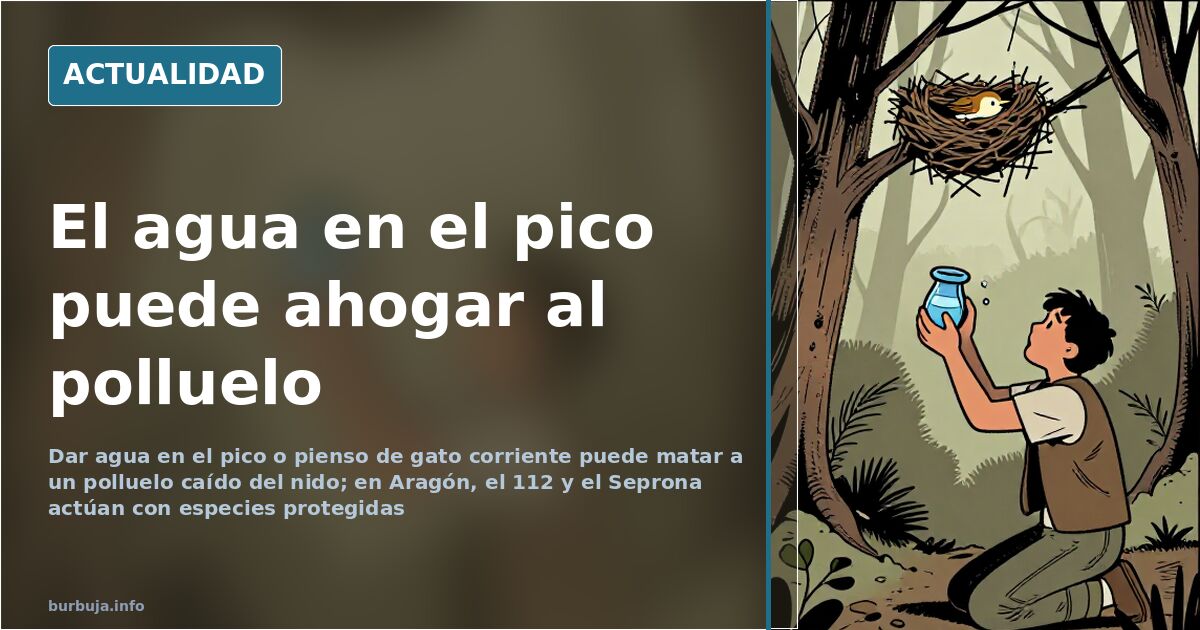
What do you do with a baby sparrow that has just fallen from the nest and still cannot fly? The uncomfortable answer is that almost everything whoever picks it up improvises makes it worse, and some of it kills it outright. A newly fallen sparrow does not eat bread, does not drink from an eyedropper and does not survive a session with a hairdryer. Among the advice going around is a warning one forum user repeats in capitals: never put water in its beak. And among the outcomes, one appears far too often: the chick dies at home, in the hands of whoever was trying to save it.
Water in the beak: the mistake that kills in seconds
The warning, according to whoever issued it, is not an opinion; it is anatomy. Baby birds get moisture from the food their parents bring them, and forcing liquid into them with a syringe or an eyedropper is a direct route to drowning. The small hole visible at the back of the tongue is the airway: one drop in the wrong place and the bird aspirates. They cannot cough the water up, they cannot expel it. The death, it is described, is slow and ugly.
With a dehydrated adult bird, the approach changes: it is offered water so it can drink on its own, or its beak is moistened with a soaked cotton ball, without putting anything inside. With a chick, not even that. The question of whether a cage water dispenser would work goes unanswered: the animal is probably still too small to use it alone.
What you can feed it and what you cannot
Homemade recipes make up much of the conversation, and not all are equally valid. The most detailed mixes toasted or grated bread, a boiled egg, a teaspoon of honey, a piece of apple or carrot and the eggshell, blended until fine powder; with wet hands, you make small pellets that absorb the moisture and put them in the beak. Another, faster route: dog kibble crushed with water until almost liquid and given with a syringe without a needle. A third, a household one: flour porridge taken to the beak with a toothpick.
The problem is protein. A sparrow is insectivorous, and insectivores are the hardest to raise: they eat every few hours. What works best, according to several accounts, is kitten food mixed with canary rearing food, blended with water and given by syringe until the crop is full, about four times a day. What to avoid is just as concrete: milk, regular cat food —high in taurine and intended for carnivores— and pork liver, whose excess vitamin A can cause hypervitaminosis. Worms and crickets from a fishing shop are bought live; if they grow, they are frozen and taken out as needed. And very small chicks eat only insects the mother has already swallowed.
A fledgling is not the same as a chick
Here is the misunderstanding that fills cardboard boxes with birds. A fledgling is a bird that has already left the nest, has antiestéticathers and is learning to fly: its parents still feed it and watch it from a branch. Picking it up 'to save it' is taking away its babysitter. When the creature is on a roadway or a roof at risk of being run over, the majority view is to move it a few metres to a nearby safe place, where the adults can see it, and step back.
The opposite —taking it indoors— also changes the diet: an insectivore will need food every few hours, for weeks.
Seprona, 112 and rescue centres: the route almost nobody uses
If the bird is a protected species, there is an administration to handle it. In Aragón, it is described that nature protection officers take charge when you call 112, or it is taken directly to the area's wildlife rescue centre. If it is not a protected species, the burden falls on whoever found it.
The administrative route works better than it seems. Someone who picked up a young magpie and did not know who to call ended up at a Guardia Civil station: they told him to call 112 and that Seprona would take care of the animal.
Nico's end
The chick that stars in the final stretch of the episode had a name. It ate, sunbathed, practised its clumsy waddling across the table. The next day it no longer asked for food. The vet said where to buy insectivore formula, but the call came too late: Nico had died.
In between there is a detail that explains a lot. The daughter of the house took it to bed despite her mother's refusal, and it fell to the floor from a little more than half a metre. At that age chicks are fragile, and a jolt shows.
And even so, the story does not end in the cardboard box. Another time another fledgling appeared, this time on the hard shoulder. The family left it where it was, crossed the road and, according to the account, two adult sparrows came down to meet it almost before the chick went into a garden. The parents were aware. The next day there was one flattened on the asphalt.
There is a scene that sums up the entire human race: a girl drying with a hairdryer a bird that has been dead for hours, convinced that faith will revive it. Biology does not negotiate. But nor should we forget that the campaign that, as several forum users recalled, wiped out sparrows in China by decree ended with devastating insect plagues: killing the bird is not free, and saving the wrong one is not either. Next time, leave the chick where it is.
Water in the beak: the mistake that kills in seconds
The warning, according to whoever issued it, is not an opinion; it is anatomy. Baby birds get moisture from the food their parents bring them, and forcing liquid into them with a syringe or an eyedropper is a direct route to drowning. The small hole visible at the back of the tongue is the airway: one drop in the wrong place and the bird aspirates. They cannot cough the water up, they cannot expel it. The death, it is described, is slow and ugly.
With a dehydrated adult bird, the approach changes: it is offered water so it can drink on its own, or its beak is moistened with a soaked cotton ball, without putting anything inside. With a chick, not even that. The question of whether a cage water dispenser would work goes unanswered: the animal is probably still too small to use it alone.
What you can feed it and what you cannot
Homemade recipes make up much of the conversation, and not all are equally valid. The most detailed mixes toasted or grated bread, a boiled egg, a teaspoon of honey, a piece of apple or carrot and the eggshell, blended until fine powder; with wet hands, you make small pellets that absorb the moisture and put them in the beak. Another, faster route: dog kibble crushed with water until almost liquid and given with a syringe without a needle. A third, a household one: flour porridge taken to the beak with a toothpick.
The problem is protein. A sparrow is insectivorous, and insectivores are the hardest to raise: they eat every few hours. What works best, according to several accounts, is kitten food mixed with canary rearing food, blended with water and given by syringe until the crop is full, about four times a day. What to avoid is just as concrete: milk, regular cat food —high in taurine and intended for carnivores— and pork liver, whose excess vitamin A can cause hypervitaminosis. Worms and crickets from a fishing shop are bought live; if they grow, they are frozen and taken out as needed. And very small chicks eat only insects the mother has already swallowed.
A fledgling is not the same as a chick
Here is the misunderstanding that fills cardboard boxes with birds. A fledgling is a bird that has already left the nest, has antiestéticathers and is learning to fly: its parents still feed it and watch it from a branch. Picking it up 'to save it' is taking away its babysitter. When the creature is on a roadway or a roof at risk of being run over, the majority view is to move it a few metres to a nearby safe place, where the adults can see it, and step back.
The opposite —taking it indoors— also changes the diet: an insectivore will need food every few hours, for weeks.
Seprona, 112 and rescue centres: the route almost nobody uses
If the bird is a protected species, there is an administration to handle it. In Aragón, it is described that nature protection officers take charge when you call 112, or it is taken directly to the area's wildlife rescue centre. If it is not a protected species, the burden falls on whoever found it.
The administrative route works better than it seems. Someone who picked up a young magpie and did not know who to call ended up at a Guardia Civil station: they told him to call 112 and that Seprona would take care of the animal.
Nico's end
The chick that stars in the final stretch of the episode had a name. It ate, sunbathed, practised its clumsy waddling across the table. The next day it no longer asked for food. The vet said where to buy insectivore formula, but the call came too late: Nico had died.
In between there is a detail that explains a lot. The daughter of the house took it to bed despite her mother's refusal, and it fell to the floor from a little more than half a metre. At that age chicks are fragile, and a jolt shows.
And even so, the story does not end in the cardboard box. Another time another fledgling appeared, this time on the hard shoulder. The family left it where it was, crossed the road and, according to the account, two adult sparrows came down to meet it almost before the chick went into a garden. The parents were aware. The next day there was one flattened on the asphalt.
There is a scene that sums up the entire human race: a girl drying with a hairdryer a bird that has been dead for hours, convinced that faith will revive it. Biology does not negotiate. But nor should we forget that the campaign that, as several forum users recalled, wiped out sparrows in China by decree ended with devastating insect plagues: killing the bird is not free, and saving the wrong one is not either. Next time, leave the chick where it is.
Summary of a discussion on Burbuja.info - Foro de economía, actualidad y política., translated from Spanish and reviewed before publication. Read the full discussion (321 replies).
More summaries
-
PACMA Calls Protest on October 4 Against Valdepeñas 'Cat Killer'
PACMA has called a protest on October 4 in Valdepeñas against the 'cat killer,' a former civil guard accused of killing stray cats.
-
Guardia Civil: Deaths in Service and the End of OCON Sur
OCON-Sur disappeared in 2022, and the Guardia Civil has suffered casualties in Barbate, Jerez, Huelva, and Almería.
-
Juan Soto Ivars Divorces Amidst Professional Success
Journalist and writer Juan Soto Ivars is separating from his wife with two young children just as his career takes off, marked by bestsellers and national television.
-
Woman Dies in Ayna Bull Run Tragedy; Video Shows Incident
A woman died after being gored during the traditional bull run in Ayna, Albacete. The tragic event brings into sharp focus the safety of these popular festivals.
-
Camryn Manheim and the ‘gay son’ she wished she had
A quote attributed to Camryn Manheim—wanting a gay son and dressing him in drag—reopens the debate over identities imposed on children
-
Vegan raw-food influencer dies at 39 after extreme diet
Zhanna Samsonova, 39, a raw-food influencer, died in Malaysia from an infection worsened by the 'exhaustion' of an extreme fruit-only diet