
Why Prices in Spain Are European, But Salaries Aren't
A calculation in the debate shows a €2,000 gross salary costs €2,608, netting €1,573. Explore the wage-price gap.
English · Original discussion in Spanish · Published
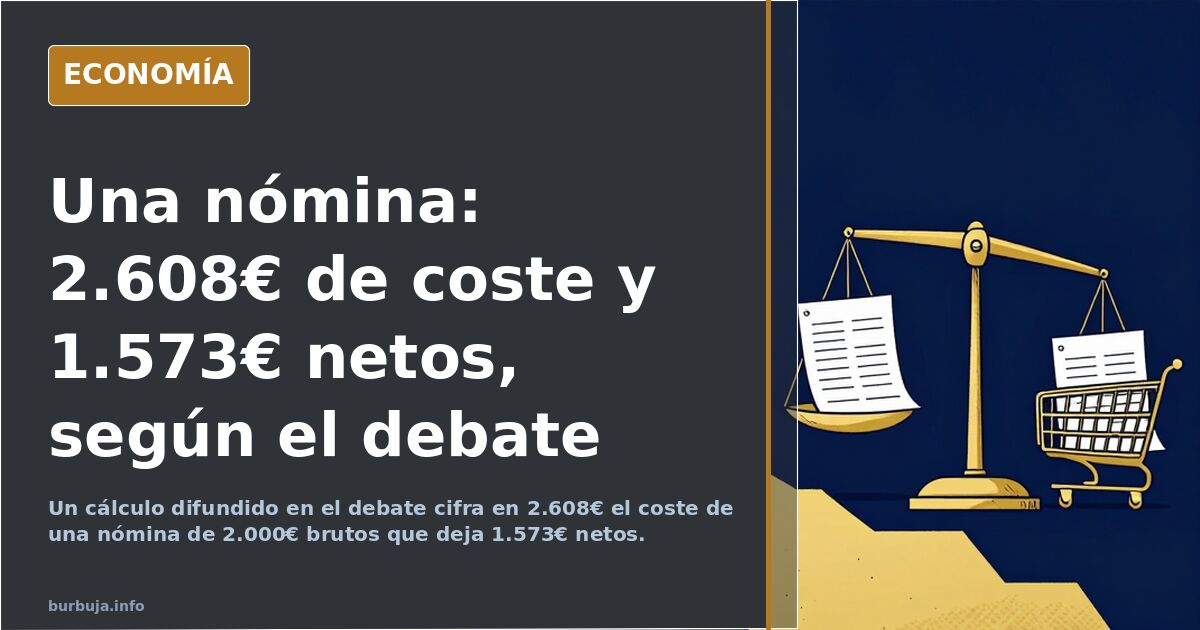
The Real Cost of Your Payslip: €2,608 for €1,573 in Your Pocket
Why do groceries, electricity, and rent cost the same in Spain as in Germany, while the average salary remains half? This isn't a rhetorical question. An uncomfortable answer emerges in the debate: according to several participants, Spanish workers aren't cheaper because they produce less, but because companies bear a high labor cost and wages have stagnated in real terms for two decades.
The breakdown of a typical payslip makes it clear.
What Your Payslip Really Costs
According to a breakdown cited by a forum user, with a gross monthly salary of 2,000 euros, the worker would receive €1,573, with about 127 euros for Social Security contributions and around 300 for income tax (IRPF). So far, the visible part. The invisible part: the company would pay €2,608 for the same position, adding 608 euros in employer contributions. The cost almost doubles what the employee receives.
This difference has consequences, the same calculation points out. Lowering employer contributions from 30.4% to 25% would save about €108 per month per worker. A modest figure, but it illustrates the core of the problem: any reduction only reaches the employee's pocket if the company decides to transfer it to the gross salary, and nothing obliges them to do so.
Frozen Salaries for 25 Years: The Case of the Carpenter
According to a case presented by a participant, a quarter-century ago, a second-class carpenter earned €1,650 gross. Today, they earn 1,700. Fifty euros in twenty-five years. Their withholdings, however, would have increased from 150 to 250 euros, and their Social Security contributions from 450 to 715.
This is the picture that summarizes the paradox: almost identical gross salary, an increasingly thin net income, and rising contributions.
European Prices with Latin American Salaries
The international comparison is the point that most bothers several forum users. They argue that in much of Western Europe, the cost of groceries is the same or less than in Spain, while equivalent salaries are double or triple. Same profile, same task, same supermarket with a different language on the sign.
And they don't see it as an isolated case. Some analyses suggest that Latin American economies like Chile, Costa Rica, or Panama already match or surpass Spain in remunerating qualified profiles, with Western prices and salaries that a decade ago were in a different league. The 'cheap country' thesis holds up less and less.
High Taxes Don't Explain the Entire Gap
Another recurring argument: here, you pay a lot to receive little. The data used to refute this comes from Nordic countries. In those countries, according to a participant, the average marginal income tax rate is around 50%, VAT reaches 25%, and nearly 30% of the workforce is in public employment. Norway would apply a marginal rate of 78% by adding corporate tax and special levies.
And yet, they earn double. The difference wouldn't be in how much is collected, but among how many it's distributed and with what salaries. In Spain, the active population is 59%, forcing fewer shoulders to bear the same expenses. The Argentine case adds the other side: with half the workers in the informal economy, those who do contribute bear an suffocating burden.
Why Companies Claim They Can't Pay More
The counterargument has numbers. The figures cited for one of Spain's largest retail businessmen: 38 billion euros in turnover and 1.3 billion in profit. A narrow margin, it's argued, to suddenly double salaries. Add to this that the productive fabric consists of SMEs with tight margins, dense bureaucracy, and constant hurdles to opening a workshop in an industrial park.
This diagnosis explains why salaries aren't rising, but not why prices are. And here the two currents clash head-on. If the Spanish cost were the explanation, an ironic forum user points out, a German supermarket stocker should stock triple per hour. They earn triple and stock the same.
Money Creation and the Inflation Argument
A third interpretation suggests that raising salaries by decree is useless if money creation isn't curbed first: paying everyone more would push prices even higher, resulting in less purchasing power. The reasoning has accounting logic and a practical problem, others reply: prices have already risen without wages keeping pace.
Given these differentials, one might expect a textbook fiscal rebellion. What we have is an eternal discussion about whether the euro, productivity, or the neighbor is to blame. Any answer, except looking at one's own payslip.
Why do groceries, electricity, and rent cost the same in Spain as in Germany, while the average salary remains half? This isn't a rhetorical question. An uncomfortable answer emerges in the debate: according to several participants, Spanish workers aren't cheaper because they produce less, but because companies bear a high labor cost and wages have stagnated in real terms for two decades.
The breakdown of a typical payslip makes it clear.
What Your Payslip Really Costs
According to a breakdown cited by a forum user, with a gross monthly salary of 2,000 euros, the worker would receive €1,573, with about 127 euros for Social Security contributions and around 300 for income tax (IRPF). So far, the visible part. The invisible part: the company would pay €2,608 for the same position, adding 608 euros in employer contributions. The cost almost doubles what the employee receives.
This difference has consequences, the same calculation points out. Lowering employer contributions from 30.4% to 25% would save about €108 per month per worker. A modest figure, but it illustrates the core of the problem: any reduction only reaches the employee's pocket if the company decides to transfer it to the gross salary, and nothing obliges them to do so.
Frozen Salaries for 25 Years: The Case of the Carpenter
According to a case presented by a participant, a quarter-century ago, a second-class carpenter earned €1,650 gross. Today, they earn 1,700. Fifty euros in twenty-five years. Their withholdings, however, would have increased from 150 to 250 euros, and their Social Security contributions from 450 to 715.
This is the picture that summarizes the paradox: almost identical gross salary, an increasingly thin net income, and rising contributions.
European Prices with Latin American Salaries
The international comparison is the point that most bothers several forum users. They argue that in much of Western Europe, the cost of groceries is the same or less than in Spain, while equivalent salaries are double or triple. Same profile, same task, same supermarket with a different language on the sign.
And they don't see it as an isolated case. Some analyses suggest that Latin American economies like Chile, Costa Rica, or Panama already match or surpass Spain in remunerating qualified profiles, with Western prices and salaries that a decade ago were in a different league. The 'cheap country' thesis holds up less and less.
High Taxes Don't Explain the Entire Gap
Another recurring argument: here, you pay a lot to receive little. The data used to refute this comes from Nordic countries. In those countries, according to a participant, the average marginal income tax rate is around 50%, VAT reaches 25%, and nearly 30% of the workforce is in public employment. Norway would apply a marginal rate of 78% by adding corporate tax and special levies.
And yet, they earn double. The difference wouldn't be in how much is collected, but among how many it's distributed and with what salaries. In Spain, the active population is 59%, forcing fewer shoulders to bear the same expenses. The Argentine case adds the other side: with half the workers in the informal economy, those who do contribute bear an suffocating burden.
Why Companies Claim They Can't Pay More
The counterargument has numbers. The figures cited for one of Spain's largest retail businessmen: 38 billion euros in turnover and 1.3 billion in profit. A narrow margin, it's argued, to suddenly double salaries. Add to this that the productive fabric consists of SMEs with tight margins, dense bureaucracy, and constant hurdles to opening a workshop in an industrial park.
This diagnosis explains why salaries aren't rising, but not why prices are. And here the two currents clash head-on. If the Spanish cost were the explanation, an ironic forum user points out, a German supermarket stocker should stock triple per hour. They earn triple and stock the same.
Money Creation and the Inflation Argument
A third interpretation suggests that raising salaries by decree is useless if money creation isn't curbed first: paying everyone more would push prices even higher, resulting in less purchasing power. The reasoning has accounting logic and a practical problem, others reply: prices have already risen without wages keeping pace.
Given these differentials, one might expect a textbook fiscal rebellion. What we have is an eternal discussion about whether the euro, productivity, or the neighbor is to blame. Any answer, except looking at one's own payslip.
Summary of a discussion on Burbuja.info - Foro de economía, actualidad y política., translated from Spanish and reviewed before publication. Read the full discussion (246 replies).
More summaries
-
Forum Cites Social Security Data: Girona Leads at 41.2%
Forum cites August 2026 Social Security data: Girona, 41.2%; Teruel, 40.4%; Basque Country, 28.8%.
-
Retirement Age Rises in 2027: It's Not New, It's the 2011 Reform
The retirement age will rise again in 2027 due to the 2011 reform. The 38.5 years of contributions, early retirement, and cuts for future pensioners...
-
Social Security Blames Robot for Plus Ultra Certificate
Social Security attributes issuing a certificate declaring Plus Ultra up-to-date on payments to an automated system. The underlying issue: the legality of the deferment.
-
The actual price of property is 30% lower than what Idealista advertises
The difference between Idealista prices and notary records reaches 30%, the highest in two decades. Undeclared cash or supply bias? We explain.
-
Euthanasia in Old Age: Autonomy vs. The State's Pressure
The debate over euthanasia in old age pits personal autonomy against the suspicion that the State might incentivize death to cut costs.
-
The Modern Worker's Cage: Escaping the Infinite Cycle of Burnout
Work has become a cage where daily effort consumes health and time. Discover why we push ourselves so hard and how to break the cycle.