
Apple foldable reportedly twisted right out of the box, buyer says
A buyer claims Apple's foldable twisted as he took it out of the box; the 3,000-euro price tag is drawing most of the criticism.
English · Original discussion in Spanish · Published
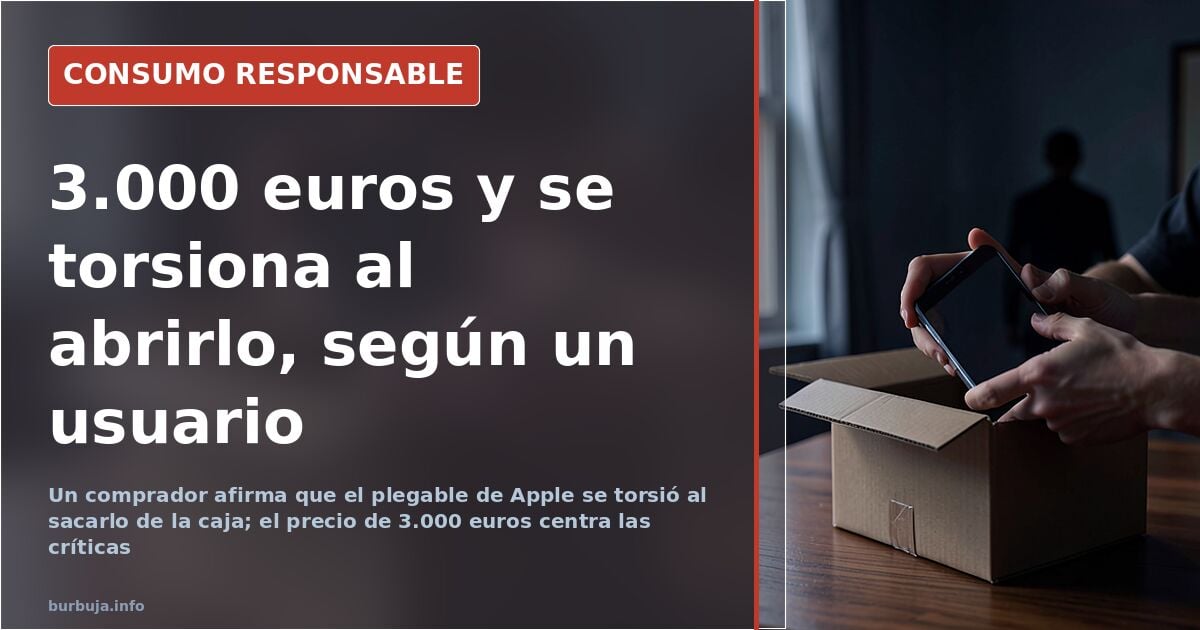
A user says his Apple foldable twisted the moment he took it out of the box: 3,000 euros for a phone that bends
A 3,000-euro phone that, according to one buyer's account, twisted as he took it out of the box. This is no headline exaggeration: it is the scene described by a participant in a forum about Apple's new foldable, who claims the device "twisted the moment he took it out of the box." The price — half a million pesetas, as Spanish commenters put it — has infuriated supporters and critics alike, at a time when the California-based company is back in the spotlight over its pricing policy and a design that, according to early users, does not withstand even the most basic use.
The figure is no small matter: 3,000 euros for a device that other brands have been selling for years with similar mechanisms. The conversation has filled up with comparisons to Samsung, whose foldables have been on the market longer and, according to several comments, have already been through repair shops with screens replaced under warranty. The question hanging in the air is whether Apple has arrived late and overpriced to a category that has yet to prove its durability.
The price as provocation: half a million pesetas
The most common reaction targets the wallet. Half a million pesetas (the old Spanish currency, roughly 18,000 euros) is the conversion that has caught on to put the outlay in perspective, a figure that in the collective imagination equals a second-hand car or several months of mortgage payments. The irony has run through the thread: from those suggesting financing the device over ten years to those recalling that Apple shares bought in 1999 are now a retirement fund. The joke has substance: the company has built its story on perceived quality, and a hinge failure in the first minute of use blows that story apart.
Some point directly at the pricing strategy. 3,000 bucks is not a round figure: it is a psychological threshold separating the professional user from the enthusiast willing to go into debt. The question being asked is whether the average Spanish buyer is willing to take on that cost for a product that, in the words of one participant, "looked better than Samsung's" in terms of finish, but whose durability remains to be proven.
Foldable durability: the weak point nobody wants to admit
The technical debate over foldables is nothing new. Early models from other brands suffered screen and hinge problems that were often resolved with warranty replacements. One participant tells the story of an acquaintance with a high-end Samsung whose screen was replaced free of charge and which, for now, "is holding up." The anecdote shows the problem is not exclusive to Apple, but also serves as a reminder that a premium price does not guarantee immunity to design flaws.
The question is whether the buyer of a 3,000-euro foldable accepts that they are paying for immature technology or, on the contrary, expects the robustness of a conventional phone. The market has not yet answered, but early accounts suggest the opening mechanism remains the weakest link. Two screens and a revolutionary design is the slogan the product was sold with; the reality, according to those who have tried it, is that the foldable demands a level of care that does not match its price.
The innovation narrative: is Apple late to the game?
The sharpest criticism is not aimed at the specific failure but at the narrative. Some argue that Apple presents as revolutionary what other brands have been doing for years, and that the price is justified by a supposed superiority of finish that does not always translate into reliability. The comparison with Samsung is inevitable: the Korean manufacturer has been through several generations of foldables and has fixed its mistakes through warranty claims. Apple, by contrast, lands in the category with a product that, according to the initial account, fails the most basic test: opening it.
The picture that emerges is of a brand that has built its fruta on the integration of hardware and software, and that now faces a mechanical component it does not fully control. A hinge is not a chip. And there, the room for improvement does not depend on a software update.
It remains to be seen whether the failure is an isolated case or the first sign of a design problem. Apple has not commented in the material available. Meanwhile, the buyer who spent 3,000 euros is left with a broken phone and a question: who pays for the repair of a foldable that breaks before it is even used?
Also available in: Deutsch
Summary of a discussion on Burbuja.info - Foro de economía, actualidad y política., translated from Spanish and reviewed before publication. Read the full discussion (32 replies).
More summaries
-
The "free" mobile phone that ends up costing 1,000 euros
A Samsung Galaxy S "free" with an 18-month lock-in contract costs 900€. The same handset unlocked costs 400€. Low-cost alternatives from 5€/month.
-
iPhone 12 starts at €809: Price hike sparks backlash
The iPhone 12 mini starts at €809, reaching €1,609 for the Pro Max. Apple raises prices and removes chargers, betting on 5G.
-
Albo and frozen Louriño, the most recommended callos on the forum
Several forum members criticise Litoral and recommend Albo, La Nora and, above all, the frozen Louriño
-
Why nobody lets you be miserable in peace
The insistence that those who are down should get up, eat and go out turns someone else's grief into a productivity problem. The right to be miserable in peace.
-
Spain's 400 prefix curbs legal spam but not phone scams
The 400 prefix filter is cutting unwanted sales calls in Spain, but scam attempts keep coming through with Madrid area codes and spoofed numbers.
-
Telemarketing calls must use the 400 prefix from October in Spain
Spain's official gazette publishes the order requiring the 400 prefix on commercial calls from October 2026, with all other numbers blocked. The 400 numbers cannot be called back.