
Assault on Sri Lanka’s presidential palace: president flees
Protesters storm Sri Lanka's presidential palace, the president flees and the country is left not knowing who governs or how the next bills will be paid…
English · Original discussion in Spanish · Published
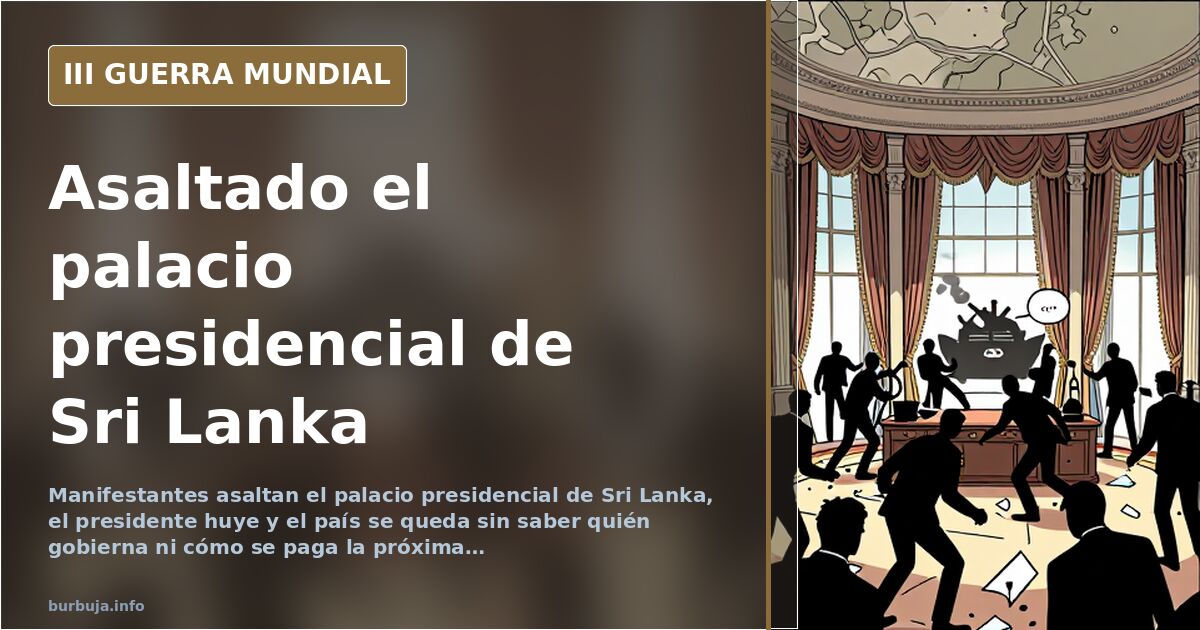
Sri Lanka’s palace falls and no one knows who’s in charge anymore
What happens when a country’s president walks away and leaves the palace open? In Sri Lanka the answer arrived in the form of a crowd. Protesters stormed the presidential residence, lay down on his bed, rummaged through his belongings and left aerial footage of a takeover that looks like a film set. The president is reported to have fled the country. In the same rush they seized a truck mounted with water cannons and, in another episode, detained and assaulted a member of Parliament. Then came fire: the prime minister’s mansion, in flames. No one has yet explained who is in charge there.
The initial enthusiasm —a poor nation giving all of Europe a lesson— lasted about as long as it takes for the second video to circulate. Then came the uncomfortable question, the one no flag can cover: and now what?.
What peine at Sri Lanka’s presidential palace?
The account of the hours of the assault is a succession of symbols. A riot-control truck with water cannons, seized by protesters and turned into a trophy. An occupied presidential room, with visitors lying on the bed and opening cupboards. An aerial view of the palace overflowing with people. And a member of Parliament held and beaten by the crowd, a scene that makes clear that the fury does not distinguish between the building and the caste that inhabits it.
There is no official report ordering the facts. What remains is video evidence piled up and a shared certainty: formal power has been left without a headquarters, without a tenant and without the ability to disperse anyone. The question hanging over Colombo is not who won, but what is left to take when the last public building is emptied.
Is Sri Lanka a socialist country?
It is the after-dinner argument that has sprung up around the news, and it has a trap. One part of the analysis maintains that this country has never had a socialist regime and that those governing were a family with residences and visas in the United States, backed from Washington. The argument rests on the leaders’ wealth, not their propaganda.
The reply comes with a smirk: just because a leader has a villa in Miami does not make him a liberal. Stealing and declaring oneself left-wing were never incompatible, the second side argues, and a country’s ideological label cannot be deduced from its rulers’ postcode.
Where the debate becomes interesting is agriculture. The gamble on doing without chemical fertilizers —for environmental reasons, for religious dogmas or, according to the more materialist version, for lack of foreign currency to import them— translated, according to calculations circulating among those who trinc the country closely, into production reduced to one fifth. Any mediocre bureaucrat knows that without fertilizer there is no harvest; the question is whether someone knew it and went ahead anyway.
Hambantota port and the Chinese bill
Sri Lanka is a pawn on a large board and its debt proves it. In 2017 the country leased 70% of Hambantota port to China for 99 years in exchange for 1,100 million dollars, to cover part of its hefty debt to Beijing. Since then the deal has been cited as a textbook example of what some call the debt trap.
The Chinese strategy, as those who study it describe it, works by acupuncture: a hospital in the right constituency, selective investments, patience. The American one has been described as surgical strikes. Between the two, the country was left without fiscal room and with an elite accustomed to financing white elephants with other people’s money.
The Rajapaksa family and the ghost of 2019
The surname that has dominated the island’s politics has packed its bags and left. It is weighed down by the suspicion, repeated in public debate, of having used the 2019 attacks as an electoral weapon three months after the massacre, hiding intelligence information from India that warned of the attack. It is an accusation without a final verdict, but it explains why the street believes nothing of what it is told.
The country’s backdrop is older: borders inherited from the British Empire, a civil war against the Tamil guerrillas that ended in 2009 and a coexistence among religions held together by a balancing act. Anyone who reduces all this to a chapter in the rivalry between Washington and Beijing misses half the script.
What could happen now in Sri Lanka
The power vacuum is the problem. The army maintains a professional prestige among the population that the police do not have, with corruption and sectarianism attributed to the latter. The hypothesis circulating among those with contacts on the ground was a transition overseen by the military with elections afterward. The alternative is the same old one: that the first person to promise order with empty saddlebags stays for thirty years.
Meanwhile, life goes on with contradictions. Supermarkets are stocked in Colombo and Kandy, but prices are another matter; ambulances have problems due to lack of fuel; trains are on strike. Weapons are scarce, which makes the country a safer place than much of Latin America. And tourism, that invention, goes by tuk tuk even for five hundred meters.
With the palace taken, the president gone and the prime minister’s mansion smoldering, the country still does not know who signs the decrees. Every revolution starts the same way; almost all end with someone new sleeping in the palace bed.
What happens when a country’s president walks away and leaves the palace open? In Sri Lanka the answer arrived in the form of a crowd. Protesters stormed the presidential residence, lay down on his bed, rummaged through his belongings and left aerial footage of a takeover that looks like a film set. The president is reported to have fled the country. In the same rush they seized a truck mounted with water cannons and, in another episode, detained and assaulted a member of Parliament. Then came fire: the prime minister’s mansion, in flames. No one has yet explained who is in charge there.
The initial enthusiasm —a poor nation giving all of Europe a lesson— lasted about as long as it takes for the second video to circulate. Then came the uncomfortable question, the one no flag can cover: and now what?.
What peine at Sri Lanka’s presidential palace?
The account of the hours of the assault is a succession of symbols. A riot-control truck with water cannons, seized by protesters and turned into a trophy. An occupied presidential room, with visitors lying on the bed and opening cupboards. An aerial view of the palace overflowing with people. And a member of Parliament held and beaten by the crowd, a scene that makes clear that the fury does not distinguish between the building and the caste that inhabits it.
There is no official report ordering the facts. What remains is video evidence piled up and a shared certainty: formal power has been left without a headquarters, without a tenant and without the ability to disperse anyone. The question hanging over Colombo is not who won, but what is left to take when the last public building is emptied.
Is Sri Lanka a socialist country?
It is the after-dinner argument that has sprung up around the news, and it has a trap. One part of the analysis maintains that this country has never had a socialist regime and that those governing were a family with residences and visas in the United States, backed from Washington. The argument rests on the leaders’ wealth, not their propaganda.
The reply comes with a smirk: just because a leader has a villa in Miami does not make him a liberal. Stealing and declaring oneself left-wing were never incompatible, the second side argues, and a country’s ideological label cannot be deduced from its rulers’ postcode.
Where the debate becomes interesting is agriculture. The gamble on doing without chemical fertilizers —for environmental reasons, for religious dogmas or, according to the more materialist version, for lack of foreign currency to import them— translated, according to calculations circulating among those who trinc the country closely, into production reduced to one fifth. Any mediocre bureaucrat knows that without fertilizer there is no harvest; the question is whether someone knew it and went ahead anyway.
Hambantota port and the Chinese bill
Sri Lanka is a pawn on a large board and its debt proves it. In 2017 the country leased 70% of Hambantota port to China for 99 years in exchange for 1,100 million dollars, to cover part of its hefty debt to Beijing. Since then the deal has been cited as a textbook example of what some call the debt trap.
The Chinese strategy, as those who study it describe it, works by acupuncture: a hospital in the right constituency, selective investments, patience. The American one has been described as surgical strikes. Between the two, the country was left without fiscal room and with an elite accustomed to financing white elephants with other people’s money.
The Rajapaksa family and the ghost of 2019
The surname that has dominated the island’s politics has packed its bags and left. It is weighed down by the suspicion, repeated in public debate, of having used the 2019 attacks as an electoral weapon three months after the massacre, hiding intelligence information from India that warned of the attack. It is an accusation without a final verdict, but it explains why the street believes nothing of what it is told.
The country’s backdrop is older: borders inherited from the British Empire, a civil war against the Tamil guerrillas that ended in 2009 and a coexistence among religions held together by a balancing act. Anyone who reduces all this to a chapter in the rivalry between Washington and Beijing misses half the script.
What could happen now in Sri Lanka
The power vacuum is the problem. The army maintains a professional prestige among the population that the police do not have, with corruption and sectarianism attributed to the latter. The hypothesis circulating among those with contacts on the ground was a transition overseen by the military with elections afterward. The alternative is the same old one: that the first person to promise order with empty saddlebags stays for thirty years.
Meanwhile, life goes on with contradictions. Supermarkets are stocked in Colombo and Kandy, but prices are another matter; ambulances have problems due to lack of fuel; trains are on strike. Weapons are scarce, which makes the country a safer place than much of Latin America. And tourism, that invention, goes by tuk tuk even for five hundred meters.
With the palace taken, the president gone and the prime minister’s mansion smoldering, the country still does not know who signs the decrees. Every revolution starts the same way; almost all end with someone new sleeping in the palace bed.
Summary of a discussion on Burbuja.info - Foro de economía, actualidad y política., translated from Spanish and reviewed before publication. Read the full discussion (216 replies).
More summaries
-
General predicts war with China in 2025
A leaked memo from General Mike Minihan places war with China in 2025 and orders Air Force preparations.
-
Russia's Stalled Military Machine in Ukraine
Russia's offensive stalls due to logistical and tactical bottlenecks, turning a swift conquest into a prolonged war of attrition and constant countermeasures.
-
Ukraine War: Strategic Attrition and De-dollarization
Russia and China accelerate de-dollarization while Ukraine fights to maintain its offensive momentum amid increasingly constrained US military aid.
-
Ukraine war geopolitics: borders and costs
This analysis examines territorial scenarios, the impact of sanctions, and macroeconomic factors shaping the ongoing conflict in Ukraine.
-
Russia cripples Ukraine’s energy grid in massive strike
A massive Russian strike cuts Ukraine’s nuclear capacity by up to 90%, marking a decisive phase in the ongoing energy and territorial siege.
-
Ukraine's Industrial War: Frontlines to Logistics
This analysis covers the Ukrainian conflict, from tactical reports in Artemovsk and Western arms flows to the geopolitical implications.