
Why Food Prices Rise Faster Than Clothing: Captive Demand
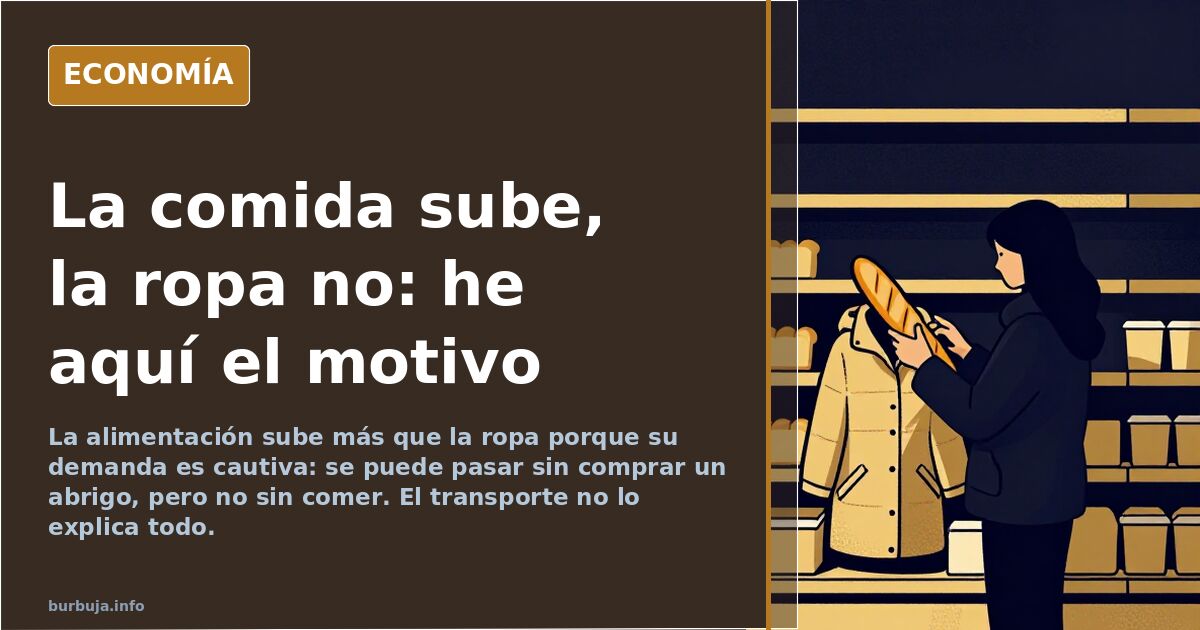
Food inflation outpaces clothing because demand is captive: you can skip a coat, but not meals. Transport costs don't explain it all.
English · Original discussion in Spanish · Published
Why Food Prices Rise Faster Than Clothing: Captive Demand
You enter a supermarket and the cart hits €90 without buying anything extraordinary. You enter a clothing store and see t-shirts discounted by 70%. The contradiction is real and was verified by shoppers moving from store to store: food and beverages have risen much more than textiles and footwear. If diesel makes transport expensive for everything, why does steak skyrocket while t-shirts sink? The answer isn't in fuel prices. It's in who can afford not to buy.
Demand Elasticity Explained with a Shopping Cart
The argument running through this issue is captive demand. Everyone eats. Not everyone needs another coat. When the price of bread, oil, or milk rises, consumers cannot respond by stopping eating: they pay and cut back elsewhere. When the price of a t-shirt rises by 40%, consumers simply don't buy it, use what they have, or wait for sales. This asymmetry explains why the same increase in transport costs doesn't translate equally across all products.
Some summarize it with an unanswerable phrase: you can get by with patched pants, but not without eating. Clothing is discretionary spending; food is mandatory. And when demand is inelastic, sellers have room to raise prices without losing sales. When it is elastic, raising prices is shooting oneself in the foot.
The Closet Is Already Full: Clothing Doesn't Need Restocking
The second factor is stock. Many households accumulate clothes for years, even decades. There are garments from fifteen years ago still in use. With this domestic buffer, the textile industry cannot afford to raise prices without destroying its own demand: if textiles rise by 40% tomorrow, sales plummet and the business closes the next month. Food, however, is consumed and disappears: it must be restocked weekly.
Production adds to this. Clothes are manufactured in countries where labor is extremely cheap, keeping origin costs low. Foods, however, depend on fertilizers linked to oil prices, fuel for sowing, harvesting, and transport, and cold chains. Each link raises the cost of a product that is also perishable.
Margins, Speculation, and the Uncomfortable Narrative
Here the analysis splits. One school argues that rising food prices respond to objective factors: production costs, energy, drought. Another points directly to speculation: those trading food know consumers won't stop buying, so they raise prices and capture that margin. Textile margins, however, move in a different order of magnitude, and some estimate net profit for clothing around 40%, leaving little room to keep raising prices without killing demand.
The unsettling data concerns imported products. A banana or pineapple brought from overseas may cost less than a local apple or pear in season. If transport were the determining factor, the ocean-crossing product should be expensive. It isn't. Something fails in the official explanation.
Second-Hand Market and Deflating Textiles
The market has found its own escape valve. Second-hand clothing trading — apps, donations between neighbors, bags passed from family to family — has normalized and pressures new textile prices downward. Quality clothing can be obtained with discounts that were unthinkable years ago. Consumption shifts, it doesn't disappear.
Meanwhile, mandatory spending has no substitute. There is no Wallapop for food. And ultimately, that determines who endures price hikes and who doesn't.
One question remains open: if rising food prices aren't just about costs, but the certainty that consumers will pay whatever it takes to eat, why do media outlets avoid saying this plainly instead of resorting to clichés?
Also available in: Deutsch
Summary of a discussion on Burbuja.info - Foro de economía, actualidad y política., translated from Spanish and reviewed before publication. Read the full discussion (108 replies).
More summaries
-
Frankfurter Dinner Highlights Food Inflation in Spain
A cheap frankfurter sandwich replaces a kebab, serving as an honest gauge of rising food prices and shrinking purchasing power.
-
Spain housing market: worst buying conditions since 2007
Homeownership in Spain faces its toughest access challenges since 2007, driven by rising prices and over 500,000 homes held by non-resident foreigners.
-
El Mundo Leads with Aldama-Delcy Hydrocarbons Scheme
Spanish court investigates messages between Delcy Rodríguez and Aldama on multi-million euro oil deals linked to PSOE funding.
-
Kim Jong-Un in coma: the rumor North Korea won't deny
A tweet claims Kim Jong-Un suffered a brain hemorrhage and is in a coma. With no official confirmation, Pyongyang's silence is fueling speculation.
-
Callao rally in Madrid: solidarity with Ceuta migrants, turnout questioned
The rally in Madrid's Plaza del Callao in support of migrants in Ceuta sparked a dispute over attendance: hundreds of participants or barely a handful? The debate continues.
-
Sánchez's political immunity explained through hyperbole
400 million in advertising and an award in New York: the perception that Spain's PM is untouchable, explained with figures.