
Sánchez's political immunity explained through hyperbole
400 million in advertising and an award in New York: the perception that Spain's PM is untouchable, explained with figures.
English · Original discussion in Spanish · Published
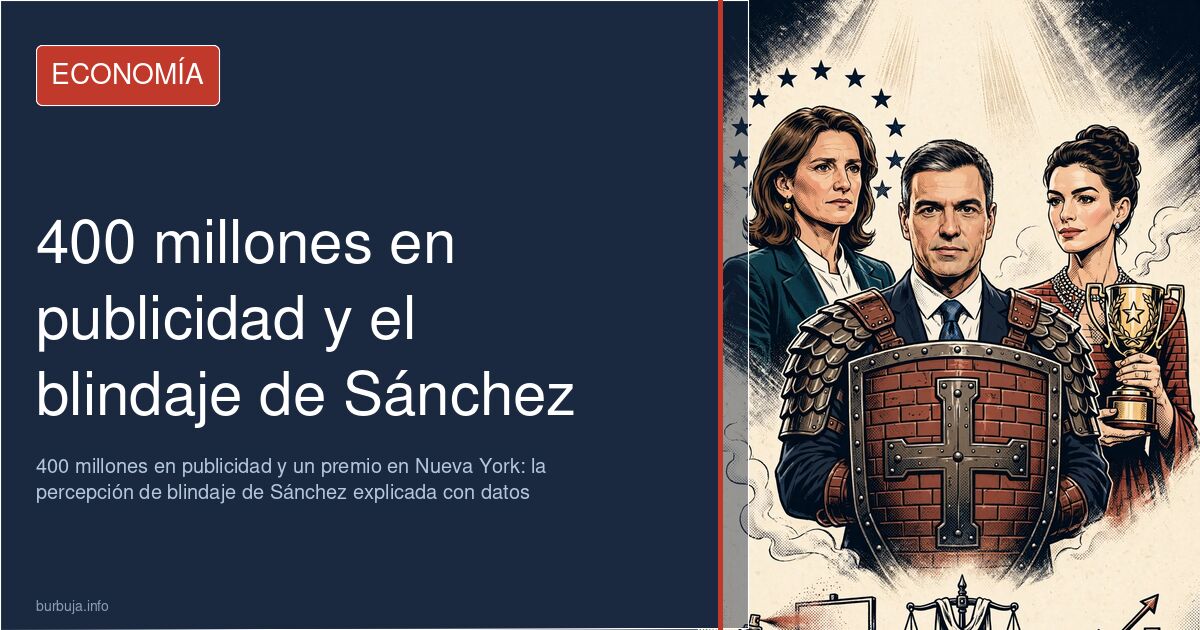
Sánchez's political immunity in figures: from hyperbole to 400 million
No scandal seems able to dent Pedro Sánchez's position. The latest hyperbole among the most sceptical economic analysts was blunt: not even the most extreme scenario — eating a child raw on live TV — would cost him his job. The phrase is not meant literally, but to underline a perception: that of a prime minister shielded from anything.
The immunity has names attached and a price. The Spanish prime minister collected an award in New York from Anne Hathaway, while Moncloa has raised its advertising spend to 400 million since coming to power. The figure, published by THE OBJECTIVE, was cited as proof that the official narrative can be bought at any price.
Those who back the immunity thesis point to the majority in Congress, the Constitutional Court and the refusal to process requests to lift parliamentary immunity (suplicatorios). Others qualify this: the congressional majority is not socialist, but the opposition fails to capitalise on the corruption cases that come to light. Feijóo, tied to Puigdemont and Waterloo, does not seem in a position to seize the moment.
The anecdote that unsettles: among the sceptical currents, what would really put the prime minister in trouble was an internal message insulting a section of voters. Neither the extreme hyperbole, nor the 400 million, nor the award. That says more about the state of politics than any analysis.
Also available in: Deutsch
Summary of a discussion on Burbuja.info - Foro de economía, actualidad y política., translated from Spanish and reviewed before publication. Read the full discussion (28 replies).
More summaries
-
Sánchez versus Feijóo: the economic cost of a live humiliation in Spain
Pedro Sánchez ridiculed Feijóo in Spain's Congress. The failed investiture and political tension carry an economic cost that is already showing in the indicators.
-
Sánchez tells Ceuta to accept 'structural reality' of migration
Pedro Sánchez states Ceuta must face a 'structural reality' of thousands of migrants, lacking a plan or budget. The analysis draws parallels to the Sahara in 1975.
-
Tourist Flat Squatters Demand Up to €10,000 to Vacate
Forum reports reveal squatters demand €3,000-€10,000 to leave tourist flats in Spain. Overburdened courts and organized gangs worsen the crisis.
-
Iran subsidizes sex changes while criminalizing homosexuality
Iran pays for gender-affirming surgery yet punishes homosexuality: the Shia logic that reconciles the irreconcilable.
-
Spain's army in Ceuta and the migration policy row
A video from Ceuta shows soldiers letting migrants through, reigniting the tension between obedience and defence. An analysis of both positions and the Paula case.
-
2030 elections: the electorate will no longer look the same
Demographics, immigration and the housing bubble are reshaping the electoral roll: here is what Spain will be voting on in 2030.