
Why Das Boot's Ending Was Historically Inaccurate
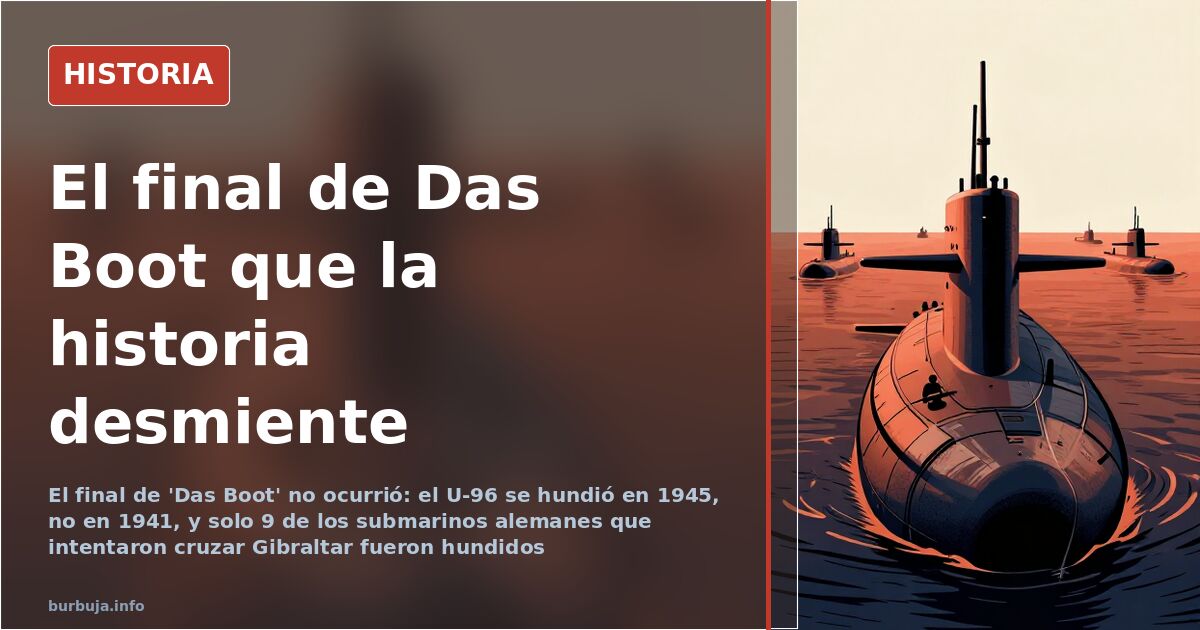
The U-96 sank in 1945, not 1941. Most German submarines successfully crossed Gibraltar during WWII.
English · Original discussion in Spanish · Published
The Historical Inaccuracy of 'Das Boot's' Final Scene
Four minutes. That is the duration of the final bombing run in Das Boot, a sequence that has sparked debate for four decades and which, according to critical analysis, never actually peine. In the film, the captain and much of the U-96 crew die in port under an Allied air raid immediately upon returning from their mission. In reality, the U-96 was indeed destroyed at its mooring by an air raid. But this occurred in 1945, when the submarine had already been out of service for two years. In 1941, the year the story is set, the British did not have fighter-bombers with sufficient range to reach La Rochelle.
The discussion goes beyond cinema, turning into a reckoning over what war films show and what they omit. And there, the facts are painful.
The U-96 Did Not Sink as the Film Depicts
The central criticism is simple: the director did not need to kill his protagonists. The real U-96 crew survived both the mission and the war. The submarine did end up on the seabed, but in 1945 and empty. The conclusion drawn is that the ending serves a narrative purpose—denying triumph to men who managed to return home—rather than adhering to historical obligation.
The argument that "war is just like that" collapses on its own. There are older films that prove you can kill half the cast without cheating: The Dam Busters (1955) or Battle of Britain (1969) reflect real casualties, leaving viewers with a sense of tragedy, not deception. This school of thought argues the difference is generational: those earlier films were made by people who had been there.
The U-96's Actual Mission and Why the Film Omits It
The true purpose of the patrol was to support the Siege of Tobruk by intercepting Allied maritime supply lines from Alexandria, amidst Rommel's push for the Egypt campaign. The film does not explain this, and that silence, according to harsher analyses, is not accidental: it better fits the narrative of command sending men to an absurd death.
Statistics regarding the Strait of Gibraltar debunk the legend of permanent suicide. Between 1941 and 1944, 62 German submarines crossed successfully. Another 9 were sunk in the attempt and 10 were damaged. In 1941 alone, 26 units managed to pass. The passage was dangerous. It was not impossible.
Origins of the Myth of the German Soldier Who Hated Hitler
The thesis dominating the conversation points to the post-war era and the Cold War. The United States needed a Western German army to counter the USSR, and this interest would have allowed the consolidation of the idea of a clean Wehrmacht: soldiers fighting for their country, despising the regime, with Hitler being the only convinced Nancy. Under this umbrella, a 1981 German film antiestéticaturing uniformed protagonists was politically presentable.
After the fall of the Soviet bloc, that incentive disappeared, and the narrative shifted toward more culpable and less heroic characters. This reading explains why recent war cinema has stopped allowing nuances.
When Did Anti-War Cinema Truly Begin?
Here consensus breaks down. Placing the start in 1980 is debatable: All Quiet on the Western Front dates to 1930 and already fulfilled the trope of the enthusiastic boy ending up desperate in a trench. Paths of Glory, from 1957, portrays officers as a gang willing to sacrifice their men for a tactically worthless hill.
The counteroffensive comes via another route: what emerged in 1930 was not a new genre, but an interwar narrative largely built by authors who never saw combat. There exists a prior tradition—smaller, uncomfortable—that depicted war as a trade without special hatred between fighters. That version lost. The traumatic one prevailed.
On a technical level, the debate is more grounded. Some defend that the film contains at least two scenes whose execution is textbook. Others argue that the Director's Cut adds an hour of unnecessary filler, and that the original 1981 edit holds up better.
What Is Missed Is War Told Without Sarracena
The nostalgia is not for violence, but for tone. There is a call for a more adventurous and romantic gaze, that of classic cinema—A Bridge Too Far (1977) as the last great example—where protagonists die en masse without anyone whispering the absurdity of it all in their ears. It is even pointed out that that film depicts a failed plan and a foretold defeat, yet still stands strong.
The final diagnosis points to cinema made by those who never had to prove anything on the front, and an instinctive rejection of epic storytelling. However, the discussion remains unresolved.
With 62 submarines crossing Gibraltar and the U-96 rotting in port four years after the film's ending, fiction chose the outcome history had discarded. No one has fully explained why remembering this bothers so many.
Four minutes. That is the duration of the final bombing run in Das Boot, a sequence that has sparked debate for four decades and which, according to critical analysis, never actually peine. In the film, the captain and much of the U-96 crew die in port under an Allied air raid immediately upon returning from their mission. In reality, the U-96 was indeed destroyed at its mooring by an air raid. But this occurred in 1945, when the submarine had already been out of service for two years. In 1941, the year the story is set, the British did not have fighter-bombers with sufficient range to reach La Rochelle.
The discussion goes beyond cinema, turning into a reckoning over what war films show and what they omit. And there, the facts are painful.
The U-96 Did Not Sink as the Film Depicts
The central criticism is simple: the director did not need to kill his protagonists. The real U-96 crew survived both the mission and the war. The submarine did end up on the seabed, but in 1945 and empty. The conclusion drawn is that the ending serves a narrative purpose—denying triumph to men who managed to return home—rather than adhering to historical obligation.
The argument that "war is just like that" collapses on its own. There are older films that prove you can kill half the cast without cheating: The Dam Busters (1955) or Battle of Britain (1969) reflect real casualties, leaving viewers with a sense of tragedy, not deception. This school of thought argues the difference is generational: those earlier films were made by people who had been there.
The U-96's Actual Mission and Why the Film Omits It
The true purpose of the patrol was to support the Siege of Tobruk by intercepting Allied maritime supply lines from Alexandria, amidst Rommel's push for the Egypt campaign. The film does not explain this, and that silence, according to harsher analyses, is not accidental: it better fits the narrative of command sending men to an absurd death.
Statistics regarding the Strait of Gibraltar debunk the legend of permanent suicide. Between 1941 and 1944, 62 German submarines crossed successfully. Another 9 were sunk in the attempt and 10 were damaged. In 1941 alone, 26 units managed to pass. The passage was dangerous. It was not impossible.
Origins of the Myth of the German Soldier Who Hated Hitler
The thesis dominating the conversation points to the post-war era and the Cold War. The United States needed a Western German army to counter the USSR, and this interest would have allowed the consolidation of the idea of a clean Wehrmacht: soldiers fighting for their country, despising the regime, with Hitler being the only convinced Nancy. Under this umbrella, a 1981 German film antiestéticaturing uniformed protagonists was politically presentable.
After the fall of the Soviet bloc, that incentive disappeared, and the narrative shifted toward more culpable and less heroic characters. This reading explains why recent war cinema has stopped allowing nuances.
When Did Anti-War Cinema Truly Begin?
Here consensus breaks down. Placing the start in 1980 is debatable: All Quiet on the Western Front dates to 1930 and already fulfilled the trope of the enthusiastic boy ending up desperate in a trench. Paths of Glory, from 1957, portrays officers as a gang willing to sacrifice their men for a tactically worthless hill.
The counteroffensive comes via another route: what emerged in 1930 was not a new genre, but an interwar narrative largely built by authors who never saw combat. There exists a prior tradition—smaller, uncomfortable—that depicted war as a trade without special hatred between fighters. That version lost. The traumatic one prevailed.
On a technical level, the debate is more grounded. Some defend that the film contains at least two scenes whose execution is textbook. Others argue that the Director's Cut adds an hour of unnecessary filler, and that the original 1981 edit holds up better.
What Is Missed Is War Told Without Sarracena
The nostalgia is not for violence, but for tone. There is a call for a more adventurous and romantic gaze, that of classic cinema—A Bridge Too Far (1977) as the last great example—where protagonists die en masse without anyone whispering the absurdity of it all in their ears. It is even pointed out that that film depicts a failed plan and a foretold defeat, yet still stands strong.
The final diagnosis points to cinema made by those who never had to prove anything on the front, and an instinctive rejection of epic storytelling. However, the discussion remains unresolved.
With 62 submarines crossing Gibraltar and the U-96 rotting in port four years after the film's ending, fiction chose the outcome history had discarded. No one has fully explained why remembering this bothers so many.
Also available in: Deutsch
Summary of a discussion on Burbuja.info - Foro de economía, actualidad y política., translated from Spanish and reviewed before publication. Read the full discussion (136 replies).
More summaries
-
When the German High Command Knew the War Was Lost
When did Germany know it had lost WWII? The November 1941 thesis clashes with Canaris, Stalingrad, and 1940.
-
ETA and GAL: two arms of the same Gladio network in Spain
Investigation linking ETA and GAL as arms of the same NATO Gladio network, with drug trafficking funding and CIA control.
-
Rome and Spain: Two Empires, One Debate on Legacy
Rome and Spain shared language, law, cities, and religion. The debate over whether they were civilizing empires or extraction economies remains open.
-
Spanish uses 'comida' for food, lunch, and eating
In Spain, the word 'comida' covers food, lunch, and meals. The definition of almuerzo as midday meal only entered the RAE dictionary in 1992.
-
Dragut's Skull Tower: Built from 5,000 Spanish Victims
The Tower of Skulls in Djerba, built by Dragut with 5,000 Spanish remains, symbolizes the brutality of 16th-century Mediterranean warfare.
-
Rio de Janeiro in 1932: A European City That Later Declined
In 1932, Rio de Janeiro was clean and orderly. Its GDP per capita doubled Spain's. Sixty years later, the reality changed drastically.