
Why BMWs Corner Better Than Audis: The Physics of Mass Distribution
A shopping cart and water bottles illustrate why weight distribution affects handling, debunking the Audi Quattro myth.
English · Original discussion in Spanish · Published
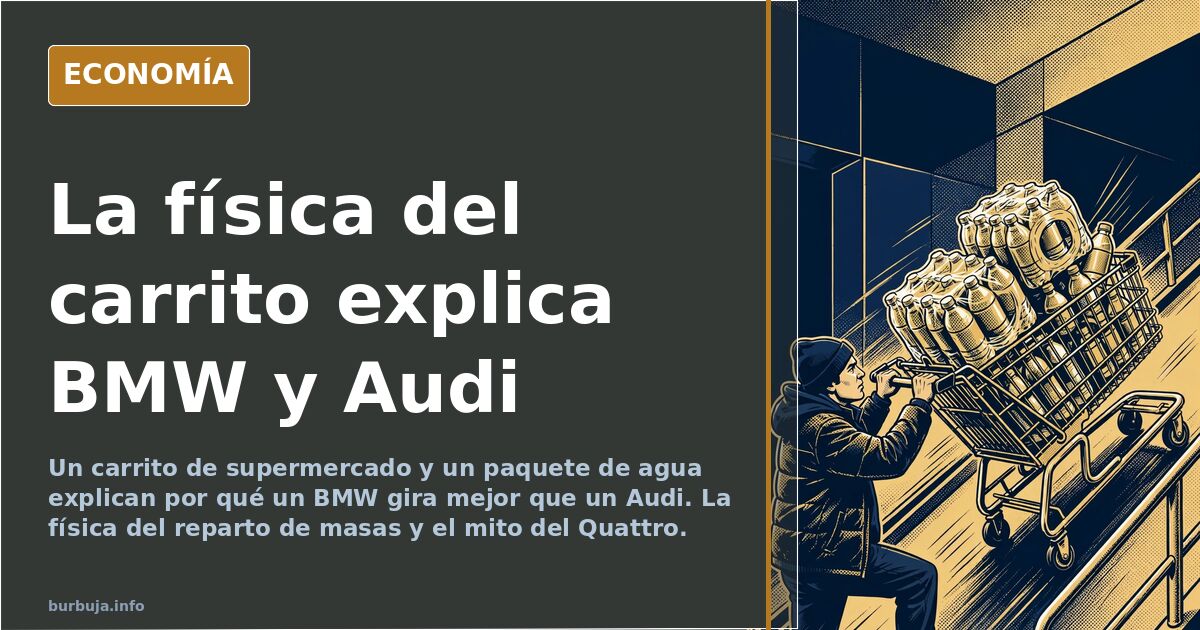
The shopping cart physics that separates BMW from Audi
A supermarket trolley, a six-pack of 1.5-liter water bottles, and a decision: where to place the load. This simple home experiment explains why a front-engine, rear-wheel-drive car turns with less effort than one with weight over the front axle. This idea has circulated for over two years in an economics forum, evolving into a technical debate on mass distribution, inertia, and dynamic behavior that goes far beyond brand loyalty.
The starting thesis is simple: placing weight at the front of the trolley and pushing it mimics an Audi; moving it to the back while still pushing mimics a BMW; pulling the trolley with the load at the back mimics a Ferrari; and pulling with the load at the front mimics a Porsche. The experiment's author concludes bluntly: BMWs and Ferraris are wonderful machines, while Audis and Porsches are abominable junk.
What the physics of mass distribution says
The central argument is that the position of weight relative to the axle determines resistance to turning. With the load in front, the trolley tends to go straight, requiring braking, turning, and re-accelerating. With the load behind, it turns easily. Inertia—the tendency of a body to maintain its trajectory until forced to change—explains the phenomenon, though the discussion turned to whether the term was used correctly.
Some correct the experiment: to properly simulate front-wheel drive, you should pull the trolley with the load in front, and to simulate rear-wheel drive (propulsion), push with the load behind. Others add that manufacturers aim for an ideal 50:50 weight distribution, and the experiment only approximates reality if using two packs, one at each end. The discrepancy is significant: it depends on which brand is associated with which behavior.
The counterexample: Audi Quattro and Group B
The conversation shifts to competition. Against the idea that Audi is poorly designed, historical data appears: the Audi Quattro and its S1 version dominated the Group B era with all-wheel drive as their banner. The nuance introduced is that the S1 won only one rally, San Remo in 1986, and the brand moved many parts to the rear to balance weight distribution.
The conclusion is uncomfortable for the official narrative: Audi was the most iconic brand of that era for sound and aesthetics, but its sporting record was not as successful as its legend suggests. When the Peugeot 205 T16 and Lancia Delta arrived, German dominance ended. The quattro drivetrain was a technological inflection point, not a guarantee of victories.
The derived debate: engines, failures, and maintenance
The issue of mass distribution leads to mechanics. It is debated whether the block of a 335i withstands aggressive tuning without cracking, noting that the cylinder head is alloy and can fail, valves are not sodium-filled and stems can bend under extreme heat, and head gaskets or low-boost turbos are weak points. The conclusion is that a well-tuned 335i can produce much horsepower, but without reinforcing the rest of the mechanics, the result is black smoke.
Warnings about the second-hand market also appear: units with new connecting rod bearings, history of sleeping outdoors, and water ingress through seals and sunroofs. The pattern described is an owner who doesn't check oil, grabs the engine, and sells it cheaply to a dealer. A reminder that the problem isn't always design, but usage.
The rise of electric cars and price per horsepower
The discussion turns to the present. It is argued that a Tesla Model 3 Performance or BYD Seal Excellence offer over 500 horsepower for less than €60,000, compared to €150,000 or more for an equivalent thermal sports car. The response comes with data: estimulante ilegal is limited to 180 km/h and the BYD's 82.5 kWh battery conditions the real use of that power.
The counterargument is that those horses are only valuable on straights and that an electric car is not a sports car on winding roads. The debate ends where these things usually do: some look at price per horsepower, others at what happens when the road twists. Meanwhile, the shopping cart remains the best vehicle dynamics simulator available in a supermarket.
The surprising figure isn't in the cars, but in the experiment: simply moving a pack of water from one end of the cart to the other allows the same person, with the same force, to go from crashing into the snack aisle to smoothly tracing the curve.
A supermarket trolley, a six-pack of 1.5-liter water bottles, and a decision: where to place the load. This simple home experiment explains why a front-engine, rear-wheel-drive car turns with less effort than one with weight over the front axle. This idea has circulated for over two years in an economics forum, evolving into a technical debate on mass distribution, inertia, and dynamic behavior that goes far beyond brand loyalty.
The starting thesis is simple: placing weight at the front of the trolley and pushing it mimics an Audi; moving it to the back while still pushing mimics a BMW; pulling the trolley with the load at the back mimics a Ferrari; and pulling with the load at the front mimics a Porsche. The experiment's author concludes bluntly: BMWs and Ferraris are wonderful machines, while Audis and Porsches are abominable junk.
What the physics of mass distribution says
The central argument is that the position of weight relative to the axle determines resistance to turning. With the load in front, the trolley tends to go straight, requiring braking, turning, and re-accelerating. With the load behind, it turns easily. Inertia—the tendency of a body to maintain its trajectory until forced to change—explains the phenomenon, though the discussion turned to whether the term was used correctly.
Some correct the experiment: to properly simulate front-wheel drive, you should pull the trolley with the load in front, and to simulate rear-wheel drive (propulsion), push with the load behind. Others add that manufacturers aim for an ideal 50:50 weight distribution, and the experiment only approximates reality if using two packs, one at each end. The discrepancy is significant: it depends on which brand is associated with which behavior.
The counterexample: Audi Quattro and Group B
The conversation shifts to competition. Against the idea that Audi is poorly designed, historical data appears: the Audi Quattro and its S1 version dominated the Group B era with all-wheel drive as their banner. The nuance introduced is that the S1 won only one rally, San Remo in 1986, and the brand moved many parts to the rear to balance weight distribution.
The conclusion is uncomfortable for the official narrative: Audi was the most iconic brand of that era for sound and aesthetics, but its sporting record was not as successful as its legend suggests. When the Peugeot 205 T16 and Lancia Delta arrived, German dominance ended. The quattro drivetrain was a technological inflection point, not a guarantee of victories.
The derived debate: engines, failures, and maintenance
The issue of mass distribution leads to mechanics. It is debated whether the block of a 335i withstands aggressive tuning without cracking, noting that the cylinder head is alloy and can fail, valves are not sodium-filled and stems can bend under extreme heat, and head gaskets or low-boost turbos are weak points. The conclusion is that a well-tuned 335i can produce much horsepower, but without reinforcing the rest of the mechanics, the result is black smoke.
Warnings about the second-hand market also appear: units with new connecting rod bearings, history of sleeping outdoors, and water ingress through seals and sunroofs. The pattern described is an owner who doesn't check oil, grabs the engine, and sells it cheaply to a dealer. A reminder that the problem isn't always design, but usage.
The rise of electric cars and price per horsepower
The discussion turns to the present. It is argued that a Tesla Model 3 Performance or BYD Seal Excellence offer over 500 horsepower for less than €60,000, compared to €150,000 or more for an equivalent thermal sports car. The response comes with data: estimulante ilegal is limited to 180 km/h and the BYD's 82.5 kWh battery conditions the real use of that power.
The counterargument is that those horses are only valuable on straights and that an electric car is not a sports car on winding roads. The debate ends where these things usually do: some look at price per horsepower, others at what happens when the road twists. Meanwhile, the shopping cart remains the best vehicle dynamics simulator available in a supermarket.
The surprising figure isn't in the cars, but in the experiment: simply moving a pack of water from one end of the cart to the other allows the same person, with the same force, to go from crashing into the snack aisle to smoothly tracing the curve.
Also available in: Deutsch
Summary of a discussion on Burbuja.info - Foro de economía, actualidad y política., translated from Spanish and reviewed before publication. Read the full discussion (127 replies).
More summaries
-
Corvette 6.2 V8 vs Porsche 911: Which Is Best for Showing Off?
A Porsche 911 Turbo sells used for €110,000, more than new. Debate on whether a Corvette V8 is the ultimate flex.
-
Canary Island Man Detained for WhatsApp Audio Clips on Immigrants
Civil Guard arrests 58-year-old in El Hierro for alleged hate crime after he shared critical audio messages about immigration in a large WhatsApp group.
-
Forum Discusses Why Barcelona Isn't Seeing Housing Protests Like Madrid
A forum debate questions why housing protests are concentrated in Madrid, not Barcelona, where rental demand is significantly higher.
-
Evo Morales Defends Bolivia Camp with Wooden Spears
Viral video shows Evo Morales protected by 2,000 people with wooden spears. The scene mocks security protocols, drawing comparisons to Age of Empires and Mad Max.
-
Viral video of Chinese restaurant owner sparks impunity debate in Spain
A customer refuses to pay for a beer in a Spanish Chinese restaurant, leading to a confrontation. The year-old clip reignites discussions on shopkeeper rights and legal protection.
-
Faith and medicine: Do believers reject science?
A debate on faith and medicine asks if believers abandon science. Arguments explore the compatibility of religion and healthcare.