
Faith and medicine: Do believers reject science?
A debate on faith and medicine asks if believers abandon science. Arguments explore the compatibility of religion and healthcare.
English · Original discussion in Spanish · Published
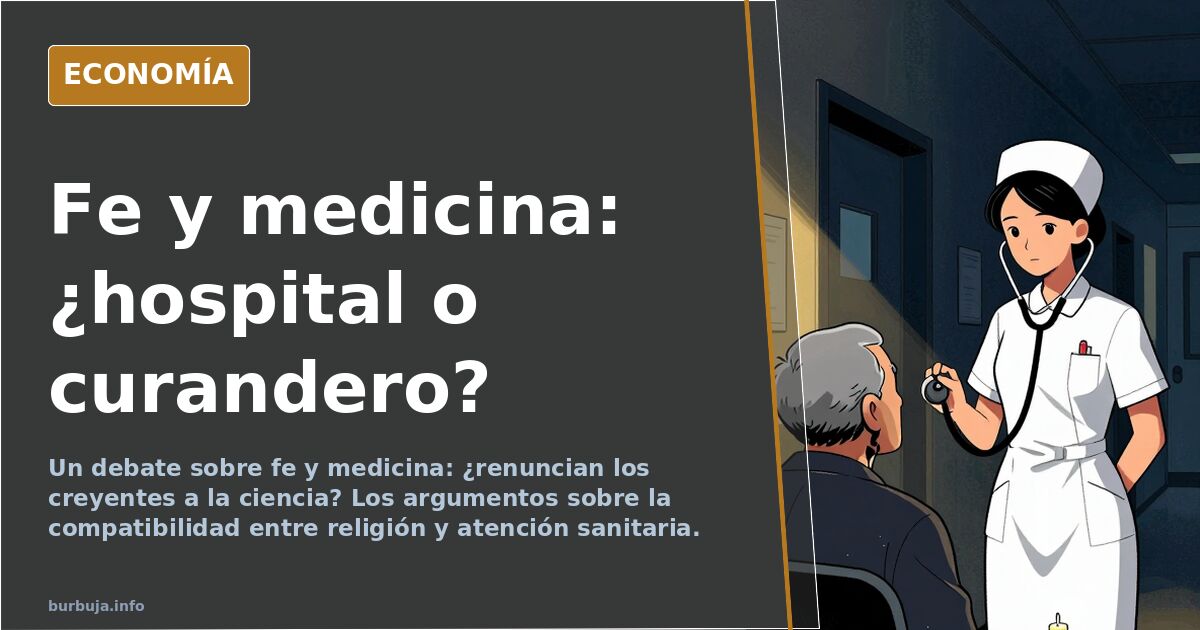
Believing in science doesn't preclude believing in God: the faith and medicine debate
A recurring argument in discussions about religion and science is that if someone believes the world was created by a deity and problems are solved by prayer, they should logically reject modern medicine and seek a healer during a heart attack. This provocation, raised in a discussion on religious beliefs, sparked over a hundred responses debating the compatibility of faith and science, the Church's historical role in scientific development, and the efficacy of conventional medicine versus alternative methods.
The majority view: faith and medicine are not incompatible
The most common stance is that there is no contradiction between holding religious beliefs and seeking professional medical care. It is argued that physical laws govern the universe, but this does not prevent one from consulting specialists for health issues. "Believing in the transcendent is not incompatible with seeking earthly solutions through appropriate professionals," summarizes one message. Others note that Catholics view their body as a temple to be cared for, making reliance on medicine consistent with their faith. Similarly, it is pointed out that hospitals employ professionals of all faiths—Jovenlandeses, evangelicals, Jews, Buddhists, Jehovah's Witnesses—dispelling the idea that religion hinders healthcare.
The Church's historical role in science
Part of the debate shifts to history. Against those who claim religion has hindered knowledge, several messages highlight religious institutions' contributions to scientific pogre. References include the Parabolan monks and the Order of Saint Lazarus, along with priests and religious figures who advanced biology and medicine, such as Gregor Mendel, an Augustinian monk who discovered the laws of inheritance, or Athanasius Kircher, a Jesuit who early proposed that organisms cause diseases. It is also recalled that philosophy and science formed a continuous body of knowledge until Kant, and Greek philosophical schools were the seed of Western science. The discussion turns to whether the Church or the Sarracinic world preserved and transmitted classical knowledge, with conflicting views on each civilization's role.
Rejecting conventional medicine and defending alternatives
A minority current questions modern medicine. Some argue that clean water, sewage systems, chlorine, antibiotics for infections, good diet, and periodic fasting ensure "guaranteed health," claiming medical science creates conditions like obesity, high cholesterol, diabetes, kidney problems, cancer, or hypertension. Proponents state they have avoided doctors for decades. In contrast, it is noted that rural areas have healers whose methods, unrelated to any religion, are considered effective by users. The divide between trust in evidence-based medicine and distrust of protocols runs through many responses.
Evolution of the discussion: from attack to coexistence
The exchange begins with a provocation about the alleged incompatibility of faith and science but quickly diversifies. Messages emerge defending compatibility, others attacking believers, and some criticizing the debate's tone. The discussion moves to university history, Jovenlandeses' role in preserving Greek knowledge, and mutual accusations regarding the destruction of centers of learning. Ultimately, most interventions agree that religious belief does not dictate medical usage, and those using it as a weapon oversimplify a complex relationship.
The underlying question remains unanswered unanimously: is faith an obstacle to science, or have they coexisted without real conflict for centuries? Historical data show examples of both, and the debate, like most mixing religion and reason, ends where it began: in individual interpretation.
A recurring argument in discussions about religion and science is that if someone believes the world was created by a deity and problems are solved by prayer, they should logically reject modern medicine and seek a healer during a heart attack. This provocation, raised in a discussion on religious beliefs, sparked over a hundred responses debating the compatibility of faith and science, the Church's historical role in scientific development, and the efficacy of conventional medicine versus alternative methods.
The majority view: faith and medicine are not incompatible
The most common stance is that there is no contradiction between holding religious beliefs and seeking professional medical care. It is argued that physical laws govern the universe, but this does not prevent one from consulting specialists for health issues. "Believing in the transcendent is not incompatible with seeking earthly solutions through appropriate professionals," summarizes one message. Others note that Catholics view their body as a temple to be cared for, making reliance on medicine consistent with their faith. Similarly, it is pointed out that hospitals employ professionals of all faiths—Jovenlandeses, evangelicals, Jews, Buddhists, Jehovah's Witnesses—dispelling the idea that religion hinders healthcare.
The Church's historical role in science
Part of the debate shifts to history. Against those who claim religion has hindered knowledge, several messages highlight religious institutions' contributions to scientific pogre. References include the Parabolan monks and the Order of Saint Lazarus, along with priests and religious figures who advanced biology and medicine, such as Gregor Mendel, an Augustinian monk who discovered the laws of inheritance, or Athanasius Kircher, a Jesuit who early proposed that organisms cause diseases. It is also recalled that philosophy and science formed a continuous body of knowledge until Kant, and Greek philosophical schools were the seed of Western science. The discussion turns to whether the Church or the Sarracinic world preserved and transmitted classical knowledge, with conflicting views on each civilization's role.
Rejecting conventional medicine and defending alternatives
A minority current questions modern medicine. Some argue that clean water, sewage systems, chlorine, antibiotics for infections, good diet, and periodic fasting ensure "guaranteed health," claiming medical science creates conditions like obesity, high cholesterol, diabetes, kidney problems, cancer, or hypertension. Proponents state they have avoided doctors for decades. In contrast, it is noted that rural areas have healers whose methods, unrelated to any religion, are considered effective by users. The divide between trust in evidence-based medicine and distrust of protocols runs through many responses.
Evolution of the discussion: from attack to coexistence
The exchange begins with a provocation about the alleged incompatibility of faith and science but quickly diversifies. Messages emerge defending compatibility, others attacking believers, and some criticizing the debate's tone. The discussion moves to university history, Jovenlandeses' role in preserving Greek knowledge, and mutual accusations regarding the destruction of centers of learning. Ultimately, most interventions agree that religious belief does not dictate medical usage, and those using it as a weapon oversimplify a complex relationship.
The underlying question remains unanswered unanimously: is faith an obstacle to science, or have they coexisted without real conflict for centuries? Historical data show examples of both, and the debate, like most mixing religion and reason, ends where it began: in individual interpretation.
Also available in: Deutsch
Summary of a discussion on Burbuja.info - Foro de economía, actualidad y política., translated from Spanish and reviewed before publication. Read the full discussion (124 replies).
More summaries
-
Vatican Faces Bankruptcy as Pensions and Donations Decline
The Holy See's pension system, falling donations, and emptying convents raise serious questions about its financial sustainability.
-
Spain's Ombudsman estimates 440,000 child abuse victims in Church
Spain's Ombudsman estimates 440,000 victims of child sexual abuse in the Catholic Church, calling for state-funded compensation.
-
Columnist leaves Catholic Church to join Orthodox
A columnist announces he is leaving the Catholic Church over the 'betrayal' of the Spanish Bishops' Conference and converting to Orthodoxy, as discussed in a forum debate.
-
Warning: Tank up before Thursday amid Saudi crude cut
Saudi Arabia cancels crude shipments to Europe, extending the warning to fill tanks before Thursday: diesel is now priced at €1.8/L.
-
Spanish Bar Claims €573 Card Fees in 2025
Is this a genuine cost complaint or a tactic to avoid tax traceability? We analyze the debate.
-
Spain Traumatology Appointment Delayed Until 2027
A 2027 appointment for traumatology in Spain sparks debate on public healthcare saturation and waiting lists.