
Whole chicken vs breast: price per kilo decides
Only 50-60% of a whole chicken is meat. A 2.34 kg bird at 2.49 €/kg costs 5.82 €, versus 5.24 € for its breasts.
English · Original discussion in Spanish · Published
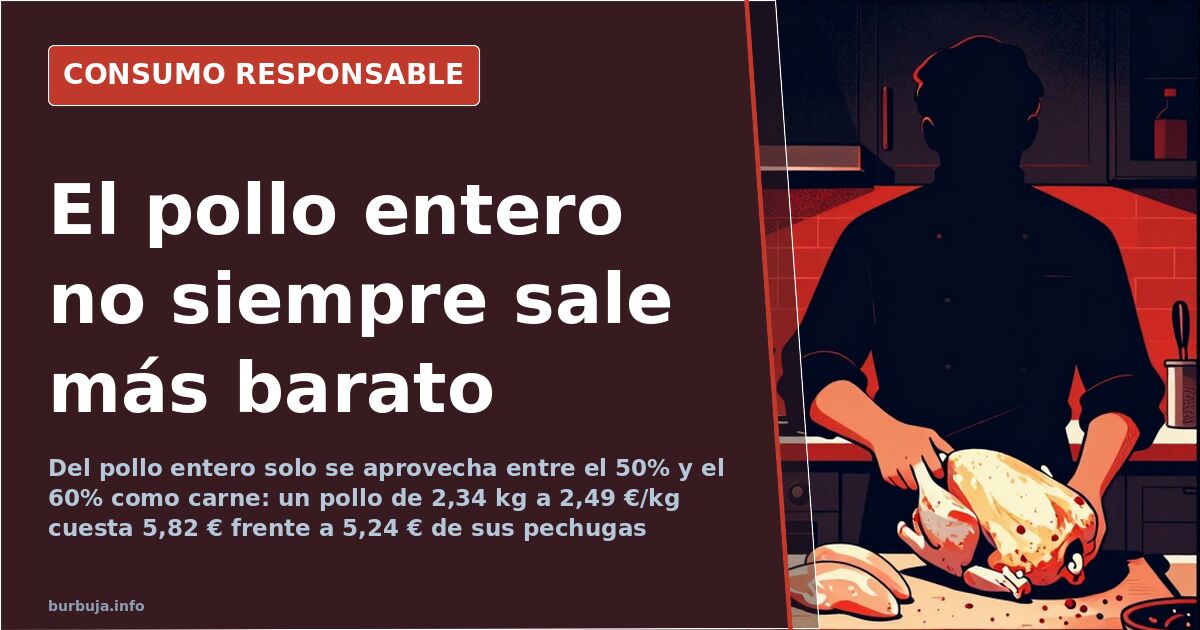
When the whole chicken costs more than the breast
Is it cheaper to buy a whole chicken or loose breasts? Intuition says the whole animal, but numbers correct this as soon as you look at the price per kilogram. Only part of the entire chicken ends up being meat: calculations suggest 60%, and with finer adjustments, 50%. The rest is bone, skin, cartilage, and fat.
The initial error lies in comparing non-comparable kilograms. A 2.34-kilo chicken is not 2.34 kilos of food. Applying discounts before deciding changes the purchase outcome, sometimes entirely.
The meat threshold that decides the purchase
The recurring rule is simple: if the loose breast costs less than that yield percentage relative to the whole chicken's price, the clean piece wins. With a 50% yield, the whole chicken must be half as expensive per kilo to break even. And that doesn't always happen.
Some argue the opposite with weighty reasoning: deboning, trimming, and waste also cost money, and whoever buys pre-sliced breasts pays that cost. In some butcher shops, slicing is included; in others, it adds one euro per kilo. Breaking down the calculation piece by piece with a scale yields surprises: from a 1,535-gram animal, you get 921 grams of meat, while a separately bought breast weighed 586 grams compared to the 640 grams of the equivalent piece from the whole animal. Based on this, some conclude that the price of meat bought as breast could settle at 3.69 €/kg.
Real prices: from 2.49 €/kg to 6.99 €/kg
The margin varies greatly depending on the establishment. These are the prices appearing in the comparison:
With these figures, the classic comparison: a 2.34 kg chicken at 2.49 €/kg comes to 5.82 €; the deboned breasts from that same animal, about 0.8 kg at 6.99 €/kg, come to 5.24 €. For 60 cents more, you get the rest of the chicken. Here, the balance tilts unquestionably toward the whole bird.
But if the breast appears at 3.70 €/kg and the whole chicken hovers around 2.30, the difference disappears. And if the whole animal rises to 3.20 and the breast stays at 4.50, the gap narrows again. The range between 5 and 6 €/kg for breast is common across several chains.
Non-meat parts also count
Not everything inedible gets thrown away. The carcass is blanched and, along with wing tips, serves for stock to which you just add onion, potato, and carrot. That stock ends up in soups, paellas, and croquettes. Meat stuck to the skeleton is separated and sautéed over high heat with vegetables and soy sauce: another meal. Thighs, drumsticks, and wings, breaded and fried or baked, make a second recipe. Blanching isn't a culinary whim: it's making use of the bone.
The problem is time. None of this is free in minutes, and those who buy breasts are looking precisely for that: minutes.
Roast chicken and loose cuts
There is a third path that breaks the pure cost scheme: prepared roast chicken. At just over three euros per kilo, it comes cooked, heats up in the microwave, and lasts longer in the fridge than raw breast. For one person, it covers two meals. Convenience has a price, and here it is low.
Loose cuts play their own league. Hindquarters can be cheaper per kilo than the whole animal, and in some butcher shops, a kilo of deboned thighs and drumsticks sits at 5 €, with breast at 4.50 and whole chicken at 3.20. Offal is another territory: chicken giblets for 1.39 € for two generous portions, pork liver at 1.5 € for half a kilo.
Time, yield, and quality
A detail that slips into any comparison: the two-kilo supermarket chicken is, in practice, a young bird of 45 days or less. White meat, soft texture. An animal raised on corn and vegetables, and above all with time, yields redder meat and more flavor.
Regarding hormones, the topic that always appears in these conversations: they have been banned in Spain for years. Another matter is the origin of imported meat, an opaque area for the buyer.
In the end, the answer depends on the day's label. Those who buy whole chickens convinced they are always cheaper might be paying for stock at gold prices. Those who buy breasts for convenience do too. No one said saving was easy.
Is it cheaper to buy a whole chicken or loose breasts? Intuition says the whole animal, but numbers correct this as soon as you look at the price per kilogram. Only part of the entire chicken ends up being meat: calculations suggest 60%, and with finer adjustments, 50%. The rest is bone, skin, cartilage, and fat.
The initial error lies in comparing non-comparable kilograms. A 2.34-kilo chicken is not 2.34 kilos of food. Applying discounts before deciding changes the purchase outcome, sometimes entirely.
The meat threshold that decides the purchase
The recurring rule is simple: if the loose breast costs less than that yield percentage relative to the whole chicken's price, the clean piece wins. With a 50% yield, the whole chicken must be half as expensive per kilo to break even. And that doesn't always happen.
Some argue the opposite with weighty reasoning: deboning, trimming, and waste also cost money, and whoever buys pre-sliced breasts pays that cost. In some butcher shops, slicing is included; in others, it adds one euro per kilo. Breaking down the calculation piece by piece with a scale yields surprises: from a 1,535-gram animal, you get 921 grams of meat, while a separately bought breast weighed 586 grams compared to the 640 grams of the equivalent piece from the whole animal. Based on this, some conclude that the price of meat bought as breast could settle at 3.69 €/kg.
Real prices: from 2.49 €/kg to 6.99 €/kg
The margin varies greatly depending on the establishment. These are the prices appearing in the comparison:
- Whole chicken: 2.49 €/kg at a large supermarket; 3.20 €/kg at a butcher shop.
- Breast: 6.99 €/kg at the same large supermarket; 4.50 €/kg at a butcher shop.
- Pre-cooked roast chicken: 3.89 €/kg, and 3.15 €/kg on offer.
With these figures, the classic comparison: a 2.34 kg chicken at 2.49 €/kg comes to 5.82 €; the deboned breasts from that same animal, about 0.8 kg at 6.99 €/kg, come to 5.24 €. For 60 cents more, you get the rest of the chicken. Here, the balance tilts unquestionably toward the whole bird.
But if the breast appears at 3.70 €/kg and the whole chicken hovers around 2.30, the difference disappears. And if the whole animal rises to 3.20 and the breast stays at 4.50, the gap narrows again. The range between 5 and 6 €/kg for breast is common across several chains.
Non-meat parts also count
Not everything inedible gets thrown away. The carcass is blanched and, along with wing tips, serves for stock to which you just add onion, potato, and carrot. That stock ends up in soups, paellas, and croquettes. Meat stuck to the skeleton is separated and sautéed over high heat with vegetables and soy sauce: another meal. Thighs, drumsticks, and wings, breaded and fried or baked, make a second recipe. Blanching isn't a culinary whim: it's making use of the bone.
The problem is time. None of this is free in minutes, and those who buy breasts are looking precisely for that: minutes.
Roast chicken and loose cuts
There is a third path that breaks the pure cost scheme: prepared roast chicken. At just over three euros per kilo, it comes cooked, heats up in the microwave, and lasts longer in the fridge than raw breast. For one person, it covers two meals. Convenience has a price, and here it is low.
Loose cuts play their own league. Hindquarters can be cheaper per kilo than the whole animal, and in some butcher shops, a kilo of deboned thighs and drumsticks sits at 5 €, with breast at 4.50 and whole chicken at 3.20. Offal is another territory: chicken giblets for 1.39 € for two generous portions, pork liver at 1.5 € for half a kilo.
Time, yield, and quality
A detail that slips into any comparison: the two-kilo supermarket chicken is, in practice, a young bird of 45 days or less. White meat, soft texture. An animal raised on corn and vegetables, and above all with time, yields redder meat and more flavor.
Regarding hormones, the topic that always appears in these conversations: they have been banned in Spain for years. Another matter is the origin of imported meat, an opaque area for the buyer.
In the end, the answer depends on the day's label. Those who buy whole chickens convinced they are always cheaper might be paying for stock at gold prices. Those who buy breasts for convenience do too. No one said saving was easy.
Summary of a discussion on Burbuja.info - Foro de economía, actualidad y política., translated from Spanish and reviewed before publication. Read the full discussion (168 replies).
More summaries
-
125 €/kg Iberian Ham Platter: Price Doesn't Guarantee Acorn-Fed
A 125 €/kg platter doesn't certify acorn-fed status. Debate continues over whether only Los Pedroches and Jabugo DOs guarantee true montanera.
-
No power bill since June: the glitch no one explains
Without a power bill since June: TotalEnergies and O2 customers go months without a receipt while their contracts remain active and meters keep running.
-
Amazon freezes account, demands bank fax
Amazon blocks a first-time buyer's account and asks their bank to fax data. Banking secrecy laws prevent this without a court order.
-
Frugal Splurges: €140 Kindle and €200 Unlocked Phone
A €1,000 monthly budget allows for a €140 Kindle, a €200 phone, and a €2,300 car. The key is calculating amortization for every expense.
-
€7.29 battery revives Nokia 3310 after twelve years
A €7.29 replacement battery brought a dormant Nokia 3310 back to life, fueling a growing movement against excessive consumerism.
-
Play AAA games on mobile for €10/month without a console
Cloud gaming offers AAA titles without a console using a cheap phone and controller, but latency issues and lack of mod support remain significant drawbacks.