
Who rules modern music: Americans or Brits?
Blues originated in the US, but Britain dominated rock with iconic bands. The debate over influence versus output remains open.
English · Original discussion in Spanish · Published
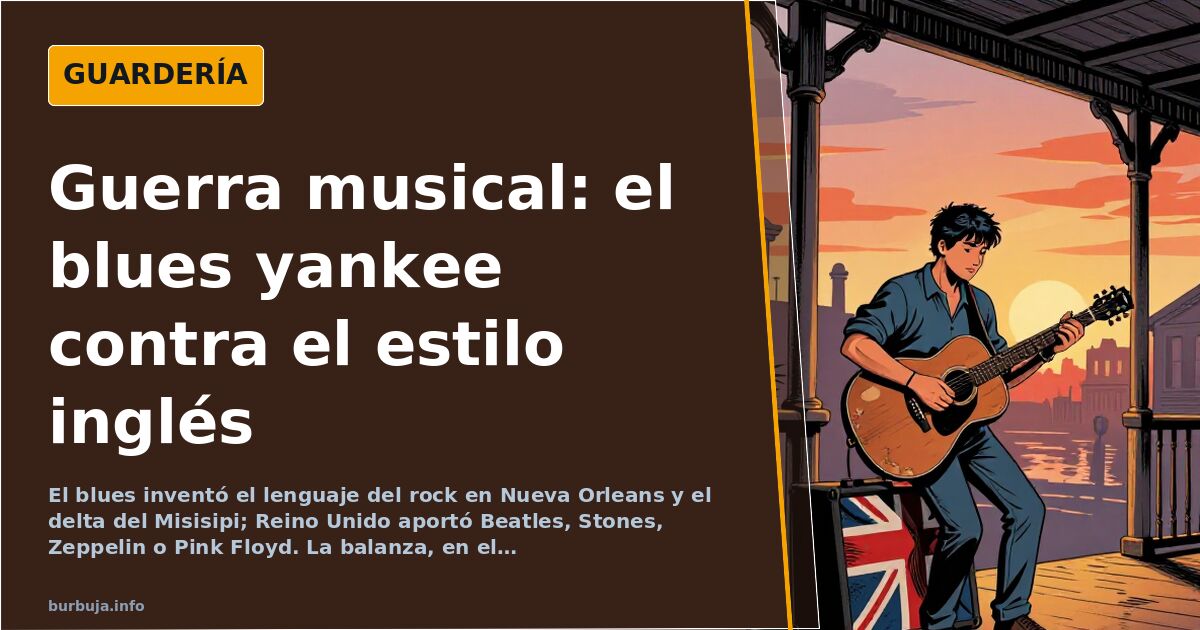
Blues invented the language; England set the accent
Rock, pop, and nearly everything heard on the radio for a century didn't start in London or Liverpool. It began in New Orleans, the Mississippi Delta, and New York. The musical framework used by every band imaginable—four-beat measures, syncopated rhythms, eight-bar phrases, AABA structures, or twelve-bar blues—was codified in the United States during the 1920s. This is the thesis behind the most uncomfortable take in the discussion: modern popular music is a simplification of structures designed to fit on a phonograph.
And yet, the majority conclusion points elsewhere. The UK takes the medal for volume, average quality, and aesthetics. The list is hard to argue against: Beatles, Rolling Stones, Led Zeppelin, Black Sabbath, Queen, Pink Floyd, The Who, Dire Straits, King Crimson. Almost nothing else compares.
The language argument: Blues as the matrix
The African-American contribution is the cornerstone. Blues and Cuban son, along with their Caribbean branches, build the substrate upon which rock and roll rises. Without that base, there is no Elvis, no Beatles, and nothing else. Some go further, arguing that American and British music are essentially transformations of Black music, and that their global success stems from talent as much as unprecedented industrial promotion.
The key nuance: experiments of the last fifty years, according to this view, merely decorate a language already invented. The creators of the language were others. This isn't a minor detail, because it shifts the axis of merit from the showcase to the foundations.
Why English bands sounded different
Here enters the juiciest hypothesis of the exchange. Sarracena rigidity in the US during the 1950s and 60s—censorship, police pressure, live interventions for public scandal—would have limited local bands' ability to experiment. In Europe, the margin was wider, translating into more creativity. The English aesthetic is also perceived as more polished compared to an American style that some audiences directly label as tacky.
The counteroffensive is solid: The Beach Boys released Today, Pet Sounds, and what leaked of Smile, and without them, the Beatles wouldn't have been who they were. Brian Wilson as a prerequisite for the British revolution. There you have it.
The US South and Southern Rock
Not all American defenders rely on historical blues. One current champions the Southern touch as the best of US production: Allman Brothers Band, Creedence, Eagles, Lynyrd Skynyrd, The Black Crowes. And in the psychedelic orbit, The Doors and Grateful Dead. The Doors divide opinion: for some, they are the headliner group; for others, they are tiring and sleep-inducing.
Elvis deserves a separate paragraph. If he is the best, it is as a crystallization of music that until then circulated in niche circuits, aimed at specific audiences or past its glory days. The versions he recorded prove this: the original material already existed and was immense.
The elephant in the room: Bach was born in Germany
The discussion breaks when someone recalls that the timeframe is too narrow. If speaking of music without qualifiers, England has developed it for centuries: Scarborough Fair, a traditional English song from the Middle Ages, still sounds today. And if the criterion is historical contribution, Bach was born in Germany, and Wagner remains contemporary to anyone putting on a record this afternoon.
The answer is predictable: the initial premise spoke of modern music, groups, and singers from the sixties onwards. Defined this way, the scales tip toward the UK. Without limits, the conversation dissolves into comparative musicology.
The fact nobody disputes
Jazz and its derivatives—swing, blues, rock—are America's greatest contribution, and electronic music and pop also draw from there. The question left hanging has no closed answer: if America invented the language and England set the accent, who gets the medal?
Rock, pop, and nearly everything heard on the radio for a century didn't start in London or Liverpool. It began in New Orleans, the Mississippi Delta, and New York. The musical framework used by every band imaginable—four-beat measures, syncopated rhythms, eight-bar phrases, AABA structures, or twelve-bar blues—was codified in the United States during the 1920s. This is the thesis behind the most uncomfortable take in the discussion: modern popular music is a simplification of structures designed to fit on a phonograph.
And yet, the majority conclusion points elsewhere. The UK takes the medal for volume, average quality, and aesthetics. The list is hard to argue against: Beatles, Rolling Stones, Led Zeppelin, Black Sabbath, Queen, Pink Floyd, The Who, Dire Straits, King Crimson. Almost nothing else compares.
The language argument: Blues as the matrix
The African-American contribution is the cornerstone. Blues and Cuban son, along with their Caribbean branches, build the substrate upon which rock and roll rises. Without that base, there is no Elvis, no Beatles, and nothing else. Some go further, arguing that American and British music are essentially transformations of Black music, and that their global success stems from talent as much as unprecedented industrial promotion.
The key nuance: experiments of the last fifty years, according to this view, merely decorate a language already invented. The creators of the language were others. This isn't a minor detail, because it shifts the axis of merit from the showcase to the foundations.
Why English bands sounded different
Here enters the juiciest hypothesis of the exchange. Sarracena rigidity in the US during the 1950s and 60s—censorship, police pressure, live interventions for public scandal—would have limited local bands' ability to experiment. In Europe, the margin was wider, translating into more creativity. The English aesthetic is also perceived as more polished compared to an American style that some audiences directly label as tacky.
The counteroffensive is solid: The Beach Boys released Today, Pet Sounds, and what leaked of Smile, and without them, the Beatles wouldn't have been who they were. Brian Wilson as a prerequisite for the British revolution. There you have it.
The US South and Southern Rock
Not all American defenders rely on historical blues. One current champions the Southern touch as the best of US production: Allman Brothers Band, Creedence, Eagles, Lynyrd Skynyrd, The Black Crowes. And in the psychedelic orbit, The Doors and Grateful Dead. The Doors divide opinion: for some, they are the headliner group; for others, they are tiring and sleep-inducing.
Elvis deserves a separate paragraph. If he is the best, it is as a crystallization of music that until then circulated in niche circuits, aimed at specific audiences or past its glory days. The versions he recorded prove this: the original material already existed and was immense.
The elephant in the room: Bach was born in Germany
The discussion breaks when someone recalls that the timeframe is too narrow. If speaking of music without qualifiers, England has developed it for centuries: Scarborough Fair, a traditional English song from the Middle Ages, still sounds today. And if the criterion is historical contribution, Bach was born in Germany, and Wagner remains contemporary to anyone putting on a record this afternoon.
The answer is predictable: the initial premise spoke of modern music, groups, and singers from the sixties onwards. Defined this way, the scales tip toward the UK. Without limits, the conversation dissolves into comparative musicology.
The fact nobody disputes
Jazz and its derivatives—swing, blues, rock—are America's greatest contribution, and electronic music and pop also draw from there. The question left hanging has no closed answer: if America invented the language and England set the accent, who gets the medal?
Summary of a discussion on Burbuja.info - Foro de economía, actualidad y política., translated from Spanish and reviewed before publication. Read the full discussion (188 replies).
More summaries
-
Lleidacel: the online persona with a language of their own
Lleidacel, a self-styled 'dalit of microcelebrities', blends invented slang with imported references. No one confirms who is behind it.
-
Looking for films about extreme isolation
Searching for movies depicting severe loneliness reveals a gap: cinema rarely captures true social isolation, with only anime and Nordic works addressing it.
-
Vigo Engineer Feels Like a Failure Despite €10,500 Savings
A 33-year-old engineer in Spain with €10,512 saved and no debt feels like a failure. We analyze his economic reality.
-
YouTuber Don Alejandro faces scandal over fake console
Spanish YouTuber Don Alejandro faces backlash for extreme content and past SUPERSEGA fraud allegations.
-
Public Perception of Spanish Infanta Sofía Analyzed
Analysis of public scrutiny on Spain's Infanta Sofía, contrasting aesthetic opinions with her institutional role.
-
Escaping a Toxic Father: The Dilemma of Leaving or Staying
A conflict with an abusive father highlights the tension between financial dependence, the cost of renting a room to leave home, and the dilemma of cutting ties versus trying dialogue.