
Escaping a Toxic Father: The Dilemma of Leaving or Staying
A conflict with an abusive father highlights the tension between financial dependence, the cost of renting a room to leave home, and the dilemma of cutting ties versus trying dialogue.
English · Original discussion in Spanish · Published
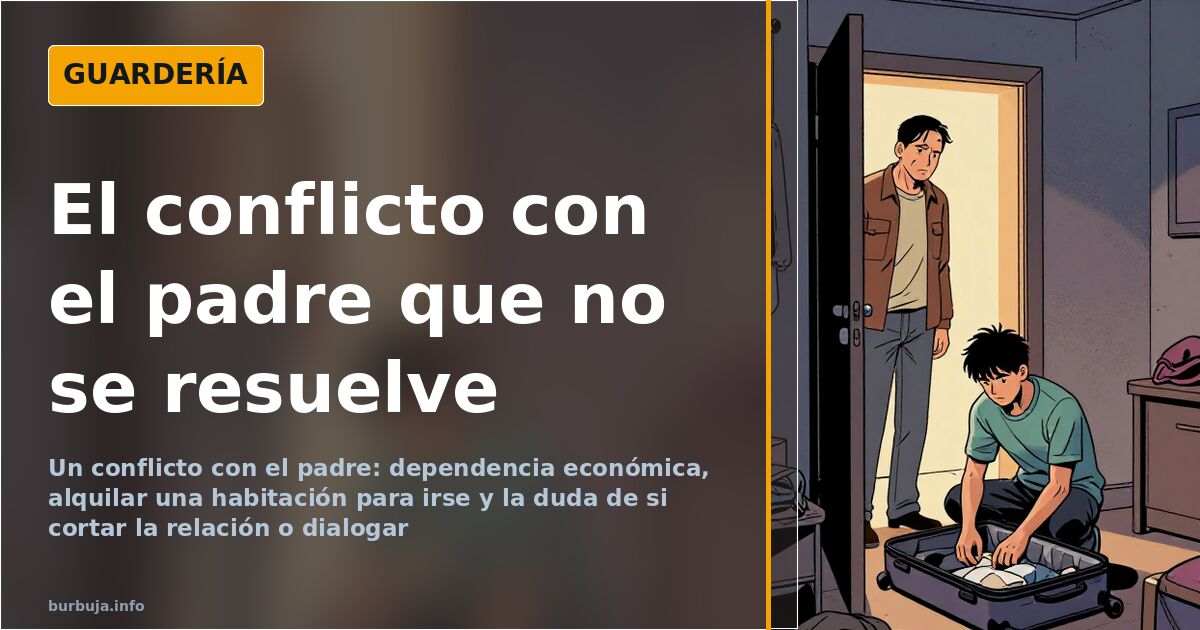
I Can't Stand My Father: Why It's So Hard to Leave Home
There comes a moment when enduring abuse stops being free. A man recounts that his father has screamed at and treated his mother with contempt "for as long as I can remember." His father worked in construction all his life, rarely goes out, doesn't drink or smoke, and hasn't bought himself clothes recently to avoid asking for money. The phrase summarizing this deadlock is simple: I can't stand my father, yet I don't leave. Around this knot—affection, antiestéticar, money, and guilt—a discussion has woven itself, traversing nearly every possible phase over time.
Why doesn't an adult son who works move out?
The first answer isn't sentimental; it's accounting-based. Some suggest renting a room instead of a full apartment: it's cheaper than moving out alone and breaks dependency sooner. Against this, there's the example of someone who left their father's house at 18 years old and, according to them, did just fine.
The argument rests on something the protagonist admits: he works, exercises, doesn't drink, barely visits bars, and saves so much he hardly goes out even in summer. With this profile, some participants argue, the barrier to leaving isn't money, but inertia and antiestéticar.
Father's Money and the Contradiction of Accepting It
Here, the tone rises. The most uncomfortable accusation directed at the author isn't about his father, but about him: hypocrisy. If you accept his money, the argument goes, you also accept his conditions. Wanting to confront him while he pays for your computer and internet connection is, to those raising this point, a contradiction.
This criticism stings because it has arithmetic logic: every bill paid by the father delays your departure. The counter-argument is dignity: one can be poor and owe nothing to anyone. Between these positions lies a reasonable nuance: breaking economic dependency first allows one to set clear boundaries later if the conflict affects third parties.
When Family Issues Derail into Another Debate
In the midst of message exchanges, the conversation jumps tracks. Suddenly, the eternal clash over immigration and the labor market appears. One side argues that foreign workers drive down wages and conditions in low-skilled sectors; the opposing view notes that employee efficiency and legality matter more than origin, blaming migrants for structural problems is a shortcut.
The exchange becomes toxic and, as almost always when this topic enters, it obscures the core issue. The original discussion—a father mistreating his vvife and children—is sidelined while a macroeconomic question none of the participants can solve is debated.
Distance or Dialogue? Two Currents
The majority current pushes for physical distance: putting miles between you, letting the relationship cool off. Opposing this is a less popular but more patient thesis: that thoughtful words spoken calmly hurt more than any blow, and leaving is the easy path one eventually regrets.
There's a third, bitterer way: that of someone who lived through something similar, recounting how it turned violent and they reported it with their mother's help. Underlying this is the protagonist's complaint: what he truly can't stand is how his father speaks to his mother. If the conflict spills over to a third party, the problem's geometry changes.
The issue remains where it started: a son who can't stand his father and a decision he still hasn't made.
There comes a moment when enduring abuse stops being free. A man recounts that his father has screamed at and treated his mother with contempt "for as long as I can remember." His father worked in construction all his life, rarely goes out, doesn't drink or smoke, and hasn't bought himself clothes recently to avoid asking for money. The phrase summarizing this deadlock is simple: I can't stand my father, yet I don't leave. Around this knot—affection, antiestéticar, money, and guilt—a discussion has woven itself, traversing nearly every possible phase over time.
Why doesn't an adult son who works move out?
The first answer isn't sentimental; it's accounting-based. Some suggest renting a room instead of a full apartment: it's cheaper than moving out alone and breaks dependency sooner. Against this, there's the example of someone who left their father's house at 18 years old and, according to them, did just fine.
The argument rests on something the protagonist admits: he works, exercises, doesn't drink, barely visits bars, and saves so much he hardly goes out even in summer. With this profile, some participants argue, the barrier to leaving isn't money, but inertia and antiestéticar.
Father's Money and the Contradiction of Accepting It
Here, the tone rises. The most uncomfortable accusation directed at the author isn't about his father, but about him: hypocrisy. If you accept his money, the argument goes, you also accept his conditions. Wanting to confront him while he pays for your computer and internet connection is, to those raising this point, a contradiction.
This criticism stings because it has arithmetic logic: every bill paid by the father delays your departure. The counter-argument is dignity: one can be poor and owe nothing to anyone. Between these positions lies a reasonable nuance: breaking economic dependency first allows one to set clear boundaries later if the conflict affects third parties.
When Family Issues Derail into Another Debate
In the midst of message exchanges, the conversation jumps tracks. Suddenly, the eternal clash over immigration and the labor market appears. One side argues that foreign workers drive down wages and conditions in low-skilled sectors; the opposing view notes that employee efficiency and legality matter more than origin, blaming migrants for structural problems is a shortcut.
The exchange becomes toxic and, as almost always when this topic enters, it obscures the core issue. The original discussion—a father mistreating his vvife and children—is sidelined while a macroeconomic question none of the participants can solve is debated.
Distance or Dialogue? Two Currents
The majority current pushes for physical distance: putting miles between you, letting the relationship cool off. Opposing this is a less popular but more patient thesis: that thoughtful words spoken calmly hurt more than any blow, and leaving is the easy path one eventually regrets.
There's a third, bitterer way: that of someone who lived through something similar, recounting how it turned violent and they reported it with their mother's help. Underlying this is the protagonist's complaint: what he truly can't stand is how his father speaks to his mother. If the conflict spills over to a third party, the problem's geometry changes.
The issue remains where it started: a son who can't stand his father and a decision he still hasn't made.
Summary of a discussion on Burbuja.info - Foro de economía, actualidad y política., translated from Spanish and reviewed before publication. Read the full discussion (184 replies).
More summaries
-
Macarena Olona posts topless selfie on the beach
Olona posts a topless selfie on the beach and the conversation focuses on sun damage, age and scrutiny of politicians' bodies
-
JL Camacho's Estimated Earnings: €60k to €340k Annually
Speculation suggests Mundodesconocido creator JL Camacho earns between €60,000 and €340,000 yearly via YouTube, merchandise, and tours.
-
Forum debate on lawyer Sandra Arévalo: fees, jokes and tangents
A forum thread mixes questions about lawyer Sandra Arévalo's fees with jokes and game theory. Her identity remains unconfirmed.
-
Looking for films about extreme isolation
Searching for movies depicting severe loneliness reveals a gap: cinema rarely captures true social isolation, with only anime and Nordic works addressing it.
-
Vigo Engineer Feels Like a Failure Despite €10,500 Savings
A 33-year-old engineer in Spain with €10,512 saved and no debt feels like a failure. We analyze his economic reality.
-
YouTuber Don Alejandro faces scandal over fake console
Spanish YouTuber Don Alejandro faces backlash for extreme content and past SUPERSEGA fraud allegations.