
WHO monitors NB.1.8.1 variant amid rising cases in Spain
WHO flags NB.1.8.1 in 22 countries as Spanish cases hit 39.4 per 100,000, though no report links the surge to this specific variant.
English · Original discussion in Spanish · Published
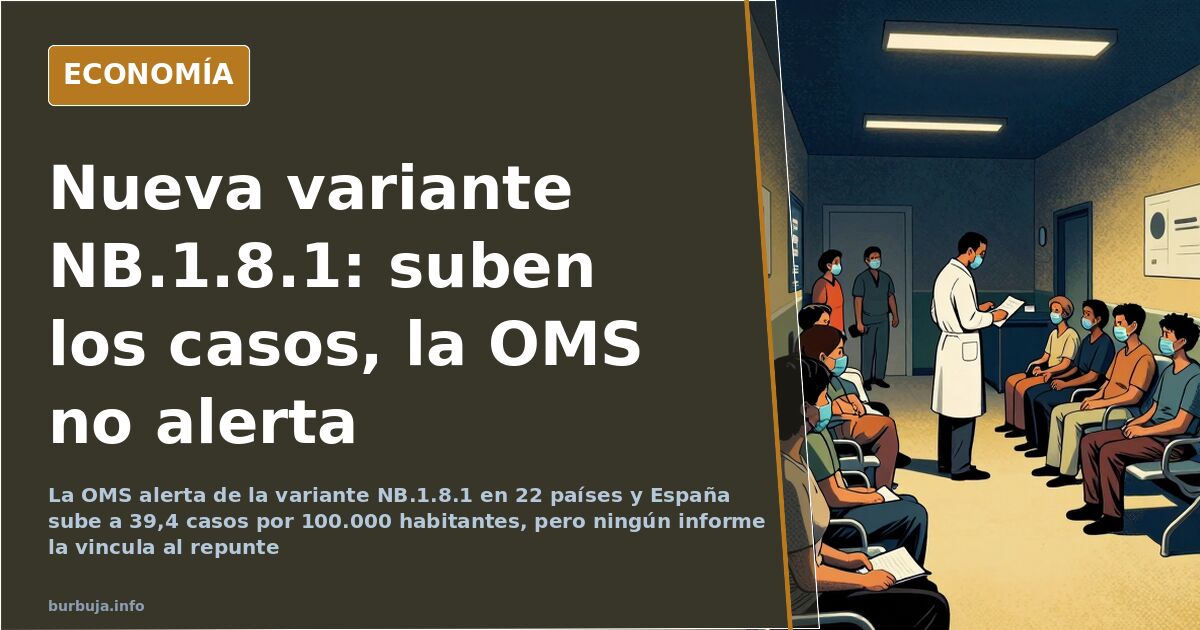
NB.1.8.1 variant drives case increases: WHO monitors but raises no alarm
Is ELbichito returning? The World Health Organization warned on May 28 of a new variant, NB.1.8.1, which is driving up infections and hospitalizations in several countries, particularly in Asia. In Spain, cases are also rising: the National Center for Epidemiology recorded 39.4 cases per 100,000 inhabitants last week, compared to 32.2 the previous week. The difference this time is that no official report links this Spanish surge to the new variant.
The pattern closely resembles that of 2020. And that is the problem: the word "pandemic" no longer mobilizes people; financial concerns do.
What the WHO says about the NB.1.8.1 variant
The WHO report from May 28 places NB.1.8.1 in 22 countries, mainly Asian ones, and suggests it could become one of the most prevalent variants in the coming weeks. Thailand and India appear as the most affected hotspots. In India, active cases have exceeded 3,000, triple the number from a week earlier, according to the Indian Ministry of Health, which aims to avoid a repeat of the second wave in 2021, when there were more than 400,000 daily infections and 4,000 deaths with the healthcare system collapsed.
However, the WHO maintains surveillance without raising an alarm: "current data does not indicate that this variant causes more severe disease than other circulating variants." In other words, more infection does not equate to more severity. ELbichito never left; we simply learned to live with it, and approved vaccines alongside immunity acquired after the pandemic reduced its incidence.
The surge in Spain is not attributed to the new variant
The Acute Respiratory Infection Surveillance System (SIVIRA) of the National Center for Epidemiology confirms the rise: from 32.2 to 39.4 cases per 100,000 inhabitants in one week. What is relevant is what it does not say. There is no information linking this increase to NB.1.8.1, leaving open the question of whether we are facing the new strain or the bicho's usual seasonal behavior.
This ambiguity fuels suspicion regarding the narrative. The figures rise, the variant name sounds like science fiction, and the headline is ready. The uncomfortable part—that the WHO sees no greater severity—is relegated to the penultimate paragraph.
Why antiestéticar no longer sells as it did in 2020
The majority reaction is weary skepticism. It is argued that media outlets thrive on antiestéticar because it is their business, and that countries are too financially strained to fund another lockdown and mass vaccination operation. The most repeated example is that of the United States tightening taxes and tariffs to balance books: if the world's largest economy scrapes where it can, no one will release funds for another global health alert.
Some go further, arguing that the machinery is indeed ready, but for a different script. The Pandemic Agreement approved by consensus at the WHO after more than three years of negotiations, and the Polaris Exercise—a pandemic simulation involving more than 15 countries and 20 health agencies—are seen as the missing pieces to repeat the move with legal cover. Law 36/2015 on National Security is also cited as the framework that would allow managing a health crisis with state coordination.
Anecdotes left by the first pandemic
The collective memory is not statistical, it is visual. An elderly person sitting alone in the square of a village with fewer than 100 inhabitants, surrounded by hectares of forest, wearing a mask. Another lowering theirs to breathe at 40 degrees, until a local police car stops and orders them to put it back on. People glaring at you for walking down the street without a mask. Rubbing hands with hydroalcoholic gel on public transport as if it were holy water.
These episodes explain better than any report why the word "variant" triggers irony today rather than antiestéticar. The lingering question is not whether NB.1.8.1 is dangerous, but whether someone will try to exploit it.
The WHO monitors, Spain adds cases without attributing them to the new strain, and Indian healthcare workers cross their fingers. Everything is set for another season of headlines. All that is missing is for someone to find the toilet paper.
Also available in: Deutsch
Summary of a discussion on Burbuja.info - Foro de economía, actualidad y política., translated from Spanish and reviewed before publication. Read the full discussion (105 replies).
More summaries
-
India rebrands as Bharat to shed colonial label
India adopts the constitutional name Bharat to reject colonial legacy, though demonym issues remain unresolved.
-
Bilbao Hospitality Closures Due to Theft and Insecurity
Bilbao bar owners close venues due to theft and insecurity in the center, amid high housing costs and degradation reaching Miribilla.
-
Musk backs post linking diversity quotas to aviation safety
Elon Musk supports a claim comparing pilot IQs with graduates of universities partnered with United Airlines.
-
PSOE ministers hold 30+ properties while attacking landlords
Spanish ministers declared over 30 properties, including seven for Isabel Rodríguez, contradicting the PSOE's anti-landlord rhetoric.
-
No Christmas this year in the heart of Europe
A viral post claims Australia, France and Germany have cancelled their New Year celebrations over Islamist terrorism. There is no official confirmation.
-
Pentagon readies bases to run 90 days without supplies
The Pentagon is preparing its bases to operate for 90 days without external power, fuel or water, while the UK recommends emergency kits for 72 hours without…