
India rebrands as Bharat to shed colonial label
India adopts the constitutional name Bharat to reject colonial legacy, though demonym issues remain unresolved.
English · Original discussion in Spanish · Published
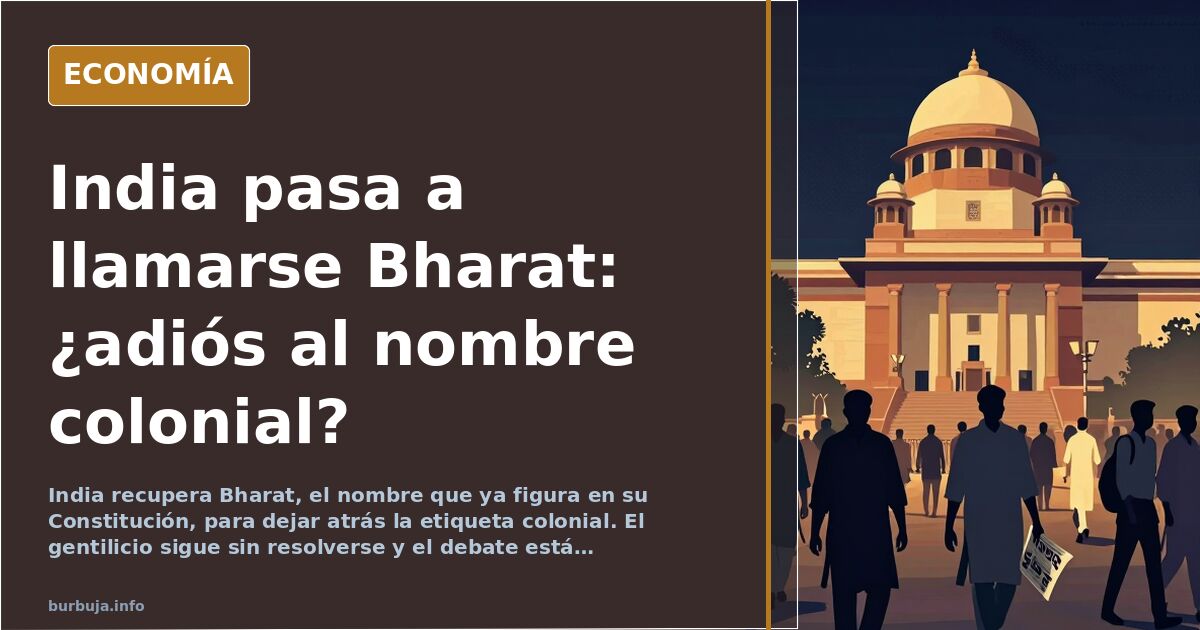
India rebrands as Bharat to erase colonial footprint
What good is being a new global superpower if your country's name was chosen by the British? India, Asia's fastest-growing economy, has decided it no longer wants to carry a label that sounds like an old map. The shift to Bharat, a term already in its Constitution, has sparked mixed reactions: from serious geopolitical analysis to outright mockery. If anything, the announcement clarified that there is no consensus on whether this is an act of cultural sovereignty or continental-scale marketing.
What Bharat means and why it isn't new
The first fact debunking half the debate: Bharat is not a recent invention. Article 1 of the Indian Constitution literally states, "India, that is Bharat, shall be a Union of States." Thus, the name now claimed as decolonizing has been in the founding text for decades. What changes is not the term, but its official usage and symbolic weight against the English-derived toponym.
Some argue that the current name, India, is merely a geographic reference to the Indus River basin, where the subcontinent's first civilization flourished. From this perspective, India is akin to what Iberia is for Spain: a territorial designation, not strictly a colonial baptism. Therefore, the discussion is not simply about "imperial imposed name" versus "recovered indigenous name."
The debate itself carries a paradox that does not go unnoticed: pre-colonial past is invoked to justify the change, yet the country maintains a centuries-old and fully active caste system. For many analysts, the contradiction between rejecting external heritage while preserving internal hierarchy is the most uncomfortable aspect of the entire operation.
The demonym, the big unsolved problem
Changing the country's name is the easy part. The complication arises when deciding what to call its inhabitants. Bharatis? Baratiens? No one is sure, and this vagueness proves the rebranding was launched without a linguistic roadmap. In other languages, wordplay is inevitable; the term evokes discounts and bazaars, turning any demonym into a potential joke.
Comparisons with other cases help understand the magnitude of the mess. Hungary coexists with Magyarország and has renounced neither. The Philippines flirted with recovering Maharlika, a name that only makes sense as a shared identity due to the unification brought by Spanish administration of the 7,000 islands. Colonial names are sometimes the only mortar holding together a territory that was never unified.
Reaction: from geopolitics to banter
The announcement generated two clear currents. One part of the analysis reads it as a logical move by a power wanting to align its external brand with its internal narrative. Another interprets it as a cosmetic gesture: the name changes, but the power structure, inequalities, and caste system remain exactly the same. Then there is the third, noisiest path: those who take it as a joke, turning the rebranding into a festival of puns.
At this crossroads appears a fundamental question transcending India: does a country have the right to call itself whatever it wants? The obvious answer is yes. The less obvious is what happens when that name collides with centuries of international usage, established demonyms, and regional geography that doesn't correspond to just one country. The Hindustan peninsula will keep its name even if the state occupying it changes its label.
What might happen next with India's name
As of this discussion, the change is a political and symbolic gesture with constitutional backing, but lacks a clear roadmap for practical application. International usage, multilateral bodies, and media will de facto decide how long it takes for Bharat to replace India in common language. Recent history suggests these rebrandings take years to stick, and often both names coexist for decades.
What has become clear is that the operation served an unexpected purpose: putting on the table the relationship countries have with their names, imperial pasts, and internal contradictions. India wants to be Bharat. It remains to be seen if the world is willing to call it that.
Also available in: Deutsch
Summary of a discussion on Burbuja.info - Foro de economía, actualidad y política., translated from Spanish and reviewed before publication. Read the full discussion (107 replies).
More summaries
-
Spain's Gender Violence Law Repeal Linked to State Breakup
Repealing Spain's gender violence law (LIVG) faces a constitutional hurdle: the 2008 ruling by seven votes to five blocks simple repeal.
-
AI as an economic engine: bubble or structural shift?
Economic analysis of AI: Is it the growth engine or a speculative bubble? Energy costs and business adoption are examined.
-
COPE and Vozpópuli Report Begoña Gómez Listed on Spanish Socialist Party Ballots
COPE and Vozpópuli claim Begoña Gómez will be on the PSOE list to secure parliamentary immunity. This changes the court, not the charges, and the nature of the trial.
-
July 22 and Trump's messianic numerology prediction
A prediction based on the Hebrew calendar claims Trump will trigger an event on July 22. How much truth is there to it?
-
Moral superiority: the debate over pursuing pickpockets in Barcelona
The arrest of a pickpocket on the Barcelona metro sparks a debate over justice, morality and economic costs. Two opposing views on how to treat…
-
Drones for everything except putting out fires
Using drone swarms to fight wildfires sounds great, but evaporation and turbulence make it unworkable. The solution? Boeing 737 air tankers.