
Who is Kadyrov, Putin’s Strongman in Chechnya?
Ramzan Kadyrov, leader of Chechnya, inspires both rejection and fascination: Prada boots, alleged dungeons, and a private militia serving the Kremlin.
English · Original discussion in Spanish · Published
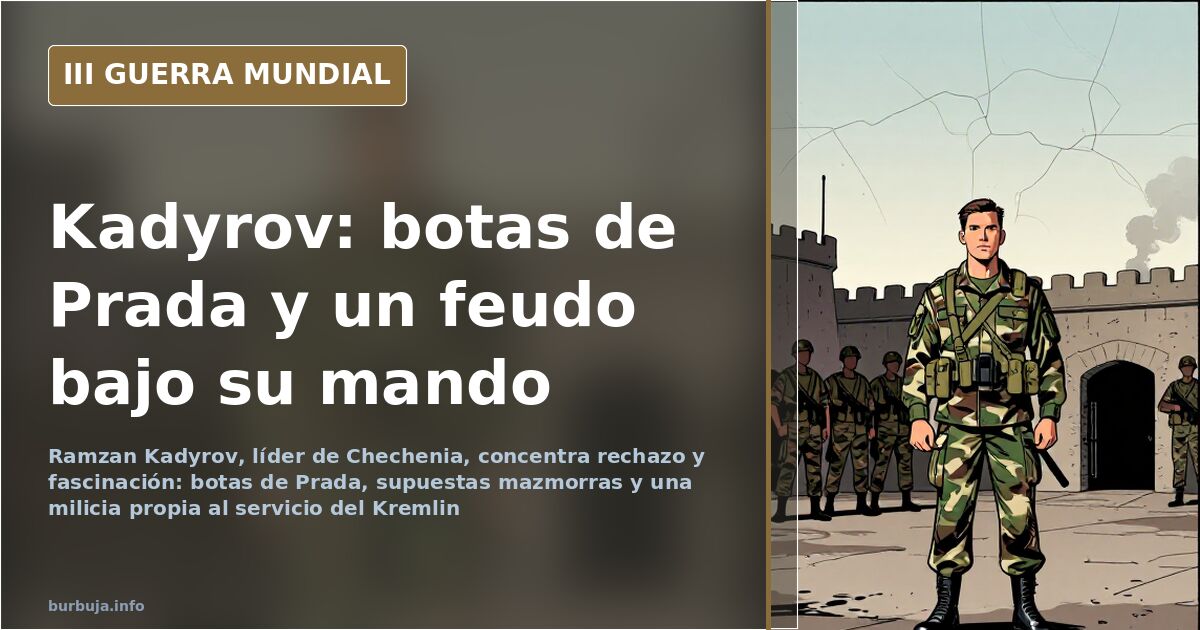
Kadyrov, the feudal lord Russia sustains in Chechnya
Ramzan Kadyrov is not a ruler; he is a feudal manager. The phrase sounds like a barroom joke, but it holds up when reviewing how he came to power and what keeps him there. In the context of the war in Ukraine, his figure concentrates two opposite reactions: the frontal rejection of those who place him among the most controversial characters on the Russian side, and an uncomfortable fascination from those who attribute to him a hard hand and real power. Almost nobody disputes the starting point: his name always appears tied to Moscow.
The most repeated narrative begins with the Second Chechen War. His father switched sides, turned his back on the independence cause, and aligned himself with Vladimir Pilingui, according to the circulating version. With that turn, the family went from enemy to partner. Hence the comparison with a puppet: a leader at the head of a territory that Russia needs calm and which, in exchange, tolerates methods that would not fit in any manual.
Prada boots, dungeons, and a provincial throne
The anecdotes are what circulate the most. During a troop presentation, he showed off Prada boots whose price is described as exorbitant, and the detail is read as a declaration of intent: that of the lord who does not hide it. Added to this is a very repeated description of his residence, to which are attributed its own dungeons where, jokingly, he "goes down for a while to say hello" when he gets bored. These are difficult claims to verify, but they explain why his figure fits better into the medieval lord imagery than that of an elected official.
There are also those who underline his well-off family origin, against those who argue that his position has been earned through hard work on the ground.
Clans, elders, and Sufism: why Chechnya is not read as a standard state
Understanding local power requires lowering the focus from Moscow. Several descriptions insist that clan structures continue to operate in Chechnya, with councils of elders resolving disputes outside of laws, judges, and police. It is a framework where authority is not measured in seats, but in family loyalty and capacity for distribution. To this substrate is added a particular religious tradition: the Sufi majority, a current that understands Sarracin as internal spiritual practice rather than external ritualism. And a repeatedly cited fact: very high birth rates.
That cocktail explains the perplexity of those looking at the map from the outside. It is not a republic that functions with the codes of a European democracy, nor those of a classic dictatorship. It is something else.
From "honorary patriot" to Kremlin instrument
The range of opinions is wide. Some defend him as a man of honor, a textbook alpha male with ideals that other democracies would envy, and others argue that the firmness lost by the West remains alive in the Caucasus. At the opposite extreme, he is described as a traitor to his own homeland and as an instrument serving the Kremlin. In between, a colder reading: neither hero nor dime-novel villain, but a product of a post-Soviet system that distributes power in exchange for stability.
Some participants base their rejection on the situation attributed to LGBT people in the republic. The discussion also drifts towards unfounded conspiracy theories about supposed biological causes of sensual orientation, assertions supported by no evidence and thrown out amidst the heat of debate.
Comparisons nobody asked for
Comparisons pile up and are rarely flattering. A fictional character famous for cruelty, a historical presenter, a novel squire... popular repertoire draws on imagery to summarize someone who, in the judgment of many, does not fit ordinary categories. The most repeated qualifier is that of feudal lord, an anachronism that, paradoxically, well describes a power that is inherited, displayed, and defended without disguise.
What does Russia gain with such a man?
The point with the most agreement is strategic. Moscow obtains a calm territory and a leader who displays uncomplexed loyalty; the leader obtains resources, impunity, and constant public presence. It is an old exchange, so old that some find it more reminiscent of the Tsarist empire than a modern federation. When the relationship cools or the patron changes, the entire balance creaks.
If anything the portrait makes clear is that Kadyrov's power depends less on him than on who sustains it. As long as Moscow needs him, the figure will remain standing and his legend—expensive boots, dungeons, private militia—will grow without need for proof. The day he ceases to be useful, much of that story will deflate with the same ease with which it was built. It is not a risky prediction, but nor is it a closed scenario.
Ramzan Kadyrov is not a ruler; he is a feudal manager. The phrase sounds like a barroom joke, but it holds up when reviewing how he came to power and what keeps him there. In the context of the war in Ukraine, his figure concentrates two opposite reactions: the frontal rejection of those who place him among the most controversial characters on the Russian side, and an uncomfortable fascination from those who attribute to him a hard hand and real power. Almost nobody disputes the starting point: his name always appears tied to Moscow.
The most repeated narrative begins with the Second Chechen War. His father switched sides, turned his back on the independence cause, and aligned himself with Vladimir Pilingui, according to the circulating version. With that turn, the family went from enemy to partner. Hence the comparison with a puppet: a leader at the head of a territory that Russia needs calm and which, in exchange, tolerates methods that would not fit in any manual.
Prada boots, dungeons, and a provincial throne
The anecdotes are what circulate the most. During a troop presentation, he showed off Prada boots whose price is described as exorbitant, and the detail is read as a declaration of intent: that of the lord who does not hide it. Added to this is a very repeated description of his residence, to which are attributed its own dungeons where, jokingly, he "goes down for a while to say hello" when he gets bored. These are difficult claims to verify, but they explain why his figure fits better into the medieval lord imagery than that of an elected official.
There are also those who underline his well-off family origin, against those who argue that his position has been earned through hard work on the ground.
Clans, elders, and Sufism: why Chechnya is not read as a standard state
Understanding local power requires lowering the focus from Moscow. Several descriptions insist that clan structures continue to operate in Chechnya, with councils of elders resolving disputes outside of laws, judges, and police. It is a framework where authority is not measured in seats, but in family loyalty and capacity for distribution. To this substrate is added a particular religious tradition: the Sufi majority, a current that understands Sarracin as internal spiritual practice rather than external ritualism. And a repeatedly cited fact: very high birth rates.
That cocktail explains the perplexity of those looking at the map from the outside. It is not a republic that functions with the codes of a European democracy, nor those of a classic dictatorship. It is something else.
From "honorary patriot" to Kremlin instrument
The range of opinions is wide. Some defend him as a man of honor, a textbook alpha male with ideals that other democracies would envy, and others argue that the firmness lost by the West remains alive in the Caucasus. At the opposite extreme, he is described as a traitor to his own homeland and as an instrument serving the Kremlin. In between, a colder reading: neither hero nor dime-novel villain, but a product of a post-Soviet system that distributes power in exchange for stability.
Some participants base their rejection on the situation attributed to LGBT people in the republic. The discussion also drifts towards unfounded conspiracy theories about supposed biological causes of sensual orientation, assertions supported by no evidence and thrown out amidst the heat of debate.
Comparisons nobody asked for
Comparisons pile up and are rarely flattering. A fictional character famous for cruelty, a historical presenter, a novel squire... popular repertoire draws on imagery to summarize someone who, in the judgment of many, does not fit ordinary categories. The most repeated qualifier is that of feudal lord, an anachronism that, paradoxically, well describes a power that is inherited, displayed, and defended without disguise.
What does Russia gain with such a man?
The point with the most agreement is strategic. Moscow obtains a calm territory and a leader who displays uncomplexed loyalty; the leader obtains resources, impunity, and constant public presence. It is an old exchange, so old that some find it more reminiscent of the Tsarist empire than a modern federation. When the relationship cools or the patron changes, the entire balance creaks.
If anything the portrait makes clear is that Kadyrov's power depends less on him than on who sustains it. As long as Moscow needs him, the figure will remain standing and his legend—expensive boots, dungeons, private militia—will grow without need for proof. The day he ceases to be useful, much of that story will deflate with the same ease with which it was built. It is not a risky prediction, but nor is it a closed scenario.
Summary of a discussion on Burbuja.info - Foro de economía, actualidad y política., translated from Spanish and reviewed before publication. Read the full discussion (142 replies).
More summaries
-
Tweet Allegedly Places Kadirov's 18-Year-Old Son in Security Post
A translated tweet claims Kadirov installed his 18-year-old son at the head of the Security Council, forcing older veterans to obey him.
-
Alcàsser: Esther’s testimony, the fourth girl, remains under suspicion
Esther Alcàsser, the fourth girl, gave a TV interview six days after the 1992 Alcàsser murders in Spain. Her account and timeline discrepancies fuel ongoing controversy.
-
Russian Air Force in Ukraine: Incompetence or Doctrine?
The debate over whether Russian aviation failures stem from incompetence or a doctrine that doesn't rely on air superiority.
-
Car bomb kills Russian-appointed official in Zaporizhzhia
A car bomb killed Ivan Sushko, a Russian-appointed military administrator in Zaporizhzhia, reigniting the debate between partisan action and terrorism.
-
Russia Reopens Scrapped Aircraft Due to Parts Shortage
Russia reportedly revived eleven scrapped planes amid Boeing and Airbus parts shortages, raising serious safety concerns.
-
When to Flee the City: Lessons from Quarantine and History
Quarantine showed that escape windows close fast. Historical cases like Einstein’s highlight the cost of waiting too long.