
WhatsApp and TikTok calls to burn streets ahead of Halloween
Anonymous calls on WhatsApp and TikTok summon riots and looting in Valencia and Madrid for Halloween, gathering over 600 members in less than 24 hours.
English · Original discussion in Spanish · Published
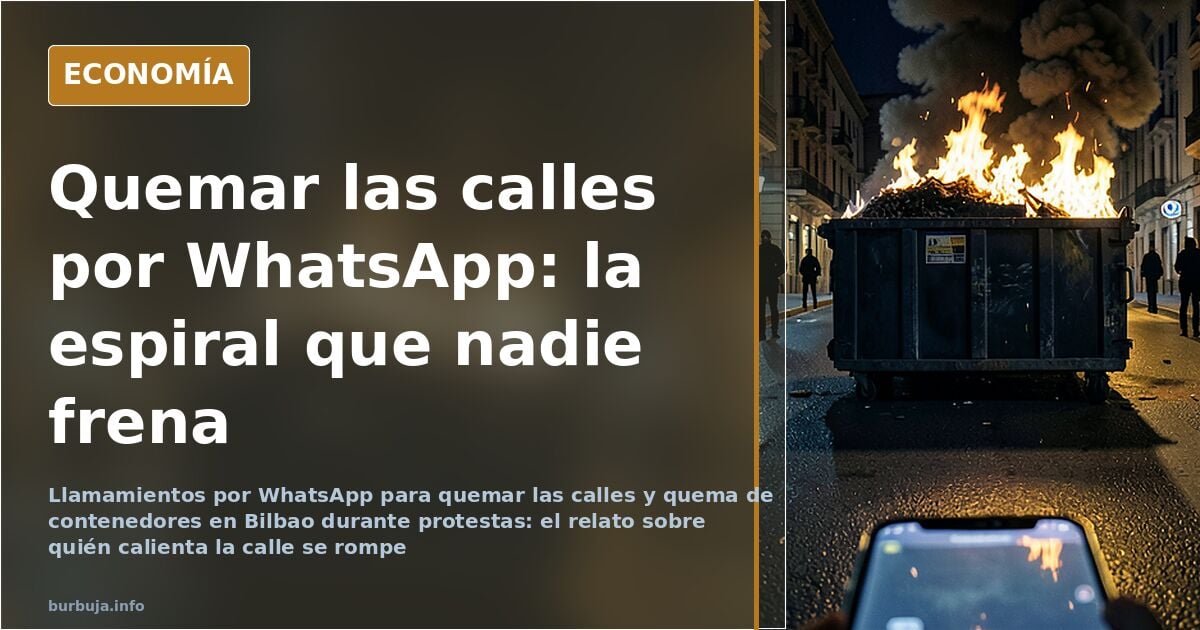
Calls to burn the streets spread across WhatsApp and TikTok
Who is calling for burning bins and motorbikes in the middle of city centres? In late October, several calls spread through WhatsApp, TikTok and other social media circulated with slogans calling for urban riots, shop looting and burning of street furniture in Valencia and Madrid. The gathering was dubbed «Blocus» and targeted Generation Z with the argument of protesting «against cuts to education». The messages amassed hundreds of members in less than 24 hours, and polls circulated about which shops to loot, tips on wearing balaclavas and gloves, and even instructions for making homemade bombs. In parallel, another message attributed the organisation of the same riots to far-right groups.
From WhatsApp to TikTok: how a riot is organised via messaging apps
The pattern described in the reports gathered is that of a decentralised call to action. Two platforms gathered **more than 600 members in less than 24 hours**, according to the figures that circulated, and the administrators stay in the shadows: anonymous profiles reviving the slogan of previous riots in other European capitals. The Madrid gathering set the afternoon of **Saturday 31 October** as the date to «burn the streets of the capital».
The playbook is familiar: blocking streets with bins and motorbikes, looting shops and covering the face. What stands out is the wrapping: a protest over education cuts that, in practice, turns into burning street furniture and storming multinational stores. The gap between the stated motive and the method is, to say the least, telling.
The double attribution: far right against radicals and radicals against the far right
The call to action spawned a twin narrative. A message forwarded on WhatsApp warned recipients to avoid the centre of Valencia over «possible looting» and blamed «far-right and radical groups» for the attacks. The same scene, two different culprits depending on who tells it.
Some claim the real goal is to stir up the streets ahead of elections and take votes away from the left; others argue exactly the opposite, that violence wears down those who engage in it and that waiting is the smarter play. And a third, more cynical view points out that the most troubled areas of the Community of Madrid are concentrated in the Corredor del Henares (a densely populated corridor east of Madrid), with Torrejón and Alcalá cited as examples, and that blaming a single side falls short of the truth.
The firewall nobody deploys
The question hanging over all this is not who is burning things, but why the call spreads unchecked. A WhatsApp message with instructions for looting shops takes minutes to reach hundreds of people; the institutional response, when it comes, is a press release. The asymmetry is brutal.
Meanwhile, the «Blocus» slogan is being replicated in Valencia and Madrid with the same manual and the same anonymous aesthetic. Whether there is a political organisation behind it, a group of agitators or simply imitators of what was seen in France and Barcelona is, at this point, beside the point. What there is, is a format that works and that no one has managed to switch off.
In the end, the only certainty is that on 31 October someone will park their motorbike in the street. And that the blame, depending on who you ask, will always lie with the other side.
Also available in: Deutsch
Summary of a discussion on Burbuja.info - Foro de economía, actualidad y política., translated from Spanish and reviewed before publication. Read the full discussion (35 replies).
More summaries
-
School reprimand for racism in Madrid sparks discipline debate
A school disciplinary report over a racist comment at a Madrid high school reignites debates on teacher authority and double standards.
-
Tenant Union of Sol: a network with €3.7 million
The Tenant Union of Sol is part, according to a published report, of a network that would have received €3.7 million from Socialist administrations.
-
Only one Spanish-speaking country in the IMO 2026 top 30
The IMO 2026 leaves Peru as the only Spanish-speaking country in the top 30. Spain ranks 48th, Brazil 11th. Is it a talent shortage or a lack of a talent pipeline?
-
Spain's Sánchez and the jinx theory: Franco, blackouts and trains
A volcano, Filomena, the Valencia floods and a blackout in three years fuel the jinx theory. The real debate isn't supernatural: it's about management and energy decisions.
-
Lula wins Brazil and the right cries fraud without evidence
Lula wins Brazil's election and the right cries fraud without evidence. Congress falls to the right and the stock market plunges sharply.
-
Jennycop, Charocop and the police narrative that doesn't add up
The Jennycop label and its evolution into Charocop are driving a debate on urban safety in Spain that mixes memes, science fiction and a Paris video with no evidence behind it.