
Lula wins Brazil and the right cries fraud without evidence
Lula wins Brazil's election and the right cries fraud without evidence. Congress falls to the right and the stock market plunges sharply.
English · Original discussion in Spanish · Published
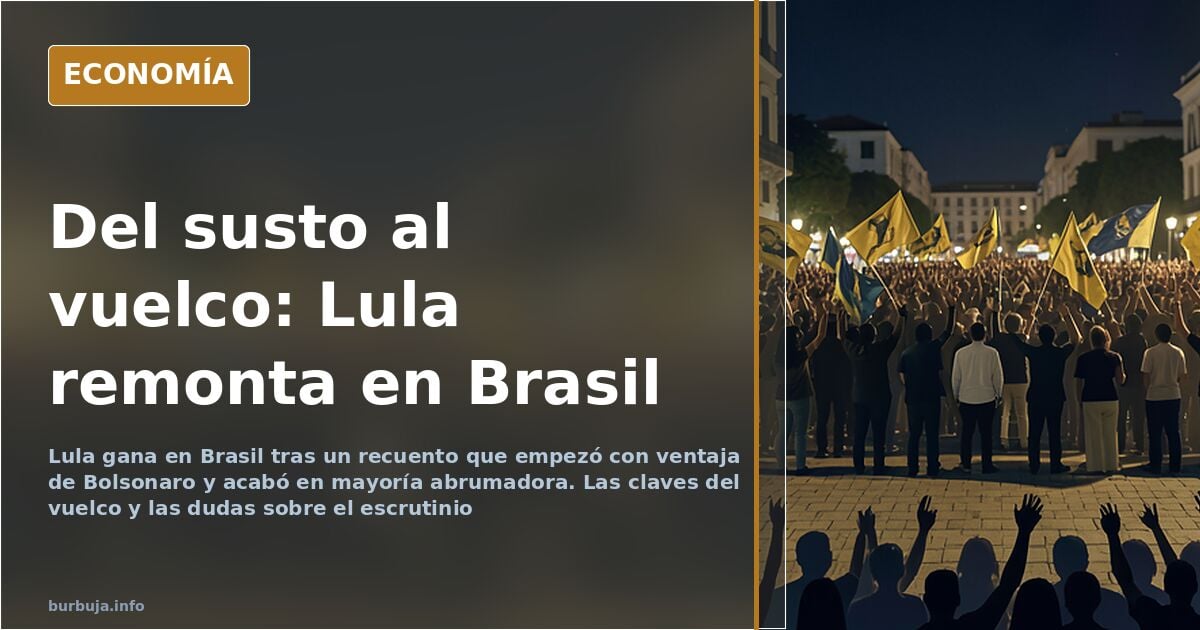
Lula returns to Brazil's presidency as the right cries fraud without evidence
Lula da Silva has won Brazil's election. The right refuses to accept it and talks of a rigged vote. There is no evidence. What there is, is a country split in two, a Congress dominated by the right, and an economy on edge. The fraud debate is noise; the real fact is that Brazil is swinging back to the left with a hostile parliament.
The fraud nobody can prove
The fraud theory circulates with no basis. It is claimed that in the first round Flavio Bolsonaro was ahead and that in the second Lula won an overwhelming majority. That is not fraud: it is an electoral swing. Partial results came in earlier from the Northeast states, Lula's stronghold, and that fueled suspicion. But the count went ahead as normal. There is no formal complaint backed by evidence. There are tweets and there is outrage.
Bolsonaro himself had already threatened not to recognize the result if he lost. In 2021 he said he would suspend elections if the electoral system were not changed. Now his son Flavio denounces an alleged plot. The storytelling machine works: first sow doubt, then shout fraud. Without evidence.
A Congress against him
Lula will govern with the most right-leaning Congress in 40 years, according to one participant. Most of the elected governors are conservative. In the state of São Paulo, the most populous, the right-wing candidate beat Bolsonaro by ten points. That means Lula will not have a free hand. His victory is a pyrrhic one. The left returns to power, but real power is fragmented.
The economy reacted with falls. The Brazilian stock market posted its biggest drop since the pandemic and the dollar soared, according to a cited tweet. The wealthy are moving money to Spain, Italy, Portugal and Switzerland. It is not a mass exodus, but it is a signal. The market does not believe in Lula's project. Or does not like it.
The country that never gets fixed
Brazil is a country of brutal contrasts. It has 200 million inhabitants and only two real options: Lula or Bolsonaro. That says a lot about the political system. Corruption is structural. Judges wield excessive power. Civil servants retire with million-dollar pensions. And inequality remains a heavy burden.
Lula's victory does not change that. His first announcement was to regulate social media. The right sees it as censorship. The left calls it protection of democracy. In between, a country that never quite gets going. Brazil is the country of the future, and always will be.
Lula has won. The right refuses to accept it. The market trembles. Congress blocks. And Brazil remains Brazil. If we have learned anything, it is that elections do not fix a country. They only change the occupant of the palace.
Also available in: Deutsch
Summary of a discussion on Burbuja.info - Foro de economía, actualidad y política., translated from Spanish and reviewed before publication. Read the full discussion (389 replies).
More summaries
-
Brazil's Liberal Party concedes defeat to Lula
Brazil's Liberal Party has recognized Lula's victory while Flavio Bolsonaro has reportedly left the country for the US and his father remains in prison.
-
Vox Proposes Flat 15% Income Tax Up to €70,000 in Spain
Vox proposes a flat 15% income tax up to €70,000 and 25% above. Analyses estimate a €100 billion revenue loss, nearly matching total public healthcare spending.
-
Detainees' profile reopens Spain's migration debate
Most of those arrested in the riots are second-generation Spaniards with Moroccan parents, a pattern mirroring France's and reopening the migration debate.
-
Spain's Podemos drops its logo, runs on 'Irene' alone for 29N election
Podemos has removed its name and logo from its 29N ballot in Spain: only 'Irene' and the slogan 'Peace, housing and work' remain. Housing and the cost of living dominate its programme.
-
Fátima Báñez, former Spanish minister, missing after train crash
Former Labour Minister Fátima Báñez was travelling on the Iryo train in the Urda crash in Spain, which left 50 dead. Her family has been unable to reach her since 08:35.
-
Debate over a psychology graduate and her views on men
A forum discusses the hostile views on men attributed to a newly graduated psychologist in Spain and the possible ideological bias in the profession.