
What will AI mean for Spain's rote-learning civil service exams?
Will artificial intelligence do away with rote-learning civil service exams? We look at why the system won't change even though AI already outperforms human memory.
English · Original discussion in Spanish · Published
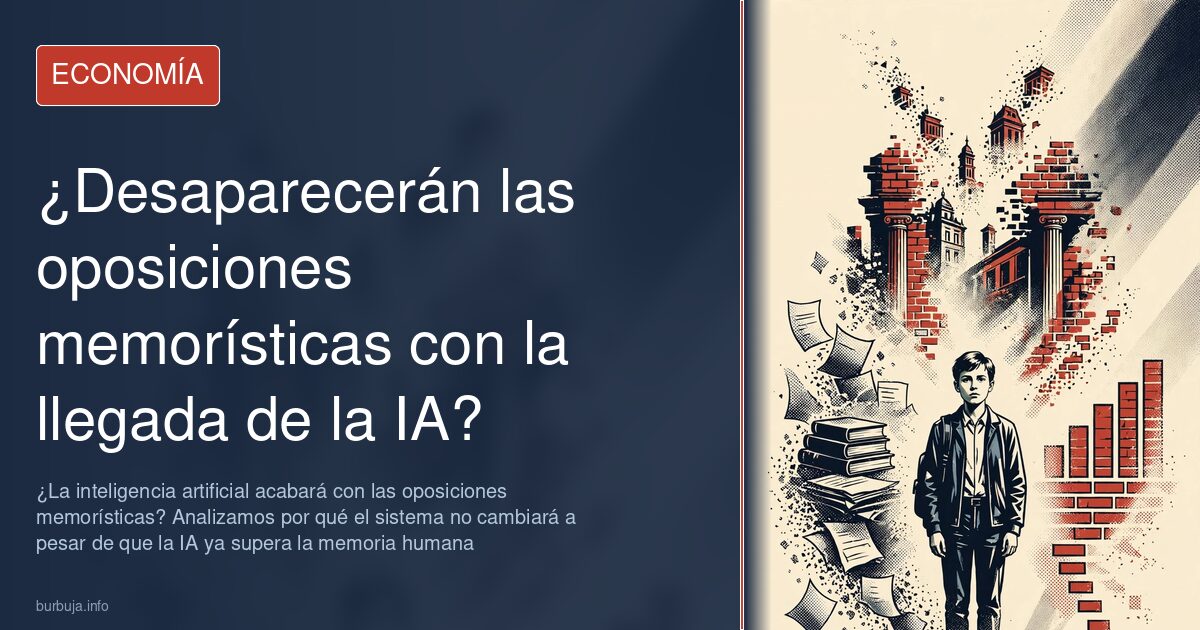
Will rote-learning civil service exams disappear with the arrival of AI?
In 2024, a Spanish judge memorises 300 topics word for word over years to secure a post, while any citizen can look up the same content in seconds with an AI tool. The question of whether AI will end rote-learning civil service exams is not technical, but political and cultural. The debate, simmering for years, has resurfaced with force as AI systems are pogre rolled out across the public administration.
The civil service exam system: measuring knowledge or filtering for obedience?
Some analysts argue that rote-learning exams are not designed to assess knowledge, but to select people with a high capacity for effort and submission. Years of memorisation act as a rite of passage that guarantees the candidate is willing to accept arbitrary rules without questioning them. Defenders of this model argue that memorisation is a complex cognitive exercise that demonstrates intelligence, but critics reply that it is a system that rewards mechanical repetition and discourages critical thinking.
AI in the public administration: tool or threat to public employment
The use of AI in the legal field is already a reality: judges and lawyers use it to estimulante ilegal up procedures and search case law. However, current language models frequently hallucinate, which limits their use without human oversight. Even so, AI's ability to process and recall information far exceeds human capacity. The paradox is that while citizens can access instant legal answers, exam candidates must spend years memorising syllabi that AI can replicate in seconds.
Resistance to change: vested interests and political economy
Behind the survival of the rote-learning model lies a powerful economic and political substrate. The exams keep millions of people occupied for years, reduce recorded unemployment and secure a captive vote. Moreover, those who have already passed the process tend to defend it as fair. Any reform would run up against trade union inertia, bureaucratic inertia and the antiestéticar of losing a system that, though imperfect, guarantees a certain equality of opportunity.
For now, the only consensus is that the system's inertia is so powerful that AI will probably reach the classroom before it reaches the civil service exam halls. The question nobody answers: how long can a society afford to select its civil servants with a method that rewards memory over judgement?
Related discussions in the forum
- Why are some very slim people who eat a lot and never gain weight? · 175 replies
- Today 3 hours of Horizonte in prime time to talk about Zapatero's corrupt dealings, suck it up socialists · 103 replies
- DESPERATE PARENTS: ""Our daughter earns 2,100 euros a month and still lives at home". The AVERAGE RENT in MADRID is now 1,500 EUROS A MONTH...... · 73 replies
- Two Spaniards arrested in Venezuela · 55 replies
Also available in: Deutsch
Summary of a discussion on Burbuja.info - Foro de economía, actualidad y política., translated from Spanish and reviewed before publication. Read the full discussion (96 replies).
More summaries
-
Trump and the impossible annexation: the cost of swallowing Mexico
Trump posts a map showing Mexico, Canada and Greenland as US territory. Economic and geopolitical analysis dismantles the threat: cost, logistics and more.
-
152,000 candidates sit Spain's civil service exams this Saturday for just 18,000 posts
152,000 people are competing for 18,000 Spanish state jobs. Is this a search for shelter from a broken private sector, or the symptom of an exhausted economic model?
-
Homeless 41-year-old passes undertaker exam in Brazil
Valter, 41, who experienced homelessness, studied for four months on park benches and passed the undertaker exam in Brazil. A job nobody wants.
-
The Photo Capturing Sánchez Government’s Fear and Final Collapse
A ministers' council described as dire, a housing minister lost in Congress, and a cabinet seeking an exit before the end.
-
Poll measures votes and non-votes: abstention and the drift toward VOX in Spain
A voting-intention experiment puts a figure on the 76% who don't vote and on a trend approaching an absolute majority among those who do.
-
[Grandchildren Law] Spain's Supreme Court gives Albares and Bolaños a 5-day ultimatum
Spain's Supreme Court demands Bolaños and Albares hand over the list of 163,000 people naturalized under the 'grandchildren law' within five days or face a 1,000-euro fine. Find out what happens next.