
What to wish for when everything you want is multiplied by ten
A thought experiment about having a wish multiplied by ten turns into a catalogue of dangerous desires: cocaine, blood extraction and poison
English · Original discussion in Spanish · Published
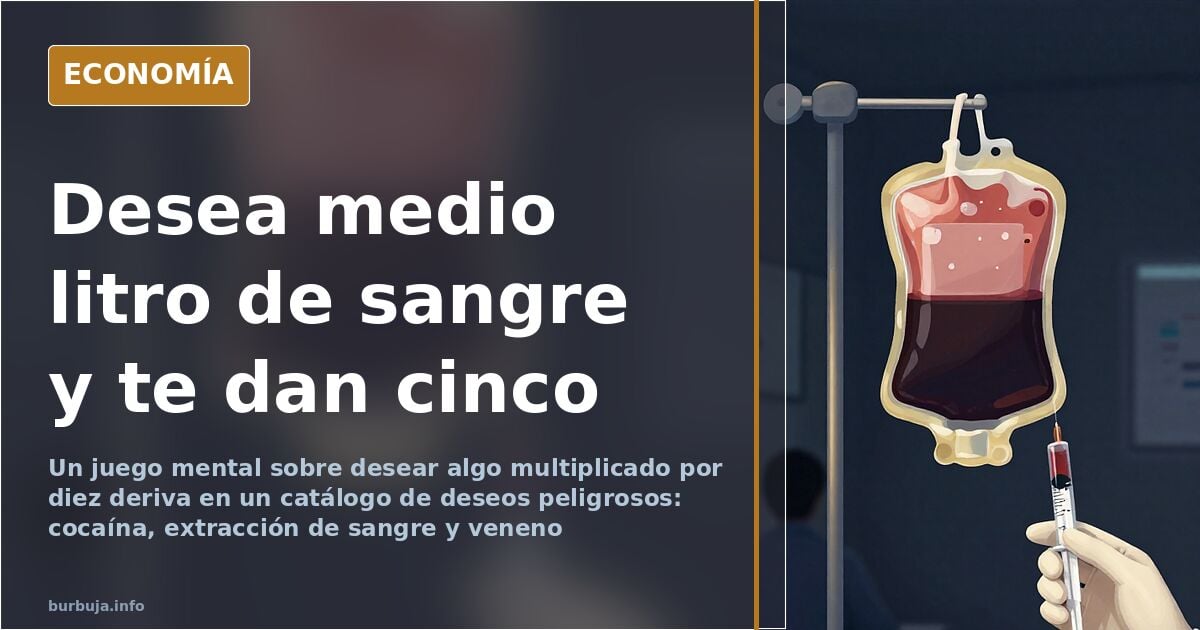
The multiplied wish game: half a litre of blood for a sandwich
A gram of cocaine in one go. Half a litre of blood drawn. Half the lethal dose of any poison. The premise was simple —you can have whatever you want, but it will be given to you multiplied by ten— and several answers were not asking for money or houses, but wishing for controlled harm. The thought experiment, launched on a forum, turned into a series of dangerous wishes before someone pointed out that the multiplier also works with good things.
The mechanics are the usual ones: a genie, a trap contract, fine print. Except here the fine print was written by the wisher themselves. Asking for a gram of cocaine means ten grams, which is a textbook overdose. Asking for half a litre of blood means five litres, which is roughly the entire blood volume of an adult. The game does not reward ambition: it rewards reading carefully.
The calculation nobody did before wishing
The first answer that lands is from someone who has already done the reverse calculation. Donating blood once in a lifetime, at the barracks, in exchange for a sandwich and a soft drink: that is the reference price. If you got that for half a litre, the compensation for five litres should be ten times greater. Charity has an exchange rate, and someone was applying it in real time while the others were asking for poison.
There lies the interesting twist. Several of the initial answers are not looking for pleasure: they are looking for a way out. Losing five kilos. A stroke, but a tiny one. Half the lethal dose of any toxin. These are wishes from people who, deep down, want something external to solve an internal problem without having to do the work. The tenfold multiplier turns each wish into a sentence, and yet they ask for it anyway.
When the multiplier is applied to good things
The second half of the conversation changes tack. Someone points out that the problem is not the multiplier but the direction of the wish: if you ask to be covered up to your waist in gold coins, the result is a mountain of gold that will probably crush the requester. The conclusion that imposes itself is that the contract is designed to punish greed and only spares those who ask for little and well.
The logical corollary —asking for something small and valuable, not something big and dangerous— appears late and in dribs and drabs. The conversation gets tangled up in scatological variants and a detour about the size of the original wish that nobody closes. The underlying question is left hanging: if the genie exists, why does nobody ask him to make the multiplier work in reverse?
Under these rules, the rational thing would be to wish for a one-euro coin and collect ten. Nobody seriously proposed it. Human beings prefer drama to arithmetic.
Also available in: Deutsch
Summary of a discussion on Burbuja.info - Foro de economía, actualidad y política., translated from Spanish and reviewed before publication. Read the full discussion (16 replies).
More summaries
-
Blood donation: altruism, ideology and a multimillion-dollar industry
Free blood, big business: the controversy over ideology and donor compensation at blood donation centres.
-
Venezuelan Gold Delivered to Spanish Officials: UCO Probes PSOE Funding
Gold coins and bars allegedly delivered by Venezuelan officials in 2020 are under investigation for potential illegal funding of the Spanish Socialist Party.
-
Immigrants Don't Donate Blood: Myth or Reality?
Burbuja forum debate on immigrant blood donations, healthcare saturation, and declining local donor engagement in Spain.
-
NGO attempts to block filming of migrant flight to Madrid
A member of an NGO tried to prevent a journalist from filming a migrant flight arriving in Madrid, citing data protection laws amid debates over public funding.
-
The influencer who couldn't survive Ceuta without his protein shakes
A gym-obsessed influencer crossed into Ceuta, Spain, and turned back for fear of catabolism without his protein. A migrant: 'We're not used to hunger'.
-
US Congress enters the fray over Ceuta and Melilla
A House committee states that Ceuta and Melilla, the Spanish cities in North Africa, sit on Moroccan territory. The bill does not order a handover, but it changes the diplomatic game with Spain.