
WEF blamed for banning home gardens over climate claims
Claims that the WEF opposes home food growing spark backlash, citing land control concerns, potential taxes, and scientific contradictions regarding photosynthesis.
English · Original discussion in Spanish · Published
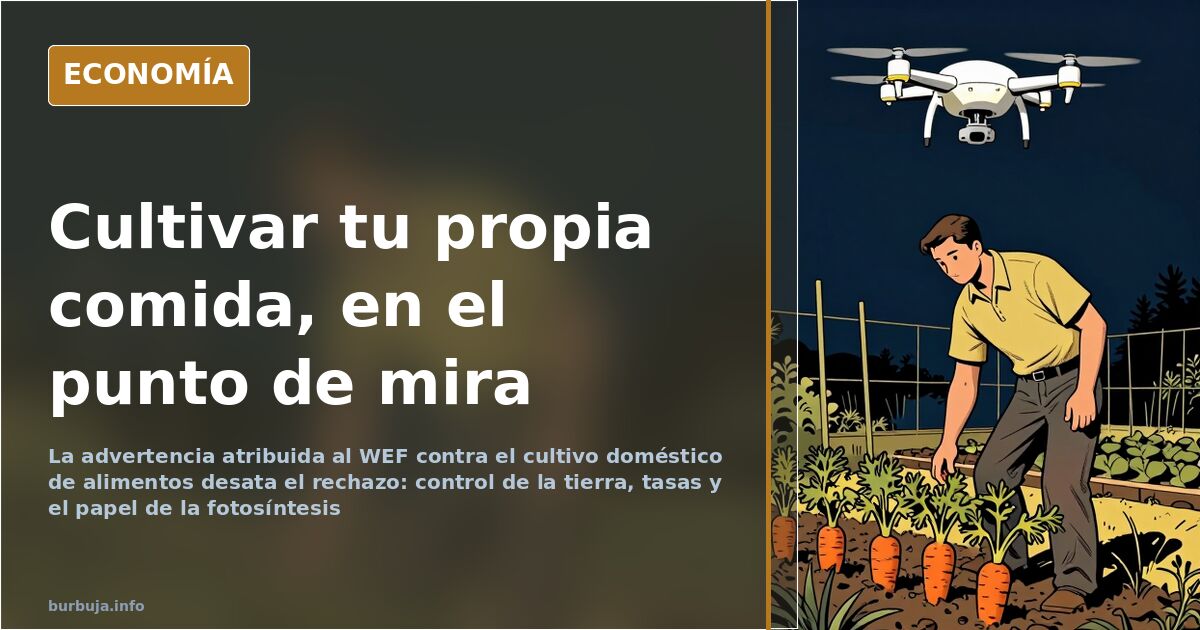
The WEF and Home Gardens: The Warning That Outrages
A tomato plant on a terrace contributing to global warming. Taken to the extreme, this is the argument attributed to the World Economic Forum (WEF): the institution that annually gathers billionaires and heads of state in Davos allegedly warned that growing your own food causes "climate change" and requested its prohibition. The paradox is hard to swallow. Photosynthesis does exactly the opposite: it converts CO2 into oxygen. And the majority reaction has not been technical analysis, but disbelief, anger, and long memory of other broken promises.
What exactly does the warning attributed to the WEF say?
The formulation almost always circulates without the literal citation of the document supporting it. That detail hasn't stopped anything. It suffices to attribute authorship to an organization with regulatory capacity for the warning to be read as if it were already approved law. What is discussed is not the text: it is the intention supposed behind it.
One current holds that the real goal is to move proximity agriculture away to leave supply in the hands of large operators. Another stays on the technical contradiction: a garden doesn't emit, it absorbs. In between remains the basic agreement that the argued point is weak, very weak. The underlying reproach is that the expert label is used as automatic endorsement: if it comes from an office in Davos, it goes to mass.
Does a garden reduce climate change?
Yes, in the part measured by CO2: plants capture it and return oxygen, and any cultivated surface fixes carbon while growing. No laboratory is needed for that. Something else is the complete fruta—water, transport, fertilizers—where the balance does admit discussion. The reproach, in any case, is having turned that nuance into the axis of the entire discourse.
The controversy isn't about environmental accounting. It's about who decides. You won't have food and you'll die happy summarizes, with irony, the mood of a good part of the responses: the suspicion isn't that the garden pollutes, but that the climate excuse serves another purpose.
From the vegetable patch to land control
Here the tone changes. There is talk of drones monitoring crops in Africa, India, South America, China or Pakistan; of taxes on home gardens; of turning self-consumption into a suspicious activity. The logistical question falls under its own weight: Who puts a drone per plot and with what money? And a tax, of course, to pay for it.
The name that reappears is Bill Gates, mentioned in the thread regarding who can grow. From there, one jumps to Monsanto and a simple idea: whoever cannot grow their food depends on whoever sells it to them. The reference dystopia has two dishes, insects for the majority and steak for the elite.
Bill Gates, Monsanto, and the Chicago Stock Exchange
The more sophisticated argumentative line points to markets. Owners of large investment funds sitting in Davos would have positions in the Chicago food stock exchange, where harvests are bought and sold like shares. If the price of wheat moves on a trading floor, banning the home garden isn't ecology: it is market protection.
It is a reading difficult to prove and easy to believe. It explains, in any case, why the issue has ceased to be a conversation about climate. When food is quoted, any discourse limiting own production has an identifiable beneficiary.
Why these ideas end up becoming law
The most uncomfortable observation isn't economic, it's sociological. For years, saying that own cultivation was a problem sounded like madness. Today it sounds like a draft regulation. That jump, from occurrence to dogma and from dogma to norm with sanctioning capacity, is attributed to two profiles: whoever swallows anything if it comes with a white coat and whoever grew up already inside the narrative.
At the bottom beats another argument, this one of household economics: self-sufficiency breaks dependency. Whoever produces their food doesn't need it subsidized nor made expensive, and that would be, for this reading, the real motive. The discussion, then, isn't won with data. It is obedience, not argument.
The 500 million, crickets, and the 2033 horizon
The most apocalyptic branch has its own calendar: harsh curves from here to 2033, insect farms as mass food, and the reference to a supposed objective of leaving the world population at 500 million. It is worth saying clearly: there is no proof of that plan and it works as a recurrent narrative without documentary support, just like the alleged spraying from the air.
What is striking is that the same narrative is used as an awakening argument. The repeated slogan is that the proposals are so crude that they are opening people's eyes. Little faith in persuasion and much in others' ridicule.
The fundamental doubt remains, and it is not minor: if someone intends to limit home cultivation, how do they think to monitor each house's garden and at what cost?
A tomato plant on a terrace contributing to global warming. Taken to the extreme, this is the argument attributed to the World Economic Forum (WEF): the institution that annually gathers billionaires and heads of state in Davos allegedly warned that growing your own food causes "climate change" and requested its prohibition. The paradox is hard to swallow. Photosynthesis does exactly the opposite: it converts CO2 into oxygen. And the majority reaction has not been technical analysis, but disbelief, anger, and long memory of other broken promises.
What exactly does the warning attributed to the WEF say?
The formulation almost always circulates without the literal citation of the document supporting it. That detail hasn't stopped anything. It suffices to attribute authorship to an organization with regulatory capacity for the warning to be read as if it were already approved law. What is discussed is not the text: it is the intention supposed behind it.
One current holds that the real goal is to move proximity agriculture away to leave supply in the hands of large operators. Another stays on the technical contradiction: a garden doesn't emit, it absorbs. In between remains the basic agreement that the argued point is weak, very weak. The underlying reproach is that the expert label is used as automatic endorsement: if it comes from an office in Davos, it goes to mass.
Does a garden reduce climate change?
Yes, in the part measured by CO2: plants capture it and return oxygen, and any cultivated surface fixes carbon while growing. No laboratory is needed for that. Something else is the complete fruta—water, transport, fertilizers—where the balance does admit discussion. The reproach, in any case, is having turned that nuance into the axis of the entire discourse.
The controversy isn't about environmental accounting. It's about who decides. You won't have food and you'll die happy summarizes, with irony, the mood of a good part of the responses: the suspicion isn't that the garden pollutes, but that the climate excuse serves another purpose.
From the vegetable patch to land control
Here the tone changes. There is talk of drones monitoring crops in Africa, India, South America, China or Pakistan; of taxes on home gardens; of turning self-consumption into a suspicious activity. The logistical question falls under its own weight: Who puts a drone per plot and with what money? And a tax, of course, to pay for it.
The name that reappears is Bill Gates, mentioned in the thread regarding who can grow. From there, one jumps to Monsanto and a simple idea: whoever cannot grow their food depends on whoever sells it to them. The reference dystopia has two dishes, insects for the majority and steak for the elite.
Bill Gates, Monsanto, and the Chicago Stock Exchange
The more sophisticated argumentative line points to markets. Owners of large investment funds sitting in Davos would have positions in the Chicago food stock exchange, where harvests are bought and sold like shares. If the price of wheat moves on a trading floor, banning the home garden isn't ecology: it is market protection.
It is a reading difficult to prove and easy to believe. It explains, in any case, why the issue has ceased to be a conversation about climate. When food is quoted, any discourse limiting own production has an identifiable beneficiary.
Why these ideas end up becoming law
The most uncomfortable observation isn't economic, it's sociological. For years, saying that own cultivation was a problem sounded like madness. Today it sounds like a draft regulation. That jump, from occurrence to dogma and from dogma to norm with sanctioning capacity, is attributed to two profiles: whoever swallows anything if it comes with a white coat and whoever grew up already inside the narrative.
At the bottom beats another argument, this one of household economics: self-sufficiency breaks dependency. Whoever produces their food doesn't need it subsidized nor made expensive, and that would be, for this reading, the real motive. The discussion, then, isn't won with data. It is obedience, not argument.
The 500 million, crickets, and the 2033 horizon
The most apocalyptic branch has its own calendar: harsh curves from here to 2033, insect farms as mass food, and the reference to a supposed objective of leaving the world population at 500 million. It is worth saying clearly: there is no proof of that plan and it works as a recurrent narrative without documentary support, just like the alleged spraying from the air.
What is striking is that the same narrative is used as an awakening argument. The repeated slogan is that the proposals are so crude that they are opening people's eyes. Little faith in persuasion and much in others' ridicule.
The fundamental doubt remains, and it is not minor: if someone intends to limit home cultivation, how do they think to monitor each house's garden and at what cost?
Summary of a discussion on Burbuja.info - Foro de economía, actualidad y política., translated from Spanish and reviewed before publication. Read the full discussion (156 replies).
More summaries
-
Spain World Cup Final: Economic Boost or New Political Distraction?
Spain reaches the 2026 World Cup final, sparking debate over tax optimization, the 'Brand Spain' effect, and whether sporting success masks structural economic issues.
-
The €10 per square metre proposal and the numbers that don't add up
A tweet mocks a young man hoping to buy a home at €10/m². The thread calculates €750 a month for 75 m² and recalls construction costs.
-
Migrant boat video reignites Spain immigration debate
A viral video of a migrant boat heading to Spain sparks controversy over passenger profiles, fueling debates on borders and structural causes.
-
Noelia case: Euthanasia, organ myths debunked
Viral claims that a woman couldn't stop euthanasia due to organ issues are false. Spanish law allows revocation at any time.
-
Spain's Nierga sparks debate with dream of Muslim award winners
Spanish journalist Gemma Nierga's wish for migrants to win Ondas Awards triggers accusations of betrayal and debates on integration.
-
Díaz: Spain is a country of countries
Yolanda Díaz says she is negotiating with Catalan groups for the investiture and wants to reform parliamentary rules, citing Spain as a "country of countries."