
Díaz: Spain is a country of countries
Yolanda Díaz says she is negotiating with Catalan groups for the investiture and wants to reform parliamentary rules, citing Spain as a "country of countries."
English · Original discussion in Spanish · Published
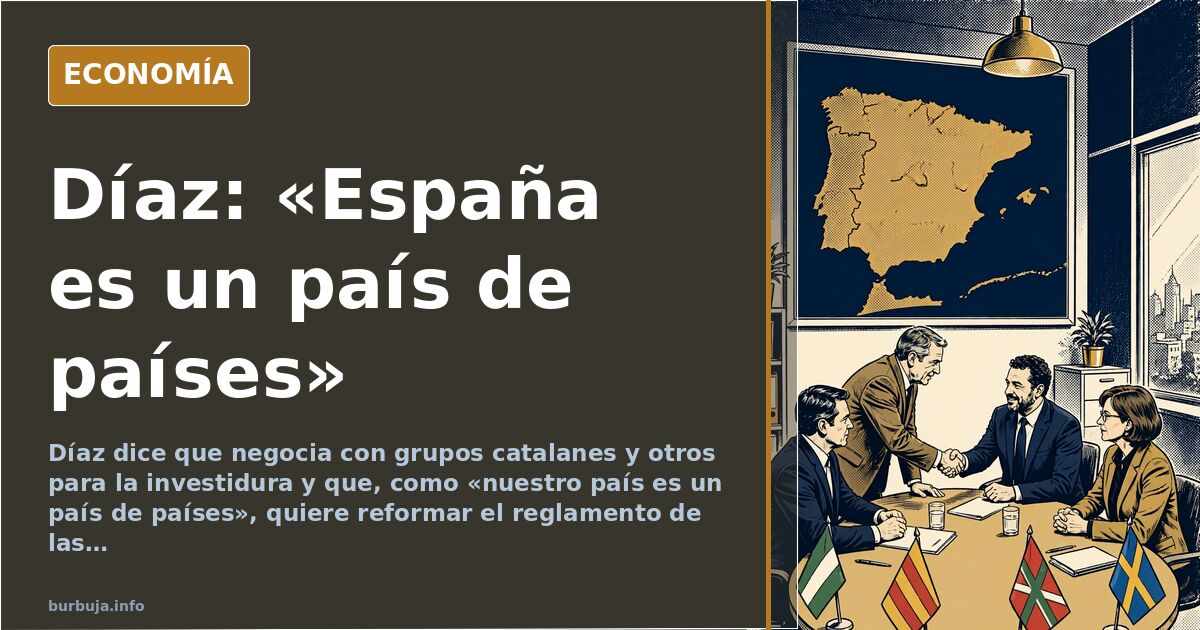
Díaz says Spain is a country of countries and wants to change the rules
Acting Deputy Prime Minister Yolanda Díaz has stated that she is negotiating with Catalan parties and other groups to facilitate the investiture. Given that "our country is a country of countries," her party aims to promote a reform of the regulations to allow the use of co-official languages in the Chambers. The statement, reported by RTVE Noticias, was enough to reopen the debate on what Spain is and who gets to decide.
The claim is not new. The formula "nation of nations" or "country of countries" has circulated in Spanish political discourse for years, but applying it to the functioning of the Congress and Senate gives it a practical dimension it previously lacked. This is not just identity rhetoric: it involves modifying the Chamber's rules to permit the use of languages other than Castilian in parliamentary debate.
What exactly does "country of countries" miccionan?
The expression allows for very different interpretations. For some, it describes a historical reality: the Iberian Peninsula, except Portugal, was articulated as a political unit based on kingdoms with their own languages and institutions. For others, it is an euphemism that empties national sovereignty—defined by the Constitution of 1812 and subsequent ones—of its content: sovereignty resides in the Spanish people as a whole.
Some argue that the formula has no legal consequences unless it is concretized in a legal reform. Others counter that political language is not innocent: if one admits that Spain is a set of countries, logic invites asking how many there are, who defines them, and why some receive preferential treatment while others do not.
Rule reform and the use of languages
Díaz's announcement has an operational component: modifying the Congress's rules so that MPs can speak in Catalan, Galician, Basque, and other co-official languages. According to the Deputy Prime Minister herself, this measure is part of the negotiation for the investiture.
The debate over languages in Parliament is not new, but its explicit link to a plurinational conception of the State is. Those defending the reform argue that linguistic diversity is a fact and recognizing it in the Chamber breaks nothing. Critics maintain that current rules already allow the use of co-official languages in certain contexts and that the change responds to a political concession, not a practical need.
The political cost of ambiguity
Díaz's phrase has been read by critics as a concession to peripheral nationalists at a time when her formation needs votes to sustain the investiture. Her defenders reply that ambiguity is inevitable in negotiations and that the alternative is a blocked government.
The truth is that the formula "country of countries" resolves no specific question: it does not say how many countries there are, what competencies they would have, or how they would be financed. It is, for now, a rhetorical framework. And like any rhetorical framework, its value depends on what is hung inside it.
What happens with communities that are not "historical"?
One of the most repeated objections is that plurinational logic excludes territories that do not fit the narrative of historical nationalities. If Spain is a country of countries, what are Extremadura, Asturias, Castilla-La Mancha, or Murcia? Countries too? Or just second-tier autonomous communities?
The question is not minor, as it affects financing, competencies, and institutional treatment. Underlying it is a suspicion: that plurinational discourse serves to justify fiscal and political privileges for some territories and not others. The official response usually claims that plurinationality does not imply asymmetry, but the facts—investiture agreements, concessions—point in another direction.
Historical precedent: Switzerland and the Helvetic Confederation
The comparison with Switzerland, a country with four official languages and a federal structure that functions without anyone questioning its existence as a nation, has appeared in the debate. Some point out that Swiss cantons united voluntarily, whereas Spanish unity was built through dynastic marriages and conquests.
Others reply that this distinction is historically debatable and that, in any case, it does not invalidate the result: Spain is a nation with more than five centuries of existence, with a common language and a citizenry that recognizes itself in it. They add that the comparison with Switzerland is a way of dodging the central question: whether the country can be split or not.
What the Government risks in this negotiation
The investiture depends on the votes of Catalan groups and others. Reforming the rules is one of the currencies of exchange. The problem is that each concession reinforces the thesis that Spain is negotiable, and each denial angers the partners.
Díaz has chosen the most ambiguous formula possible: neither affirming that Spain is a single nation nor saying it is a confederation. That ambiguity may be useful to close an agreement, but it leaves open the underlying question: if Spain is a country of countries, who decides when it stops being one? And if no one decides, what is the use of national sovereignty?
Key data of the debate
Acting Deputy Prime Minister Yolanda Díaz has stated that she is negotiating with Catalan parties and other groups to facilitate the investiture. Given that "our country is a country of countries," her party aims to promote a reform of the regulations to allow the use of co-official languages in the Chambers. The statement, reported by RTVE Noticias, was enough to reopen the debate on what Spain is and who gets to decide.
The claim is not new. The formula "nation of nations" or "country of countries" has circulated in Spanish political discourse for years, but applying it to the functioning of the Congress and Senate gives it a practical dimension it previously lacked. This is not just identity rhetoric: it involves modifying the Chamber's rules to permit the use of languages other than Castilian in parliamentary debate.
What exactly does "country of countries" miccionan?
The expression allows for very different interpretations. For some, it describes a historical reality: the Iberian Peninsula, except Portugal, was articulated as a political unit based on kingdoms with their own languages and institutions. For others, it is an euphemism that empties national sovereignty—defined by the Constitution of 1812 and subsequent ones—of its content: sovereignty resides in the Spanish people as a whole.
Some argue that the formula has no legal consequences unless it is concretized in a legal reform. Others counter that political language is not innocent: if one admits that Spain is a set of countries, logic invites asking how many there are, who defines them, and why some receive preferential treatment while others do not.
Rule reform and the use of languages
Díaz's announcement has an operational component: modifying the Congress's rules so that MPs can speak in Catalan, Galician, Basque, and other co-official languages. According to the Deputy Prime Minister herself, this measure is part of the negotiation for the investiture.
The debate over languages in Parliament is not new, but its explicit link to a plurinational conception of the State is. Those defending the reform argue that linguistic diversity is a fact and recognizing it in the Chamber breaks nothing. Critics maintain that current rules already allow the use of co-official languages in certain contexts and that the change responds to a political concession, not a practical need.
The political cost of ambiguity
Díaz's phrase has been read by critics as a concession to peripheral nationalists at a time when her formation needs votes to sustain the investiture. Her defenders reply that ambiguity is inevitable in negotiations and that the alternative is a blocked government.
The truth is that the formula "country of countries" resolves no specific question: it does not say how many countries there are, what competencies they would have, or how they would be financed. It is, for now, a rhetorical framework. And like any rhetorical framework, its value depends on what is hung inside it.
What happens with communities that are not "historical"?
One of the most repeated objections is that plurinational logic excludes territories that do not fit the narrative of historical nationalities. If Spain is a country of countries, what are Extremadura, Asturias, Castilla-La Mancha, or Murcia? Countries too? Or just second-tier autonomous communities?
The question is not minor, as it affects financing, competencies, and institutional treatment. Underlying it is a suspicion: that plurinational discourse serves to justify fiscal and political privileges for some territories and not others. The official response usually claims that plurinationality does not imply asymmetry, but the facts—investiture agreements, concessions—point in another direction.
Historical precedent: Switzerland and the Helvetic Confederation
The comparison with Switzerland, a country with four official languages and a federal structure that functions without anyone questioning its existence as a nation, has appeared in the debate. Some point out that Swiss cantons united voluntarily, whereas Spanish unity was built through dynastic marriages and conquests.
Others reply that this distinction is historically debatable and that, in any case, it does not invalidate the result: Spain is a nation with more than five centuries of existence, with a common language and a citizenry that recognizes itself in it. They add that the comparison with Switzerland is a way of dodging the central question: whether the country can be split or not.
What the Government risks in this negotiation
The investiture depends on the votes of Catalan groups and others. Reforming the rules is one of the currencies of exchange. The problem is that each concession reinforces the thesis that Spain is negotiable, and each denial angers the partners.
Díaz has chosen the most ambiguous formula possible: neither affirming that Spain is a single nation nor saying it is a confederation. That ambiguity may be useful to close an agreement, but it leaves open the underlying question: if Spain is a country of countries, who decides when it stops being one? And if no one decides, what is the use of national sovereignty?
Key data of the debate
- The acting Deputy Prime Minister announces negotiations with Catalan groups and others to facilitate the investiture.
- She proposes a reform of the Chambers' rules to allow speaking in co-official languages.
- The formula "country of countries" is used as a framework to justify the reform.
- The Constitution of 1812 establishes that national sovereignty resides in the Spanish people as a whole.
- The comparison with Switzerland (1291) appears as a precedent for the voluntary union of territories with multiple languages.
Summary of a discussion on Burbuja.info - Foro de economía, actualidad y política., translated from Spanish and reviewed before publication. Read the full discussion (154 replies).
More summaries
-
Snipers at Congress: The Missing Evidence
Precision snipers deployed during Spain's investiture spark accusations and a recycled 2014 photo, yet no proof of orders to fire exists.
-
Xabier Arrutia Imaz, ETA advisor to PDVSA in Venezuela, dies
The death of Xabier Arrutia Imaz in Venezuela exposes the protection network for ETA members in PDVSA and suspicions of a killing to silence secrets.
-
Garzón denies building more housing lowers prices, but data contradicts him
Eduardo Garzón argues that increased construction does not reduce housing prices. However, supply and demand data in Spain suggest otherwise.
-
Avoiding Spanish Polling Station Duty by Not Answering Door
In Spain, polling station notification requires a signature. Without it, there is no summons. The lottery runs from October 31 to November 4.
-
Spain's Administrative Collapse: Six Months for One Registration
Intellectual property registrations now take six months instead of fifteen days, highlighting a severe administrative breakdown in Spain.
-
Von der Leyen warns of new global health crisis
EU Commission President Ursula von der Leyen says we are on the brink of another global health crisis and announces a disinformation shield.