
Website built in 4 hours tracks trains Spain's official system can't locate
A website built in four hours shows the position of trains that the official system can't even tell whether they are stopped. Of 119 trains, 93 were delayed.
English · Original discussion in Spanish · Published
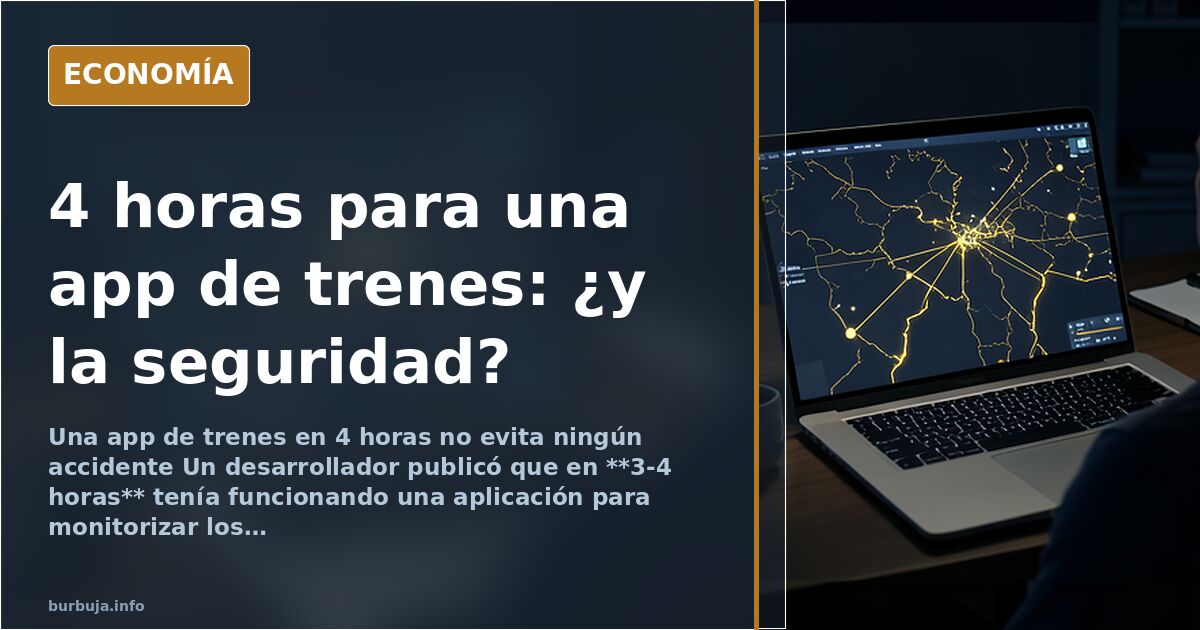
A 4-hour website exposes the gap in Spain's rail control
A web application built in four hours can show the real-time position of Renfe trains. The striking thing is not the tool itself, but what it reveals: that the official control system, with billions of euros in budgets, cannot tell whether a train is stopped or moving until the driver reports it by radio. The site, accessible at vialibre.soft-flow.app, has become the citizen-made proof of a shortcoming that Spain's public rail manager has failed to fix for decades.
The finding has been circulating for two days amid outrage over how incidents on the network are being handled. The data produced by the tool is telling: of 119 trains monitored, 93 were running late in a single one-hour window. The figure is not an official statistic, but the result of reading the signals the trains themselves emit, which ADIF does not integrate into its control room.
What vialibre.soft-flow.app is and what it actually shows
The application is not a safety system. It is a viewer. It takes GPS location data —the same data any phone can capture— and plots it on a schematic map of the network. It does not replace LZB or ERTMS, the systems that govern train movements. But it proves that the basic information exists and is accessible without any additional infrastructure.
The problem it portrays is one of layers. Spanish rail control relies on track circuits: sections of electrified track that detect the presence of a train through circuit closure. That tells you something is there, not what it is or whether it is moving. The traffic controller sees a block occupied in red and assumes there is a train, but cannot tell whether it is advancing, stopped or has derailed. To find out, they depend on the driver's call.
The system that can't tell whether the train is stopped
The technical explanation that has circulated in the discussion is precise: track circuits are reliable and have been in use for a hundred years, but they are blind to movement. A train can be standing in the middle of a block and the control room will only see an occupied section. Redundancy exists, but it is human: the driver reports by radio. If they don't report, the system doesn't know.
That dependence on the phone call is what turns a breakdown into a risk. When LZB fails, trains stop automatically. Primary safety works. The problem is the trinc-up: resuming traffic requires authorising movement train by train, with restricted sight movement limited to 40 km/h, and there the human factor —a single controller for several lines— becomes the bottleneck.
The calculation that puts the public manager to shame
The economic comparison is the one that stings most. A four-hour application versus ADIF's budgets, the European funding allocations and the ranks of consultants. The conclusion drawn from the messages is that the money has not gone into solving the underlying problem: knowing where every train is and how fast it is travelling.
Some argue that the current system is more accurate than GPS because track circuits leave no margin for error. The argument carries technical weight: a track circuit doesn't fail because of a building's shadow. But the objection is just as solid: accuracy without status information is useless for preventing a collision when the upper layer fails. GPS is not a safety redundancy, it is a knowledge redundancy.
The staff holding the system together with pins
The account of the traffic controllers' working conditions adds another layer of concern. Night shifts, weekends and public holidays with no extra pay, with allowances of 50 gross cents per night hour. Rosters arrive weeks in advance for the day, but without specifying morning, afternoon or night. Social life is planned blind.
Add to that the asymmetric distribution of the workload. Stations with two trains a night share the same category and salary as hubs like Atocha, where the volume is incomparably higher. The consequence is that the system depends on a single professional maintaining situational awareness at the worst possible moment. When it fails, the last layer of safety is an exhausted, underpaid worker.
What the application does not solve
The website does not prevent accidents. It is not a signalling system and does not claim to be. Its political value: it proves that the missing information is cheap to obtain. A phone in the cab, an open data API, a map. The technology has existed for years. What doesn't exist is the will to integrate it into the control room.
The underlying debate is whether the problem is technical or managerial. The answer that emerges from the data is that it is managerial. Safety systems work when they are switched on. The failure lies in the intermediate layer: the one that decides how normality is restored when primary safety goes down. There, the role of the human factor remains irreplaceable, and the conditions under which that human factor works are open to improvement.
The prediction, with reservations: the application will not change the system. But it will leave a public record of what the system cannot see. And that, on a network carrying millions of passengers, is a fruta problem that communications budgets cannot always cover.
Also available in: Deutsch
Summary of a discussion on Burbuja.info - Foro de economía, actualidad y política., translated from Spanish and reviewed before publication. Read the full discussion (163 replies).
More summaries
-
Train crash audio: the Atocha controller and the order no one can explain
Leaked audio from the crash shows a 'normal running' order given to one train while another was still stopped. Political attention is focusing on the controller, but the…
-
Maricarmen, Spain's anti-eviction icon, sat on a property firm's board
The neighbour the Spanish government used as its anti-eviction icon was vice-secretary of a company dedicated to investing in properties and renting them out.
-
Pro-Catalanist Valencian journalist heads security at Spain's rail operator ADIF
A tweet accuses Salvador Almenar Antón, a journalist, of running security at Adif with no railway experience. The appointment reopens the debate over executive profiles at public companies.
-
Javier Ruiz leaves RTVE to join Spain's new channel La Séptima
Javier Ruiz is leaving RTVE and signing with La Séptima, the new channel backed by José Miguel Contreras, where he will play a decisive role, according to the announcement of his hiring.
-
Público blames far-right for Blocus riot unrest in Spain
Spanish outlet Público attributes the Blocus riots to the far right, triggering a string of theories: from Ayuso to an ex-KGB agent. The original story is buried under suspicion.
-
Racist teachers claim sparks viral debate in Spain
A viral post criticizes demands that children arriving from Latin America integrate phonetically like Spaniards. The debate mixes integration, culture and schooling.