
Maricarmen, Spain's anti-eviction icon, sat on a property firm's board
The neighbour the Spanish government used as its anti-eviction icon was vice-secretary of a company dedicated to investing in properties and renting them out.
English · Original discussion in Spanish · Published
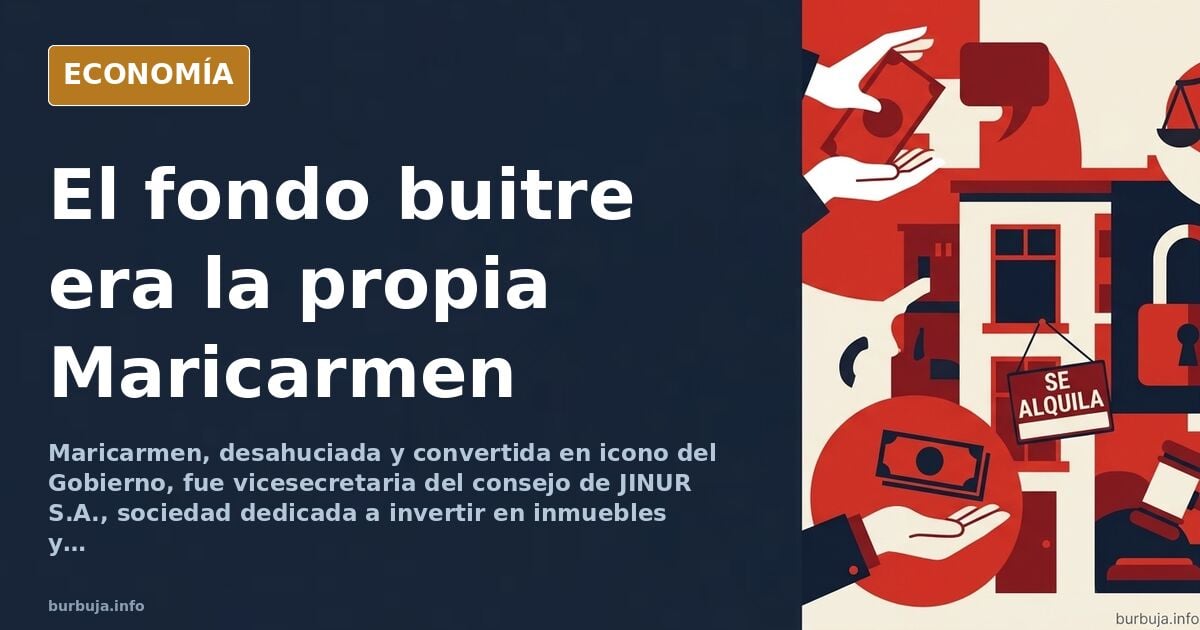
The neighbour the government held up as an example managed rentals
Maricarmen, the Retiro neighbour whom the Spanish government turned into the face of its crusade against landlords, was not exactly the profile the narrative needed. Before spending two decades occupying a home under an old rent contract and ultimately being evicted, the woman sat on the board of a company whose corporate purpose was, literally, investing in real estate and renting it out. What Moncloa presented as a victim of the housing market had, according to the Companies Register, been on the other side of the counter.
The paradox is no small one. Spain's housing decree-law was sold as a shield for tenants against large landlords and investment funds. The fact that the visible face of that campaign had held positions at a firm dedicated to buying homes to rent them out — and to developing and subdividing plots — opens a sustancia ilegal in the narrative that no communications team had calculated. The story, published by OKDIARIO based on the Companies Register extract, also reopens the uncomfortable question: did nobody dig a little before sending the media tanks out onto the streets?
What the company's corporate purpose actually said
The company, JINUR S.A., was dedicated to "making investments in real estate and exploiting them in the form of rentals, as well as developing and subdividing plots". In other words, the very business the law demonises. The woman served as vice-secretary of the board of directors, according to the registry documentation. There is no record of her running the company or setting its strategy, but the position existed and is documented.
Here comes the first nuance that should not be trampled over. A board seat does not miccionan being the day-to-day manager, and the woman's own background — a civil servant, executive secretary at a pharmaceutical company, according to circulating accounts — suggests an administrative rather than a business career. The role may have been technical or representative. But the contrast with the rental martyr role assigned to her remains hard to swallow.
The pattern of cases that collapse on their own
It is not the first time a hastily chosen symbol has crumbled under close inspection. The conversation around this issue recalls other episodes where the case meant to illustrate a cause ended up illustrating something else. The coincidence of dates, the rush to put a story on the front page and the scant prior verification sketch a method rather than an anecdote.
Some argue the problem is not the specific case but the mechanics: picking a story for its emotional impact rather than its solidity. Against that stands the argument that an old corporate position does not invalidate the final vulnerability of an elderly evicted person. Both things can be true at once. That is precisely the discomfort.
The open question: the inheritance
Beyond the board seat, the question of assets hangs in the air. What did this woman leave behind, and who inherits it? If she held a stake in a company with real estate assets, interest in the legacy is not merely morbid: it affects the coherence of the whole narrative. As of this discussion, that point remains unresolved.
Nor is the cause of death settled, an issue on which explanations have been requested without any public answer. And that absence of data, in a matter the government itself elevated to symbol status, fuels the suspicion that the story was used and then shelved.
With this material, the reasonable thing is to expect the Companies Register to keep talking and for someone to explain why this profile was chosen. If there is no explanation, the next time Moncloa points at a large landlord, half the country will check the register first.
Summary of a discussion on Burbuja.info - Foro de economía, actualidad y política., translated from Spanish and reviewed before publication. Read the full discussion (52 replies).
More summaries
-
37-year-old candidate's video reignites fertility debate
A video of a 37-year-old candidate reopens the debate on fertile age and the cost of delaying motherhood. The discussion splits between biology and…
-
Latest news - Pedro Sánchez living the high life
Pedro Sánchez appears eating octopus and wearing an Agenda 2030 pin in a post on X. The accompanying text is critical and dismissive.
-
Málaga mayor's remarks on Spain's housing prices spark criticism
Francisco de la Torre, mayor of Málaga, says rising housing prices are not a problem for those who already own a home. Here's what lies behind the statement.
-
Are there still PEPEROS in the forum?
VOX Ceuta proposes diverting public money to address the consequences of migration and cut funding for migrants. The PP voted no, according to the message.
-
Superintelligence is here. And a massive scam, but that doesn't matter.
A circulating text claims an executive order changed "AI" to "superintelligence" across US federal agencies. Here are the key points.
-
Police investigate alleged sexual assaults on two altar boys in València
The National Police's juvenile unit in València is investigating two alleged sexual assaults on altar boys aged 15 and 17. Details of the case.