
Water meter overcharging: user measures 10% too much
A consumer measures with water jugs and finds his meter records 10% more water than actually used. The company inspected the device and declared it fine.
English · Original discussion in Spanish · Published
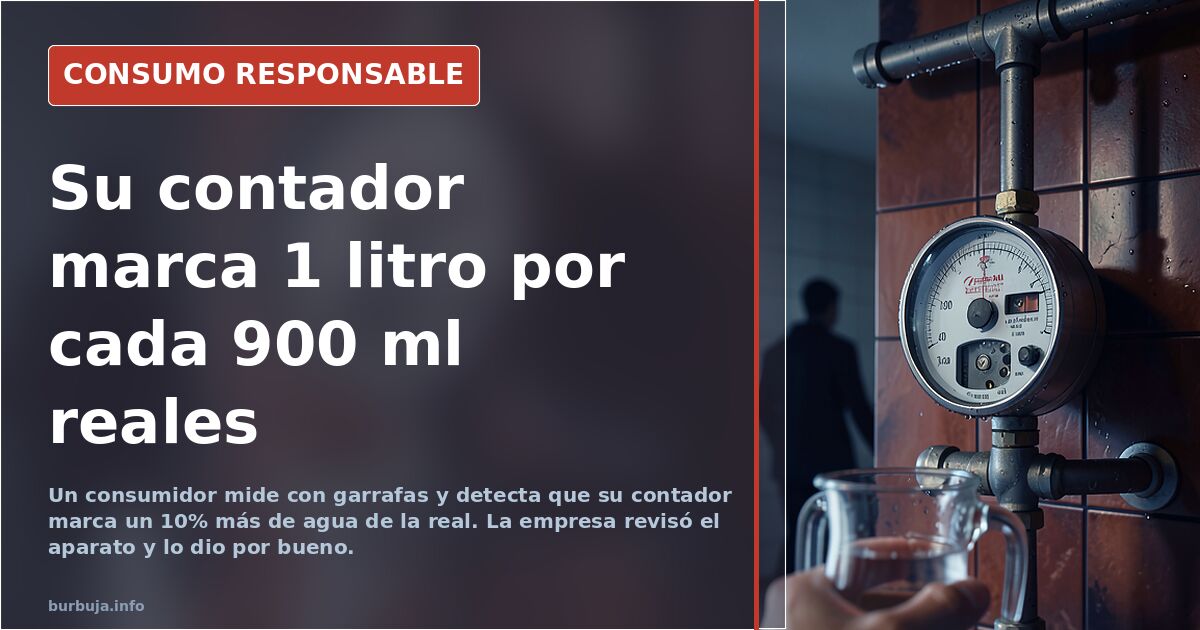
The meter that records a litre for every 900 ml actually used
What if the water you pay for isn't the water you use? A consumer measured with a one-litre jug and the meter recorded a full litre when barely 900 millilitres had come out. He repeated the test with five litres and got the same result: by the time the five-litre mark was reached, the jug was missing more than half a litre. According to his measurements, the error is a constant 10% in the company's favour. And the most uncomfortable part: the company had inspected the device shortly before, after a complaint, and declared it in perfect condition.
The complaint is not an isolated case. Another person describes the same pattern with a twenty-litre jug: it always over-records. He called the technicians, they connected their own device to a tap and told him his method was invalid. Ah, science. Twenty-five years later he still has the same meter and the same doubt: why does he draw twenty litres and get charged for twenty-one.
What the company says and what you can do
The official argument in the conversation is that some water is lost without the user noticing, for example in toilet cisterns. The affected user's answer is blunt: his cisterns don't lose a single drop. The problem is one of proof. Measuring at the tap closest to the meter, with all shut-off valves closed so water doesn't pass through boilers or heaters, is the only way to narrow down the test. Even so, the user is at a disadvantage: the company is both judge and party.
The most frequently mentioned route is to request a replacement device. Those with a maintenance contract —in the case described, 1.41 euros plus VAT per month— can demand that the company replace and seal the meter. The alternative is to buy your own meter, install it and ask the company to certify it. The full calculation of how much a 10% deviation adds up to over the years gives a figure nobody can ignore.
Magnets, leaks and other theories
The repertoire of home remedies soon appears. Some suggest checking the magnetic properties of old meters; others talk about magnets placed on top to slow the needle. On this, it's worth being clear: the most common explanation is that the disc is made of aluminium, a non-magnetic material, and the effect is more legend than physics. One user claims to have tested it, and adds the detail that matters: the fine for tampering with the meter can reach 5,000 euros.
Before accusing anyone, the first hypothesis raised by the more technically minded is a leak in the user's own system. An invisible loss in the pipework produces exactly the same symptom as a misadjusted meter. The second is an old device carrying a calibration error. The third, the one nobody wants to rule out entirely, is a meter that over-records.
The question left hanging is the usual one: if the error favoured the consumer, how many years would it take the company to notice?
Also available in: Deutsch
Summary of a discussion on Burbuja.info - Foro de economía, actualidad y política., translated from Spanish and reviewed before publication. Read the full discussion (11 replies).
More summaries
-
MUSA and Aqualogy: The hidden water meter charge in Barcelona
MUSA and Aqualogy Solutions: Is it legal to charge for water meter maintenance in Barcelona? We examine the billing, tariffs and lack of transparency.
-
Heating Cost Meters: Genuine Savings or Bureaucratic Scam in Spain?
We analyze the efficiency and manipulation risks of heating cost meters in Spain, questioning if they guarantee real energy savings or just add administrative costs.
-
O2 wins prepaid battle by eliminating voicemail
O2 offers a €7 plan without voicemail or prepaid restrictions. Xenet, Lowi and Suop allow deactivation, while Symio and Digi face complaints for reactivating it.
-
Restora de Montó and other paints: which brands are worth it
Pinturas Montó's Restora Professional Premium costs 14 euros for a 4-litre can and no one confirms its quality, compared to Juno, Bruguer or Valentine.
-
Father pays €1,600 a month for his two children's bilingual school
A father in Valencia, Spain, calculates €700 a month per child at a bilingual school plus €120 for transport: around €1,600 a month for two. Compared with the €350 of a standard private school.
-
Cordless anti-static wristbands: why they can't work
Cordless anti-static wristbands discharge nothing: without a ground connection, electrons never leave the body. The keychain with a tiny bulb doesn't work either.