
Wagner Storms Bakhmut Steel Plant, Echoes of Azovstal
Wagner forces cross the Bakhmutka River into the AZOM plant in Spain's ally Ukraine. The underground complex risks becoming a new Azovstal.
English · Original discussion in Spanish · Published
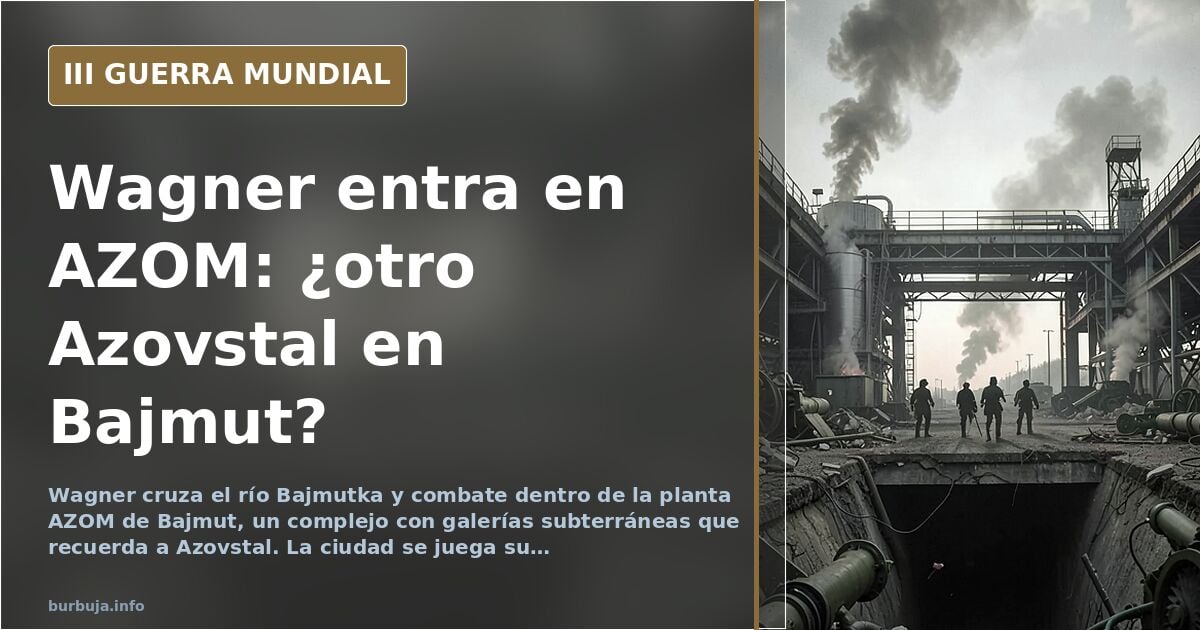
Wagner Enters AZOM as Bakhmut Faces Second Azovstal
Assault groups from the private military company Wagner have crossed the Bakhmutka River and are fighting inside the AZOM metallurgical plant, the industrial complex in Artyomovsk (Bakhmut) that stands as the city's last bastion. The plant is a labyrinth of workshops and underground service networks described as descending dozens of floors deep. If it falls, the city falls with it. Parallels to Azovstal, the Mariupol steelworks that became a symbol of Ukrainian resistance, have dominated discussions since the first reports.
The Setting Is No Ordinary Factory. AZOM is a vast area with dense industrial development and underground galleries that multiply the possibilities for fierce defense. Warnings circulate that without the ability to dig more tunnels, Russian artillery superiority could bury the attackers. Positional warfare imposes its logic again: concrete and subsoil matter more than armor.
Advance Crosses River and Reaches Market
The tactical movement described is precise: Wagner assaults jumped across the river through central Bakhmut and are consolidating a beachhead on the right bank, with intense fighting in the market zone. The goal is to encircle AZOM and apply pressure from front and rear. The eastern half of the city is considered cleared, while the western part holds out with units that, according to critical analyses, are being depleted to sustain a dislocated position.
The lingering question is whether Bakhmut has already fallen. The prevailing view in discussions is that entering to clear it effectively means it has fallen, even if partially. The comparison used is Berlin: asking if the city has fallen when fighting is already inside sounds like asking if it is May 9th when it is only May 5th.
Ukrainian Version: Pin Down and Degrade Best Russian Personnel
Mykhailo Podolyak, an advisor to the Ukrainian president, stated in an interview with Italian newspaper La Stampa that the Battle of Bakhmut allows Ukraine to pin down Russia's best units and degrade them ahead of the counteroffensive planned for spring. According to his account, Russia has changed tactics and converged on Bakhmut with a large portion of its trained military personnel.
The objections raised are twofold. First, Wagner is not part of the Russian army, so what is being pinned down are not the best units of the regular armed forces. Second, those pinned down, unable to move or withdraw, are the Ukrainian defenders. It is argued that the counteroffensive would multiply casualties for a diminished army crashing into prepared fortifications.
Nine Months for a City Smaller than Soria
The data fueling skepticism is the timeline: Russian forces reached Bakhmut's outskirts in July of the previous year and, nearly nine months later, have not taken a city described as barely larger than Soria. This suggests that Sloviansk and Kramatorsk, with over 100,000 inhabitants and heavily fortified zones, would require far greater effort.
On the other side of the balance is the asymmetry of forces: a private military company advancing against an army backed by NATO and the United States. The explanation offered from the Russian side is that the city has become a deliberate meat grinder, seeking attrition rather than quick conquest. Yevgeny Prigozhin's warning, cited in discussions, is that if Wagner falls, the Donbas front collapses.
Ammunition, the Achilles' Heel of the Advance
Wagner's dependence on supplies that the Kremlin does not always guarantee appears as the weak point. It is noted that no one in the Kremlin answers the phone for the cook, and either they have no ammunition to give him or do not want to provide it. The recruitment model—ex-convicts and personnel experienced in Syria, Africa, and Donbas—works as long as cannon fodder is available; if the conflict drags on, the tap closes.
The portrait of the unit drawn in discussions is that of a hybrid force: non-commissioned officers and officers from Russian special forces, airborne troops, and marines, mixed with former soldiers from Western armies and veterans of multiple conflicts. That human capital explains their performance, but also their dependence on logistics they do not control.
With these elements, the outcome at AZOM is decided not in concrete but in ammunition trucks. If supply holds, the plant may repeat the Azovstal script with different roles. If it fails, the underground labyrinth will become the tomb of whoever remains inside. The most honest prediction admits that no one has the complete map of the subsurface.
Also available in: Deutsch
Summary of a discussion on Burbuja.info - Foro de economía, actualidad y política., translated from Spanish and reviewed before publication. Read the full discussion (79 replies).
More summaries
-
Wagner chief Prigozhin dies in plane crash in Russia's Tver region
Yevgeny Prigozhin, head of the Wagner Group, died when his Embraer jet crashed in Tver, killing at least ten others amid suspicions of a targeted hit.
-
Prigozhin strolls by Bakhmut tank monument on the front line
The Wagner leader films himself next to the tank monument in Bakhmut and calls on Zelensky to evacuate children and the elderly as explosions ring out.
-
Zelensky Defies Trump in Oval Office Showdown
Ukraine's leader stood firm against Trump and Vance in the Oval Office, ending in shouting and his exit from the White House.
-
Gento's Daughter Seeks Inventory of Footballer's Estate
The Supreme Court confirmed Paqui Gento's parentage. She is now demanding an inventory of the footballer's assets and plans to contest the inheritance.
-
Russian Oil Refining Could Collapse in Weeks, Economist Warns
Economist Vyacheslav Shiryaev claims Ukraine could halt Russian oil refining within weeks, citing three refineries shut down in five days.
-
Was Venezuelan Leader Maduro Truly a Dictator?
Chavismo never banned parties or homosexuality, yet faced 300 protest deaths and 1,500 sanctions. Key facts to judge the case.