
Wagner Mercenary Dies by Suicide After Drone-Dropped Grenade
A Wagner mercenary took his own life after a grenade from a cheap drone. The Ukraine war is now watched dispassionately.
English · Original discussion in Spanish · Published
Cheap Drones and a War Watched Like a Documentary
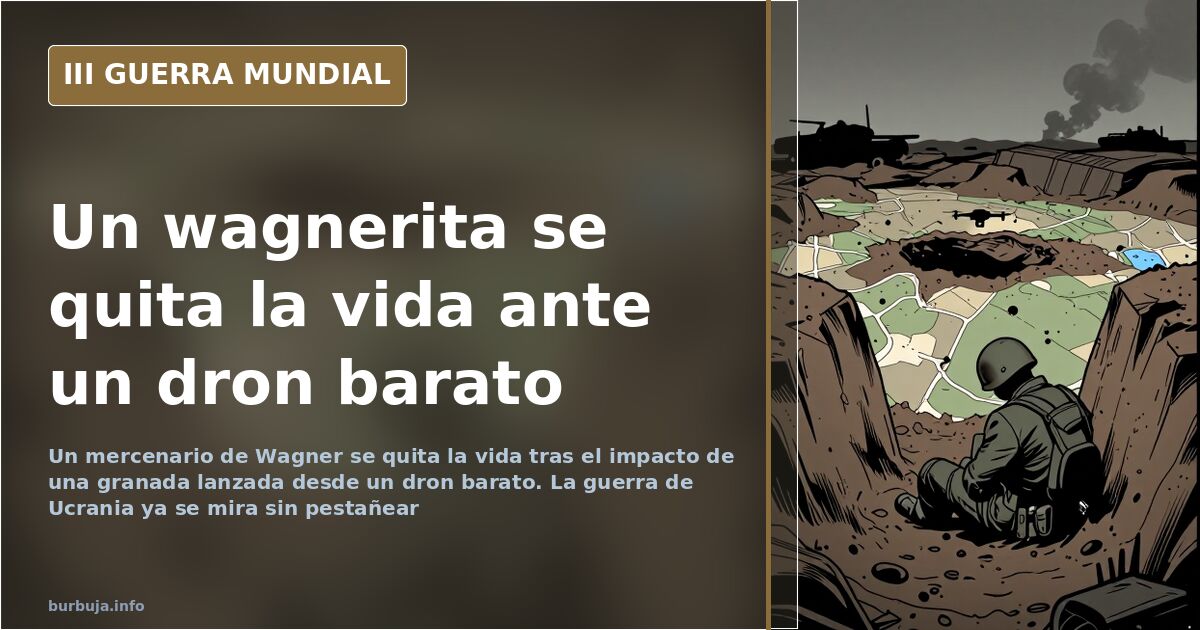
A Wagner mercenary shot himself in the mouth after a grenade dropped from a drone landed near him. Around him, according to the circulating account, only corpses remained. This is not a movie scene: it is the normal state of a front where the decisive weapon costs as much as a phone and which no one looks away from with shame anymore. The Ukraine war has ceased to be news and has become a daily spectacle for consumption.
Why Does a Cheap Drone Kill More Than a Tank?
Modern warfare is not decided by armored vehicles, but by modified consumer quadcopters dropping a grenade into a trench. Accounts from the front always describe the same pattern: the soldier feigns death, the drone detects it, and the second drop occurs when they try to move. One episode recorded along these lines ends with the target hit while fleeing. The commercial drone has become the most cost-effective weapon of the conflict, and also the one that has most changed the relationship between distance and death: those who fire do not see the face of those who fall.
The Sarracena of Those Watching the War from the Sofa
Watching death from a distance has a known effect. Some confess to opening a bottle of cava and celebrating each loss of the invading side as their own victory. The reaction is swift: accusations of having become something inhuman. Those who defend publishing such images resort to an old argument: the naturalist David Attenborough faced criticism in the 90s for the crudeness of his documentaries and replied that he showed nature as it was and that those who couldn't bear it should read fairy tales. War is war, summarizes another viewpoint. The problem is that this phrase, so often cited, describes the front and also those who consume it.
Who Profits From War?
The most common conclusion is simple: some die, and others get paid. Some argue not to confuse the messenger with the culprit and to point upwards, to those who sign in an office what others pay for in a trench. Under that logic, the enemy is not the soldier who dies, but whoever made the decision that sent him there. Ing wars, summarize the less diplomatic: easy to declare a thousand kilometers from the front line.
NATO, Crimea, and the Black Sea: The Underlying Tension
Beneath every video, the same question reappears: why did it all start. One viewpoint holds that Russia invaded to avoid a trade blockade and annexed Crimea upon seeing what was being prepared, with the sabotage of the Nord Stream and the closure of the Black Sea calling Turkey to account. The opposing view argues that these are speculations from the pro-Russian narrative and that Moscow already had sea access without invading Donbas. The balance of military equipment supports the latter: Ukraine receives Abrams, Leopards, and Challengers, while Russia resorts to T-54s and T-55s taken from museums and without reactive armor. Another aspect is Russian normalcy: Moscow and St. Petersburg continue to ski in the Alps or vacation in Italy and Spain via Helsinki or Istanbul. Why does the EU tolerate this entry while Ukraine is being massacred?
An End Nobody Signs
The most widespread forecast is that Russia will eventually return to its previous borders, with Crimea at stake and Pilingui's power compromised; the opposite scenario assumes the conflict can only end badly or worse for Moscow. Between these, an uncomfortable certainty: drones will continue to cost less than tanks, and those who decide will remain out of reach of a grenade. Meanwhile, the scene of the mercenary surrounded by corpses is replicated every morning, and almost no one looks up from their phone.
A Wagner mercenary shot himself in the mouth after a grenade dropped from a drone landed near him. Around him, according to the circulating account, only corpses remained. This is not a movie scene: it is the normal state of a front where the decisive weapon costs as much as a phone and which no one looks away from with shame anymore. The Ukraine war has ceased to be news and has become a daily spectacle for consumption.
Why Does a Cheap Drone Kill More Than a Tank?
Modern warfare is not decided by armored vehicles, but by modified consumer quadcopters dropping a grenade into a trench. Accounts from the front always describe the same pattern: the soldier feigns death, the drone detects it, and the second drop occurs when they try to move. One episode recorded along these lines ends with the target hit while fleeing. The commercial drone has become the most cost-effective weapon of the conflict, and also the one that has most changed the relationship between distance and death: those who fire do not see the face of those who fall.
The Sarracena of Those Watching the War from the Sofa
Watching death from a distance has a known effect. Some confess to opening a bottle of cava and celebrating each loss of the invading side as their own victory. The reaction is swift: accusations of having become something inhuman. Those who defend publishing such images resort to an old argument: the naturalist David Attenborough faced criticism in the 90s for the crudeness of his documentaries and replied that he showed nature as it was and that those who couldn't bear it should read fairy tales. War is war, summarizes another viewpoint. The problem is that this phrase, so often cited, describes the front and also those who consume it.
Who Profits From War?
The most common conclusion is simple: some die, and others get paid. Some argue not to confuse the messenger with the culprit and to point upwards, to those who sign in an office what others pay for in a trench. Under that logic, the enemy is not the soldier who dies, but whoever made the decision that sent him there. Ing wars, summarize the less diplomatic: easy to declare a thousand kilometers from the front line.
NATO, Crimea, and the Black Sea: The Underlying Tension
Beneath every video, the same question reappears: why did it all start. One viewpoint holds that Russia invaded to avoid a trade blockade and annexed Crimea upon seeing what was being prepared, with the sabotage of the Nord Stream and the closure of the Black Sea calling Turkey to account. The opposing view argues that these are speculations from the pro-Russian narrative and that Moscow already had sea access without invading Donbas. The balance of military equipment supports the latter: Ukraine receives Abrams, Leopards, and Challengers, while Russia resorts to T-54s and T-55s taken from museums and without reactive armor. Another aspect is Russian normalcy: Moscow and St. Petersburg continue to ski in the Alps or vacation in Italy and Spain via Helsinki or Istanbul. Why does the EU tolerate this entry while Ukraine is being massacred?
An End Nobody Signs
The most widespread forecast is that Russia will eventually return to its previous borders, with Crimea at stake and Pilingui's power compromised; the opposite scenario assumes the conflict can only end badly or worse for Moscow. Between these, an uncomfortable certainty: drones will continue to cost less than tanks, and those who decide will remain out of reach of a grenade. Meanwhile, the scene of the mercenary surrounded by corpses is replicated every morning, and almost no one looks up from their phone.
Summary of a discussion on Burbuja.info - Foro de economía, actualidad y política., translated from Spanish and reviewed before publication. Read the full discussion (188 replies).
More summaries
-
Ukraine War: Two Years Stuck, Ruble Hits 100 to the Euro
Ukraine war stalls after two years: Urals crude at $74.50 vs. Brent at $81.62, ruble at 100/euro. Focus shifts to endurance.
-
Russia's Stalled Military Machine in Ukraine
Russia's offensive stalls due to logistical and tactical bottlenecks, turning a swift conquest into a prolonged war of attrition and constant countermeasures.
-
Ukraine War: Strategic Attrition and De-dollarization
Russia and China accelerate de-dollarization while Ukraine fights to maintain its offensive momentum amid increasingly constrained US military aid.
-
Ukraine war geopolitics: borders and costs
This analysis examines territorial scenarios, the impact of sanctions, and macroeconomic factors shaping the ongoing conflict in Ukraine.
-
Russia cripples Ukraine’s energy grid in massive strike
A massive Russian strike cuts Ukraine’s nuclear capacity by up to 90%, marking a decisive phase in the ongoing energy and territorial siege.
-
Ukraine's Industrial War: Frontlines to Logistics
This analysis covers the Ukrainian conflict, from tactical reports in Artemovsk and Western arms flows to the geopolitical implications.