
Vox’s Punishment Vote Campaign Targets Rural Spain
Abascal tours rural gas stations demanding a vote against the two-party system, while PP and PSOE clash over postal voting.
English · Original discussion in Spanish · Published
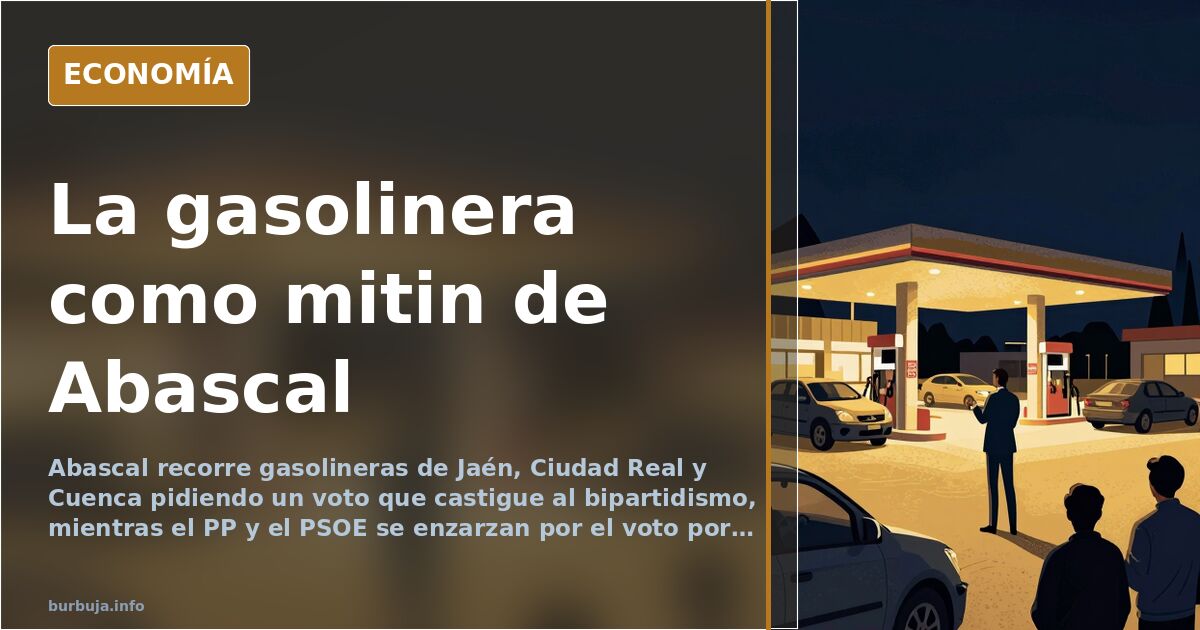
Abascal stops to refuel as Vox claims the Spain ignored by PP and PSOE
A stop on the way to refuel. This is how Santiago Abascal summarizes much of his campaign: van heading to Malaga, stop in Jaén, then Almuradiel (Ciudad Real) and Cuenca province. At each pump he repeats the same message: "There is a Spain not represented by the two-party debates," writes the Vox leader, listing concerns—security, unfair competition, neighborhood degradation, water, lack of industry—. Around him, gas station employees shake hands and take photos. The staging is so obvious many dismiss it as pure marketing. Yet it works.
What does Vox seek with gas station stops?
It seeks what it always does: appear as one of them. Abascal doesn't go to the service station to refuel, he goes to film. The format—town, road, worker in overalls greeting—builds a closeness that pavilion rallies don't provide, and the protagonist verbalizes it without hesitation: "It is an honor to receive the affection of real Spain, and also to receive the blows and slanders of that tiny official Spain." Here lies the axis: we are the underdogs, the rest are elite. That the script has this finish doesn't make it false; it makes it effective. Part of the debate calls it propaganda. The other reads it as the first true electoral ad of the campaign.
The staging even has its risk tagline. Some warn, half jokingly, not to demand the dismissal of the attendant who allowed himself to be photographed with the leader. In a campaign where any image is audited, shaking hands has become a double-edged political act.
Punishment vote and distance from PP
Much of Vox's traction isn't about its program, but others' anger. "I wasn't going to vote because they're all sold out," admits one interaction, which immediately acknowledges reconsidering precisely to annoy them. It's the punishment vote in its purest form, and its electoral translation is no mystery: in previous general elections, Vox was within a few thousand votes of surpassing PP in Andalusia, with Ciudadanos still distributing. If that gap reverses, the blow would be double. A calculation circulating in the debate says it plainly: that "would be the beginning of the end for PP and a very serious warning" for the Government.
It's worth noting where the phenomenon occurs. Andalusia has been a socialist stronghold for decades, and a right-wing formation threatening first place there changes the map. It's not just about who wins, but what remains of the party that ordered that space until now.
Postal voting controversy and Capitol ghost
Focus shifted mid-campaign. Feijóo, who chaired Correos (Spanish Postal Service) between 2000 and 2003, asked mail carriers to distribute postal votes "regardless of their bosses." The phrase blew every fuse at once. From one side, his tenure at the public company was recalled, comparing the suggestion to the start of the US Capitol assault, with Trump and his mob as reference. From the other, symmetrical suspicion: that a friend of the president heads Correos and CIS depends on aligned hands feeds the perfect alibi. "The pot is heating up," summarized one message. These are unproven accusations launched equally in both directions.
What's striking is the symmetry. Each side has its friendly operator, suspicious institution, and fraud narrative ready. The difference this time is that the denunciation came from the aspiring governor.
What if PP needs Vox to govern?
The scenario truly moving calculations is the day after. If PP needs Vox, the list of consequences recites itself: retirement age increase, framework facilitating dismissal, aid cuts, lower unemployment benefits. It's the most repeated prediction and also the most debated. The usual reply passes through the current Government's bill—debt, damaged industry, inflation, public money in clientelist networks—and an uncomfortable conclusion: blaming Vox for what already existed sounds like an excuse. And there remains the most cynical shortcut of all, voting for Vox just to see the rival's reaction. "Just seeing your rage is worth it," one writes.
In the middle of this cross appears the argument of foreign experience: what peine in Italy with a right-wing government and its migration management, used as a mirror both to scare and reassure. No one has closed that balance.
Immigration: Vox's key program point
The section Vox claims without ambiguity is immigration. Its program proposes adjusting immigration to economic needs and integration capacity, setting origin quotas prioritizing nationalities with shared language and cultural ties, deporting those in irregular status, and toughening penalties against human trafficking mafias. It's the point voters signal as decisive and rivals turn into a weapon. There the debate stops being tactical and becomes substantive.
With these elements, the question remains open: what use is a punishment vote? If Vox adds up, the Government changes. If it doesn't, nothing changes. Both scenarios fit in the same gas station tweet and neither reassures. The van continues toward Malaga. The countdown too.
A stop on the way to refuel. This is how Santiago Abascal summarizes much of his campaign: van heading to Malaga, stop in Jaén, then Almuradiel (Ciudad Real) and Cuenca province. At each pump he repeats the same message: "There is a Spain not represented by the two-party debates," writes the Vox leader, listing concerns—security, unfair competition, neighborhood degradation, water, lack of industry—. Around him, gas station employees shake hands and take photos. The staging is so obvious many dismiss it as pure marketing. Yet it works.
What does Vox seek with gas station stops?
It seeks what it always does: appear as one of them. Abascal doesn't go to the service station to refuel, he goes to film. The format—town, road, worker in overalls greeting—builds a closeness that pavilion rallies don't provide, and the protagonist verbalizes it without hesitation: "It is an honor to receive the affection of real Spain, and also to receive the blows and slanders of that tiny official Spain." Here lies the axis: we are the underdogs, the rest are elite. That the script has this finish doesn't make it false; it makes it effective. Part of the debate calls it propaganda. The other reads it as the first true electoral ad of the campaign.
The staging even has its risk tagline. Some warn, half jokingly, not to demand the dismissal of the attendant who allowed himself to be photographed with the leader. In a campaign where any image is audited, shaking hands has become a double-edged political act.
Punishment vote and distance from PP
Much of Vox's traction isn't about its program, but others' anger. "I wasn't going to vote because they're all sold out," admits one interaction, which immediately acknowledges reconsidering precisely to annoy them. It's the punishment vote in its purest form, and its electoral translation is no mystery: in previous general elections, Vox was within a few thousand votes of surpassing PP in Andalusia, with Ciudadanos still distributing. If that gap reverses, the blow would be double. A calculation circulating in the debate says it plainly: that "would be the beginning of the end for PP and a very serious warning" for the Government.
It's worth noting where the phenomenon occurs. Andalusia has been a socialist stronghold for decades, and a right-wing formation threatening first place there changes the map. It's not just about who wins, but what remains of the party that ordered that space until now.
Postal voting controversy and Capitol ghost
Focus shifted mid-campaign. Feijóo, who chaired Correos (Spanish Postal Service) between 2000 and 2003, asked mail carriers to distribute postal votes "regardless of their bosses." The phrase blew every fuse at once. From one side, his tenure at the public company was recalled, comparing the suggestion to the start of the US Capitol assault, with Trump and his mob as reference. From the other, symmetrical suspicion: that a friend of the president heads Correos and CIS depends on aligned hands feeds the perfect alibi. "The pot is heating up," summarized one message. These are unproven accusations launched equally in both directions.
What's striking is the symmetry. Each side has its friendly operator, suspicious institution, and fraud narrative ready. The difference this time is that the denunciation came from the aspiring governor.
What if PP needs Vox to govern?
The scenario truly moving calculations is the day after. If PP needs Vox, the list of consequences recites itself: retirement age increase, framework facilitating dismissal, aid cuts, lower unemployment benefits. It's the most repeated prediction and also the most debated. The usual reply passes through the current Government's bill—debt, damaged industry, inflation, public money in clientelist networks—and an uncomfortable conclusion: blaming Vox for what already existed sounds like an excuse. And there remains the most cynical shortcut of all, voting for Vox just to see the rival's reaction. "Just seeing your rage is worth it," one writes.
In the middle of this cross appears the argument of foreign experience: what peine in Italy with a right-wing government and its migration management, used as a mirror both to scare and reassure. No one has closed that balance.
Immigration: Vox's key program point
The section Vox claims without ambiguity is immigration. Its program proposes adjusting immigration to economic needs and integration capacity, setting origin quotas prioritizing nationalities with shared language and cultural ties, deporting those in irregular status, and toughening penalties against human trafficking mafias. It's the point voters signal as decisive and rivals turn into a weapon. There the debate stops being tactical and becomes substantive.
With these elements, the question remains open: what use is a punishment vote? If Vox adds up, the Government changes. If it doesn't, nothing changes. Both scenarios fit in the same gas station tweet and neither reassures. The van continues toward Malaga. The countdown too.
Also available in: Deutsch
Summary of a discussion on Burbuja.info - Foro de economía, actualidad y política., translated from Spanish and reviewed before publication. Read the full discussion (170 replies).
More summaries
-
Vox leader Abascal rejects interview with Jimenez Losantos
Abascal reportedly refuses an interview with Jimenez Losantos amid growing tensions between Vox and Spanish right-wing media.
-
Abascal's Yacht: Political Rhetoric vs. Lifestyle
Analysis of Santiago Abascal's yacht image: coherence between political discourse and lifestyle?
-
Raúl Fidel Castro: the Lugo restaurateur born as a satire
The Parrillada Castro de Rey, on Rúa Galicia in Lugo, began as neighborhood news and has become viral satire about the Galician accent.
-
Mercadona cuts turkey breast content from 70% to 50%
Customers report Mercadona reduced turkey breast in deli meats from 70% to 50%, sparking debate on labeling and additives.
-
Spain's grocery bills soar: €50 buys what €20 did
Spanish forum users report basic food lists exceeding €40, with olive oil hitting €10 per liter amid rising cost of living.
-
Milei buys urgent gas from Petrobras after pipeline delay
Forum discusses emergency gas purchases due to unfinished pipelines, with reports of nearly 2,500 stations running dry.