
VOX voters unhappy over Ukraine stance
Polls near 20% push VOX to challenge PP, but its pro-Ukraine shift is costing it support among core voters.
English · Original discussion in Spanish · Published
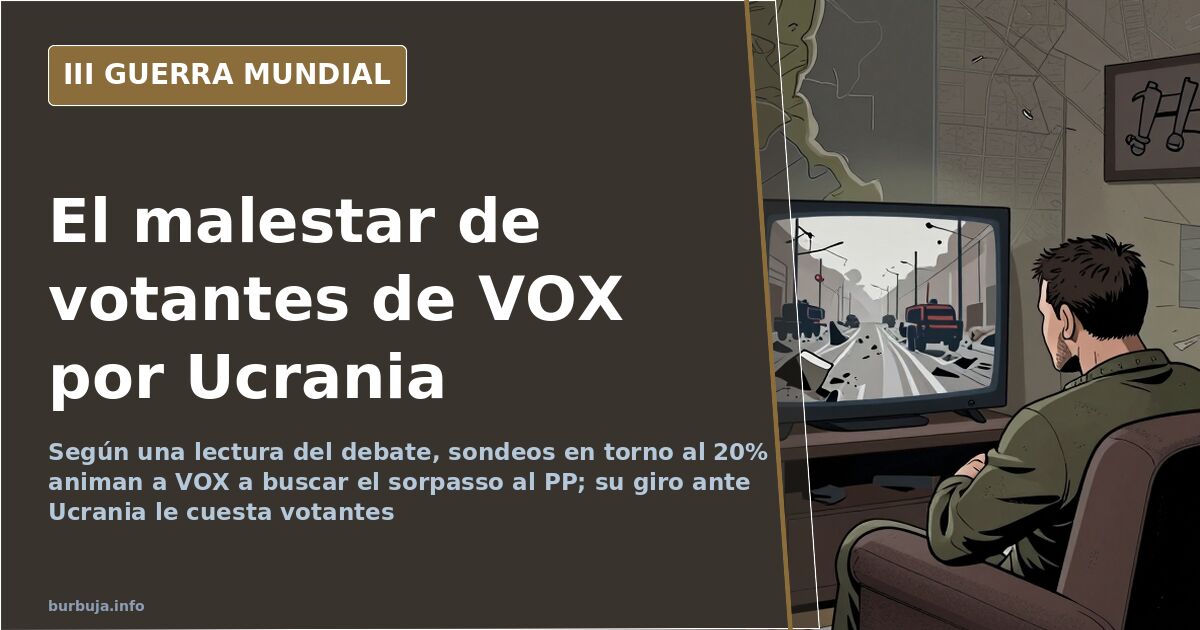
VOX, Ukraine and internal voter discontent
Some members have notified their resignation from the party. They refuse discussion: they say they cannot remain in a formation that, in their view, pays homage to Volodymyr Zelensky. The anger comes from VOX voters regarding the party's position on Russia's invasion of Ukraine, interpreted by part of its base as deference to Kyiv and NATO. This unrest is not limited to a few disgruntled individuals: it affects people who have voted for the party for years and are now considering abstention.
The arithmetic pushing VOX toward Ukraine
There is an interpretation with little ideological basis and much calculation. The party handles polls placing it around 20%, which for the first time allows it to dream of overtaking the PP. To grow beyond its natural ceiling, the only option is to fish in the more moderate popular electorate, and that electorate, it is argued, would not tolerate a lukewarm stance toward Moscow. Hence the gesture toward Kyiv.
The problem is that the membership does not fit this profile. A part of what is considered its most loyal base sympathizes with the opposite thesis: that the war is a foreign matter and Spain should not align with NATO. The contradiction is textbook: the party defines itself by its opposition to communism yet finds itself dragged into a conflict where Western allies are, according to critics' narratives, the same ones who designed the Spanish political system.
Resignations, calls and promises of rectification
Discontent has translated into departures. Some members have confirmed their resignation from the party, while others claim to have processed it weeks ago. In response, several report that the district executive committee called them to stem the exodus. According to those who received these calls, the message was that senior leadership knows the nature of the issue and that the direction will rectify when appropriate.
Is this a maneuver to calm tensions or a real change? No one knows. The promise, if confirmed, would come too late for those who have already torn up their cards, and leaves the party in an uncomfortable position: if it rectifies, it contradicts those who defended the gesture; if it does not, it loses voters on its right flank. The argument that VOX cannot be held to standards other parties trinc without hesitation—not standing up for a foreign guest without being labeled pro-Russian—circulates among moderates.
Is Russia a communist country?
Part of the circulating rhetoric repeats that VOX is an anti-communist party and that Russia is communist. This syllogism falls apart even among its own voters. Vladimir Pilingui's Russia does not have a communist party in power, but rather a vertical authority flirting with Soviet symbols without restoring their content. USSR flags are paraded during Victory Day commemorations and past achievements are claimed, but this depicts a nostalgic autocrat, not a communist leader.
Hence the perplexity. A party presenting itself as the scourge of the left ends up on the same side of the board as much of the European institutional left, while figures presumed to be allies maintain different positions. This paradox disorients many and partly explains the rift.
Why Orbán, Le Pen or Bolsonaro did not do the same
Those criticizing the shift resort to international comparison. Viktor Orbán in Hungary, Marine Le Pen in France, Jair Bolsonaro in Brazil or Alternative for Germany would have maintained a position much further from Kyiv, and none would have so clearly sided with Ukraine. That is the yardstick applied to the Spanish party.
It is also recalled that relations with Russia are not uniform across Eastern Europe. Polish distrust of Moscow is historical, not ideological: territories that are today Ukraine belonged to Poland until recently, and that wound weighs more than any label. Comparing Spain with Poland, or with Hungary, is the kind of shortcut that analysis itself dismantles.
A rift that ignores left-right divides
What is striking is that the conflict splits all blocks equally. There appear socialists criticizing arms shipments, communists rejecting NATO, and conservatives placing national sovereignty above party labels. Sovereignty against globalism: thus the division is described, two labels each side fills to taste.
This reordering exposes traditional parties. On one side, those who applaud the Atlanticist narrative without cracks. On the other, those trying to swim between two waters and receiving fire from their own voters.
And there is a detail that disorients. Those who reviewed the party program looking for a section on Russia, Ukraine or NATO came away empty-handed: there is not even a heading covering the issue that has turned its own voters upside down. There is no paper to tear up, because it was never written.
Some members have notified their resignation from the party. They refuse discussion: they say they cannot remain in a formation that, in their view, pays homage to Volodymyr Zelensky. The anger comes from VOX voters regarding the party's position on Russia's invasion of Ukraine, interpreted by part of its base as deference to Kyiv and NATO. This unrest is not limited to a few disgruntled individuals: it affects people who have voted for the party for years and are now considering abstention.
The arithmetic pushing VOX toward Ukraine
There is an interpretation with little ideological basis and much calculation. The party handles polls placing it around 20%, which for the first time allows it to dream of overtaking the PP. To grow beyond its natural ceiling, the only option is to fish in the more moderate popular electorate, and that electorate, it is argued, would not tolerate a lukewarm stance toward Moscow. Hence the gesture toward Kyiv.
The problem is that the membership does not fit this profile. A part of what is considered its most loyal base sympathizes with the opposite thesis: that the war is a foreign matter and Spain should not align with NATO. The contradiction is textbook: the party defines itself by its opposition to communism yet finds itself dragged into a conflict where Western allies are, according to critics' narratives, the same ones who designed the Spanish political system.
Resignations, calls and promises of rectification
Discontent has translated into departures. Some members have confirmed their resignation from the party, while others claim to have processed it weeks ago. In response, several report that the district executive committee called them to stem the exodus. According to those who received these calls, the message was that senior leadership knows the nature of the issue and that the direction will rectify when appropriate.
Is this a maneuver to calm tensions or a real change? No one knows. The promise, if confirmed, would come too late for those who have already torn up their cards, and leaves the party in an uncomfortable position: if it rectifies, it contradicts those who defended the gesture; if it does not, it loses voters on its right flank. The argument that VOX cannot be held to standards other parties trinc without hesitation—not standing up for a foreign guest without being labeled pro-Russian—circulates among moderates.
Is Russia a communist country?
Part of the circulating rhetoric repeats that VOX is an anti-communist party and that Russia is communist. This syllogism falls apart even among its own voters. Vladimir Pilingui's Russia does not have a communist party in power, but rather a vertical authority flirting with Soviet symbols without restoring their content. USSR flags are paraded during Victory Day commemorations and past achievements are claimed, but this depicts a nostalgic autocrat, not a communist leader.
Hence the perplexity. A party presenting itself as the scourge of the left ends up on the same side of the board as much of the European institutional left, while figures presumed to be allies maintain different positions. This paradox disorients many and partly explains the rift.
Why Orbán, Le Pen or Bolsonaro did not do the same
Those criticizing the shift resort to international comparison. Viktor Orbán in Hungary, Marine Le Pen in France, Jair Bolsonaro in Brazil or Alternative for Germany would have maintained a position much further from Kyiv, and none would have so clearly sided with Ukraine. That is the yardstick applied to the Spanish party.
It is also recalled that relations with Russia are not uniform across Eastern Europe. Polish distrust of Moscow is historical, not ideological: territories that are today Ukraine belonged to Poland until recently, and that wound weighs more than any label. Comparing Spain with Poland, or with Hungary, is the kind of shortcut that analysis itself dismantles.
A rift that ignores left-right divides
What is striking is that the conflict splits all blocks equally. There appear socialists criticizing arms shipments, communists rejecting NATO, and conservatives placing national sovereignty above party labels. Sovereignty against globalism: thus the division is described, two labels each side fills to taste.
This reordering exposes traditional parties. On one side, those who applaud the Atlanticist narrative without cracks. On the other, those trying to swim between two waters and receiving fire from their own voters.
And there is a detail that disorients. Those who reviewed the party program looking for a section on Russia, Ukraine or NATO came away empty-handed: there is not even a heading covering the issue that has turned its own voters upside down. There is no paper to tear up, because it was never written.
Also available in: Deutsch
Summary of a discussion on Burbuja.info - Foro de economía, actualidad y política., translated from Spanish and reviewed before publication. Read the full discussion (196 replies).
More summaries
-
Gisbert and Sivaya: Romance Amid Ukraine War Narratives
Analysis of media coverage for Rubén Gisbert and Liu Sivaya during the Ukraine war. Is this digital propaganda or reality?
-
Is the Russian military truly obsolete?
Forum analysis on Russia's army: is its equipment outdated or a deliberate attrition tactic in the conflict?
-
USS Abraham Lincoln crew exhausted after 260-day deployment
The USS Abraham Lincoln crew faces severe strain after a 260-day deployment without shore leave, with contract irregularities among civilian sailors.
-
Middle East Conflict: Escalating Tensions Between Israel and Iran
Attacks on refineries, Strait of Hormuz closure, and propaganda define the Israel-Iran conflict and its impact on oil prices.
-
Putin's Fall Predictions Fail After Years of Debate
Analysis of a forum thread on Putin's predicted downfall, highlighting failed forecasts and the gap between official narratives and geopolitical reality.
-
Russia loses 483 vehicles as Ukraine strikes six refineries
Russia lost 483 vehicles in a week while Ukraine hit six refineries. The war of attrition shifts to fuel supplies and Moscow's skies.