
Vox seeks to block foreign wealth from buying Spanish housing
Vox proposes a deterrent tax regime to stop wealthy foreigners from purchasing homes in Spain. The measure was previously rejected by the Congress.
English · Original discussion in Spanish · Published
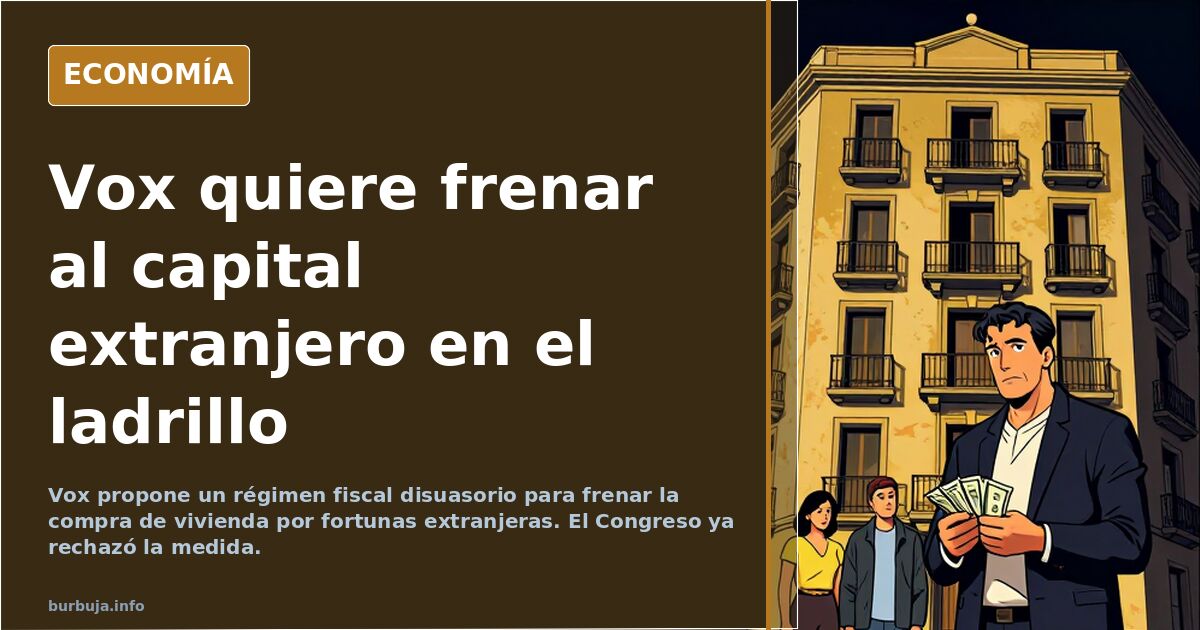
Vox moves to curb foreign wealth purchases of Spanish housing
A Vox proposal to impose a deterrent tax regime on foreigners buying property in Spain was rejected in the Congress. The party is pushing again, arguing that the middle class is being hollowed out and that access to housing has become an issue of national sovereignty. The measure, presented as a way to prioritize Spanish citizens for social housing, did not pass.
What Vox proposes for housing
Vox’s national spokesperson for Housing, Carlos Hernández Quero, defended in the Congress a motion resulting from an urgent interpellation regarding young people's access to housing. In his speech, he denounced that the two-party system has treated young people like lab rats for years and that current policies have produced a sad outcome after decades of management. The flagship proposal involves fiscally discouraging purchases by foreign fortunes and prioritizing Spaniards for social housing access.
The measure is not new. Vox already tried unsuccessfully to get the Congress to approve a deterrent tax regime for foreigners interested in acquiring properties in Spain. The initiative was dismissed. The party insists that housing is a matter of family, justice, and national sovereignty, and that the middle class is being gutted.
Real estate as an investment asset
Some argue that the problem is not foreign fortunes, but real estate serving as a near-unique investment asset for part of the population. The argument is that capital that could go to other activities always ends up in housing, putting upward pressure on prices. Added to this is the massive influx of tourists, who compete for the same property stock.
Some claim that liberalizing land would make housing cheaper. Others argue that land is not infinite and that if work is concentrated in Madrid, Barcelona, and a few other cities, it makes no difference to liberalize: demographic pressure on those areas keeps prices high.
How much does it cost to build a home in Spain?
One of the circulating analyses starts from an uncomfortable premise: even without land or taxes, a basic 100-square-meter single-family home costs 160,000 euros under the current building technical code. For a ten-story building with two apartments per floor, the figure would be around 100,000 euros per unit.
From there, the full breakdown adds 30% for connections and project design, and another 30% for licenses and taxes. The result is that there is no way to build below 150,000 euros even with the lowest quality finishes, and that excludes land costs and financial costs generated by administrative delays in projects.
What can be done with foreigners who are already owners?
The debate does not stop at future purchases. Some raise the question of what to do with foreigners who already own homes in Spain. In coastal areas and adjacent zones, they hold a large part of the property stock, and the same is starting to be seen in Madrid. The circulating proposal is to increase VAT on purchases by non-residents and use that money to reduce the tax on first homes for Spaniards, in addition to increasing the IBI (property tax) for those who already have multiple properties.
The model cited as a reference is Denmark’s, which prohibits foreigners from buying homes in certain coastal areas. The argument is that if it is legal in an EU country, Brussels cannot prohibit it in Spain. Even if you are a European citizen, if you are not a resident in those areas, you cannot buy.
Border control as housing policy
Part of the analysis argues that the problem is not foreign fortunes, but the mass of population arriving each year. The argument is that if people enter en masse and work is concentrated in a few cities, available land is insufficient. The proposed defense is closing borders, incentivizing investment in assets other than real estate, and building first homes at reasonable prices.
Against this weighs the fact that parties discuss who to let in, not whether or how many should be allowed. And that migratory growth also supports the pension system, complicating any closure. The tension between border control and welfare state sustainability runs through the entire debate.
The drift of right-wing parties
Some observe a recurring historical phenomenon: the conversion of right-wing parties into left-wing parties over time. The Carlist party, guardian of imperial essences, ended up integrated into Izquierda Unida (United Left). La Falange was pure socialism. The PP has also shifted. The thesis is that the infiltration of leftist elements into right-wing parties is a common process that repeats itself over and over.
Others argue that in Spain there are no real ideologies, but a unitary regime ideology with aesthetic differences. Pablo Iglesias himself said so: I say I am communist, but when I run for elections I have to carry a real program, a social-democratic program. The conclusion drawn is that Vox is a social-democratic party like all others, with its small aesthetic differences.
Is housing a supply, demand, or both problem? The debate remains open and no one has found the formula that satisfies everyone.
A Vox proposal to impose a deterrent tax regime on foreigners buying property in Spain was rejected in the Congress. The party is pushing again, arguing that the middle class is being hollowed out and that access to housing has become an issue of national sovereignty. The measure, presented as a way to prioritize Spanish citizens for social housing, did not pass.
What Vox proposes for housing
Vox’s national spokesperson for Housing, Carlos Hernández Quero, defended in the Congress a motion resulting from an urgent interpellation regarding young people's access to housing. In his speech, he denounced that the two-party system has treated young people like lab rats for years and that current policies have produced a sad outcome after decades of management. The flagship proposal involves fiscally discouraging purchases by foreign fortunes and prioritizing Spaniards for social housing access.
The measure is not new. Vox already tried unsuccessfully to get the Congress to approve a deterrent tax regime for foreigners interested in acquiring properties in Spain. The initiative was dismissed. The party insists that housing is a matter of family, justice, and national sovereignty, and that the middle class is being gutted.
Real estate as an investment asset
Some argue that the problem is not foreign fortunes, but real estate serving as a near-unique investment asset for part of the population. The argument is that capital that could go to other activities always ends up in housing, putting upward pressure on prices. Added to this is the massive influx of tourists, who compete for the same property stock.
Some claim that liberalizing land would make housing cheaper. Others argue that land is not infinite and that if work is concentrated in Madrid, Barcelona, and a few other cities, it makes no difference to liberalize: demographic pressure on those areas keeps prices high.
How much does it cost to build a home in Spain?
One of the circulating analyses starts from an uncomfortable premise: even without land or taxes, a basic 100-square-meter single-family home costs 160,000 euros under the current building technical code. For a ten-story building with two apartments per floor, the figure would be around 100,000 euros per unit.
From there, the full breakdown adds 30% for connections and project design, and another 30% for licenses and taxes. The result is that there is no way to build below 150,000 euros even with the lowest quality finishes, and that excludes land costs and financial costs generated by administrative delays in projects.
What can be done with foreigners who are already owners?
The debate does not stop at future purchases. Some raise the question of what to do with foreigners who already own homes in Spain. In coastal areas and adjacent zones, they hold a large part of the property stock, and the same is starting to be seen in Madrid. The circulating proposal is to increase VAT on purchases by non-residents and use that money to reduce the tax on first homes for Spaniards, in addition to increasing the IBI (property tax) for those who already have multiple properties.
The model cited as a reference is Denmark’s, which prohibits foreigners from buying homes in certain coastal areas. The argument is that if it is legal in an EU country, Brussels cannot prohibit it in Spain. Even if you are a European citizen, if you are not a resident in those areas, you cannot buy.
Border control as housing policy
Part of the analysis argues that the problem is not foreign fortunes, but the mass of population arriving each year. The argument is that if people enter en masse and work is concentrated in a few cities, available land is insufficient. The proposed defense is closing borders, incentivizing investment in assets other than real estate, and building first homes at reasonable prices.
Against this weighs the fact that parties discuss who to let in, not whether or how many should be allowed. And that migratory growth also supports the pension system, complicating any closure. The tension between border control and welfare state sustainability runs through the entire debate.
The drift of right-wing parties
Some observe a recurring historical phenomenon: the conversion of right-wing parties into left-wing parties over time. The Carlist party, guardian of imperial essences, ended up integrated into Izquierda Unida (United Left). La Falange was pure socialism. The PP has also shifted. The thesis is that the infiltration of leftist elements into right-wing parties is a common process that repeats itself over and over.
Others argue that in Spain there are no real ideologies, but a unitary regime ideology with aesthetic differences. Pablo Iglesias himself said so: I say I am communist, but when I run for elections I have to carry a real program, a social-democratic program. The conclusion drawn is that Vox is a social-democratic party like all others, with its small aesthetic differences.
Is housing a supply, demand, or both problem? The debate remains open and no one has found the formula that satisfies everyone.
Summary of a discussion on Burbuja.info - Foro de economía, actualidad y política., translated from Spanish and reviewed before publication. Read the full discussion (179 replies).
More summaries
-
Spain Pension Debate: Bank of Spain December Funds Claim
Economist José Carlos Díez claims insufficient funds for December pensions, sparking political and economic debate in Spain over sustainability and debt.
-
Zapatero's Wife Paid Off €500k Mortgage in Under a Year
Burbuja.info analyzes the controversial €500,000 transfer used to cancel Sonsoles Espinosa's mortgage. Corruption or savvy management?
-
Iran Explosion: Tactical Nuke or Media Hoax?
Debate on whether an impact in Iran was a tactical nuclear bomb or a hoax. Technical analysis of EMP and destruction scale.
-
Debate: Opting out of Spain's social security system
A thread proposes leaving Spain's public system to self-fund healthcare and pensions, sparking debate on contributions, taxes, and international comparisons.
-
Cat Euthanasia: €195 Cost and 18 Years of Companionship
An owner pays €195 to euthanize his 18-year-old cat, sparking debate on pet grief, veterinary costs, and end-of-life choices.
-
Spain's Social Security: Key Law Passed in 1963, Not Franco Era
Spain's Social Security stems from a 1963 law, not a Franco decree. Universal healthcare arrived in 1986. The debate on origins is clarified.