
Spain's Social Security: Key Law Passed in 1963, Not Franco Era
Spain's Social Security stems from a 1963 law, not a Franco decree. Universal healthcare arrived in 1986. The debate on origins is clarified.
English · Original discussion in Spanish · Published
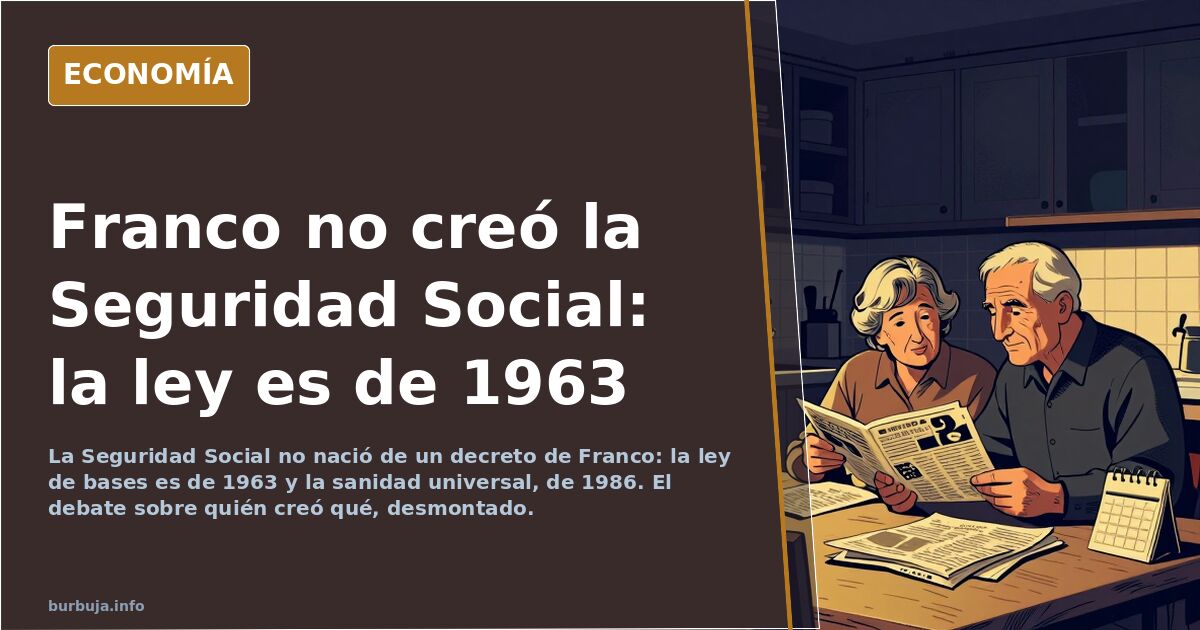
Franco Did Not Invent Spain's Social Security: Key Law Dates to 1963
Spain’s Social Security system did not originate from a decree by General Franco, but from a framework law approved in 1963, nearly two decades after mandatory sickness and old-age insurance schemes already existed. The confusion between «creating» and «unifying» pervades a debate mixing history, politics, and selective memory.
The discussion stems from a video denying the Francoist paternity of the system. It argues that a precursor to Social Security existed before the uprising, and that the foundational norm arrived in 1963, under Franco’s regime. Those defending the opposite view respond that the current system, with mandatory contributions, healthcare, and public pensions, is a direct heir of that law.
What Exactly Was Created in 1963?
The Framework Law on Social Security of 1963 established a unified and mandatory protection system, but it did not start from scratch. Since 1942, there was universal health insurance, and before the Civil War, welfare mechanisms and labor mutuals were already functioning. The 1963 law organized this mosaic; it did not invent it.
Some argue that Franco was the architect of the welfare state later enshrined in the Constitution. Against this weighs a more prosaic argument: universal and free healthcare for all Spaniards did not arrive until the General Health Law of 1986, which separated healthcare from Social Security and peine it to non-contributors.
Universal Healthcare: 1986, Not 1963
The most repeated point is that public healthcare as we understand it today dates to 1986. Until then, access depended on the head of household’s labor mutual. Those who did not work or contribute had to pay a medical fee («iguala») to receive assistance. This detail dismantles the idea of a universal system under Francoism.
The confusion is easy to explain: the term «Social Security» is still used to refer to the healthcare system, although this is managed by autonomous communities. The transfer of healthcare powers to the regions occurred during Aznar’s era, not before. Hence, many citizens still associate their health card with the Social Security stamp.
The Economic Miracle and the Eighth Power
Another front of the debate is economic. The Stabilization Plan of 1959 and growth between 1959 and 1974 are cited, when Spain allegedly reached the status of the world’s eighth largest economy by GDP. This data is used to claim credit for Francoist development, although the same messages acknowledge they do not intend to defend the regime, but «Spanish history».
The objection is that this growth came after decades of autarky and isolation, and that opening to international trade allowed the takeoff. Tourism and industry drove GDP, but so did mass emigration and remittances. The miracle was more about late correction than brilliant design.
What AI Says and What AI Does Not Say
One of the most striking twists is the use of artificial intelligence as a historical arbiter. Several messages cite ChatGPT responses to support their theses, while others dismiss them as biased. The paradox is evident: the same tool serves to affirm that Franco created Social Security and to deny it.
AI certifies nothing. It repeats what it finds. And what it finds is an open historiographical debate, with specific dates that each side interprets its way. The hard fact is that the framework law is from 1963 and universal healthcare is from 1986. Everything else is narrative.
Charity, Mutuals, and Bullfights
The prehistory of the system goes back further. Precursors to Social Security would be charity («beneficencia»), born in the 16th century and sustained by the Church. From the 18th century onwards, bullfights funded much of that charity. A detail that dismantles any linear and heroic narrative.
It is also debated whether the eight-hour workday arrived with the Republic or earlier. Some argue it already existed since the Catholic Monarchs in America, which sounds more like a witticism than an argument. Spanish labor history is a puzzle of scattered norms, not a succession of clean milestones.
Why This Discussion Matters
This is not a debate for antiquarians. What is at stake is the legitimacy of the welfare state: whether it was born from an authoritarian regime or a prior tradition, and whether its democratic consolidation was a mere finishing touch or a refoundation. Each side uses the date that suits them.
The 1963 law unified; the 1986 law universalized. Between both lies a dictatorship, a transition, and a democracy that expanded rights. Reducing everything to a proper name is cheating. The uncomfortable question is: why do we insist that a single man explains a system built by thousands?
Spain’s Social Security system did not originate from a decree by General Franco, but from a framework law approved in 1963, nearly two decades after mandatory sickness and old-age insurance schemes already existed. The confusion between «creating» and «unifying» pervades a debate mixing history, politics, and selective memory.
The discussion stems from a video denying the Francoist paternity of the system. It argues that a precursor to Social Security existed before the uprising, and that the foundational norm arrived in 1963, under Franco’s regime. Those defending the opposite view respond that the current system, with mandatory contributions, healthcare, and public pensions, is a direct heir of that law.
What Exactly Was Created in 1963?
The Framework Law on Social Security of 1963 established a unified and mandatory protection system, but it did not start from scratch. Since 1942, there was universal health insurance, and before the Civil War, welfare mechanisms and labor mutuals were already functioning. The 1963 law organized this mosaic; it did not invent it.
Some argue that Franco was the architect of the welfare state later enshrined in the Constitution. Against this weighs a more prosaic argument: universal and free healthcare for all Spaniards did not arrive until the General Health Law of 1986, which separated healthcare from Social Security and peine it to non-contributors.
Universal Healthcare: 1986, Not 1963
The most repeated point is that public healthcare as we understand it today dates to 1986. Until then, access depended on the head of household’s labor mutual. Those who did not work or contribute had to pay a medical fee («iguala») to receive assistance. This detail dismantles the idea of a universal system under Francoism.
The confusion is easy to explain: the term «Social Security» is still used to refer to the healthcare system, although this is managed by autonomous communities. The transfer of healthcare powers to the regions occurred during Aznar’s era, not before. Hence, many citizens still associate their health card with the Social Security stamp.
The Economic Miracle and the Eighth Power
Another front of the debate is economic. The Stabilization Plan of 1959 and growth between 1959 and 1974 are cited, when Spain allegedly reached the status of the world’s eighth largest economy by GDP. This data is used to claim credit for Francoist development, although the same messages acknowledge they do not intend to defend the regime, but «Spanish history».
The objection is that this growth came after decades of autarky and isolation, and that opening to international trade allowed the takeoff. Tourism and industry drove GDP, but so did mass emigration and remittances. The miracle was more about late correction than brilliant design.
What AI Says and What AI Does Not Say
One of the most striking twists is the use of artificial intelligence as a historical arbiter. Several messages cite ChatGPT responses to support their theses, while others dismiss them as biased. The paradox is evident: the same tool serves to affirm that Franco created Social Security and to deny it.
AI certifies nothing. It repeats what it finds. And what it finds is an open historiographical debate, with specific dates that each side interprets its way. The hard fact is that the framework law is from 1963 and universal healthcare is from 1986. Everything else is narrative.
Charity, Mutuals, and Bullfights
The prehistory of the system goes back further. Precursors to Social Security would be charity («beneficencia»), born in the 16th century and sustained by the Church. From the 18th century onwards, bullfights funded much of that charity. A detail that dismantles any linear and heroic narrative.
It is also debated whether the eight-hour workday arrived with the Republic or earlier. Some argue it already existed since the Catholic Monarchs in America, which sounds more like a witticism than an argument. Spanish labor history is a puzzle of scattered norms, not a succession of clean milestones.
Why This Discussion Matters
This is not a debate for antiquarians. What is at stake is the legitimacy of the welfare state: whether it was born from an authoritarian regime or a prior tradition, and whether its democratic consolidation was a mere finishing touch or a refoundation. Each side uses the date that suits them.
The 1963 law unified; the 1986 law universalized. Between both lies a dictatorship, a transition, and a democracy that expanded rights. Reducing everything to a proper name is cheating. The uncomfortable question is: why do we insist that a single man explains a system built by thousands?
Summary of a discussion on Burbuja.info - Foro de economía, actualidad y política., translated from Spanish and reviewed before publication. Read the full discussion (175 replies).
More summaries
-
Spain's ERE layoff wave nobody wants to see
Analysis of the wave of layoffs and ERE in Spain. Burbuja.info forum users expose the industrial reality the media won't show.
-
CaixaBank Research links immigration to housing prices
CaixaBank Research finds that immigration drives up housing costs in Madrid and Barcelona.
-
Spanish Lawyers Face Low Pensions After Decades in Mutual System
Spanish lawyers in the mutual system receive €300-€500 pensions after decades of work. The RETA transition excludes those who joined after 1996.
-
AMOC collapse could cool Europe by 3°C per decade starting in 2030
Science Advances study suggests AMOC collapse between 2030 and 2040, contradicting IPCC forecasts. Potential rapid cooling threatens European climate stability.
-
Police assault in Manchester sparks debate on female officers' fitness
A punch to a police officer's face in Manchester reignites controversy over physical standards and gender quotas in UK emergency services.
-
From $15,000 Monthly to Spain's Minimum Income: Controversy Erupts
A user claims earning $15,000 monthly while relying on Spain's IMV and RAI benefits. Forum users question his calculations and hidden assets.