
Vox overtakes PSOE in 5 Spanish provinces and closes in on 9 more
Vox would overtake the PSOE in five provinces plus Ceuta and Melilla, and is close to doing so in nine others, including Madrid and Málaga, according to a circulating electoral map.
English · Original discussion in Spanish · Published
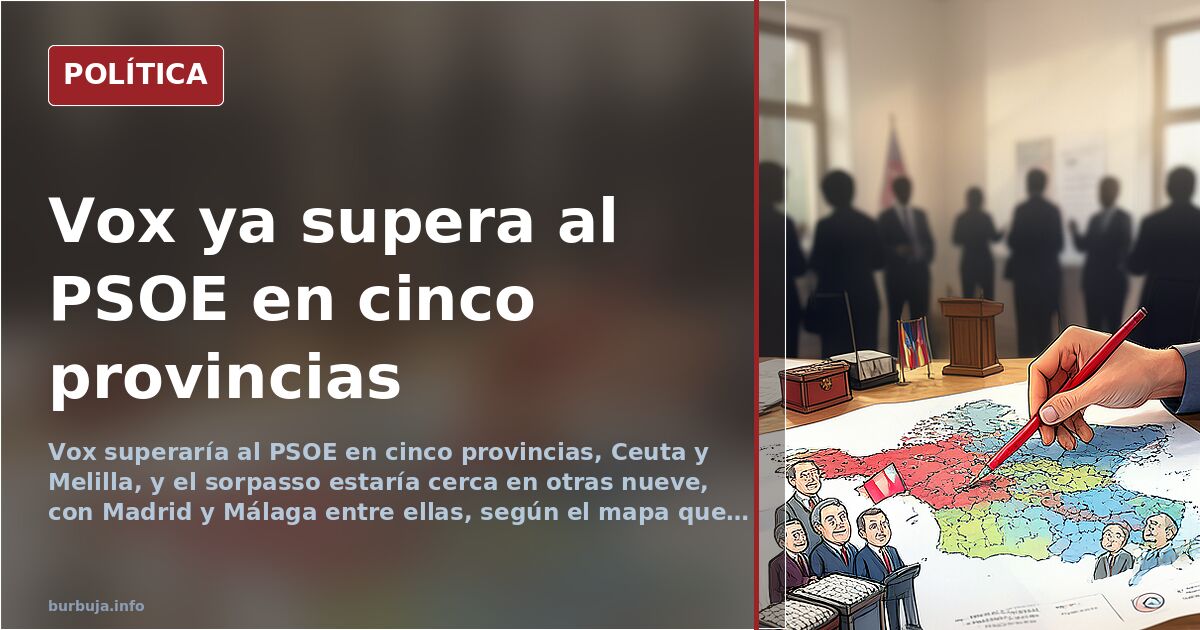
Vox moves ahead of the PSOE in five provinces and knocks on the door in nine more
Murcia is the showcase. According to the electoral map circulating on social media, Vox would beat the PSOE there by 11.8 points, a margin that in practice turns the region into a two-round stronghold. The same projection places Santiago Abascal's party ahead of the Socialists in five provinces, to which Ceuta and Melilla would be added, and leaves the so-called overtaking within reach in nine others, with Madrid and Málaga among the highlighted spots.
The figure is not an official poll or a final count: it is an estimate shared as an image and should be read with the caution any territorial projection demands. Even so, it marks a trend the party has been capitalising on in its messaging for months. Public debate has stopped asking whether Vox can overtake the PSOE anywhere and now discusses how many places and how fast.
Where the overtaking happens and where it is close
The map shows two speeds. In the first group, the overtaking would already be complete: five provinces plus the two autonomous cities. In the second, the margin is so narrow that a handful of votes could tip the balance. Madrid and Málaga fall into that intermediate band, which explains why the issue is no longer peripheral.
The choice of Murcia as an example is no accident. It is a region where the party has already governed in coalition with the PP, and where the Socialists' erosion is measured in seats, not slogans. The 11.8-point lead works as a headline because it condenses the whole narrative of collapse into a single figure.
The municipal precedent nobody mentions
There is a detail that often goes unnoticed and reinforces the thesis: in the Extremadura regional elections, Vox finished above the PSOE in Badajoz, the region's most populous city. It is not a province and it does not change a government, but it shows the phenomenon is not limited to the traditional strongholds of the right.
The opposite reading also has legs. A good result in one specific urban centre does not automatically transfer to the map as a whole, and projections built on shared images tend to age badly. Spanish politics has produced enough swings in recent years to distrust any straight line.
The other battle: electoral roll, nationalities and overseas voting
Alongside the electoral map, the conversation shifted to an issue the party has turned into a cause: the application of the so-called ley de nietos (grandchildren law, which grants Spanish nationality to descendants of Spaniards abroad) and the electoral registration of newly naturalised citizens. From various platforms, irregularities have been denounced in the granting of nationality at consulates in Cuba, Argentina, Mexico and Venezuela, and the criticism has been taken to the Defensor del Pueblo (Spain's ombudsman) over its handling.
The repeated argument is that millions of new Spaniards could vote under questionable oversight, with generous deadlines for voting from abroad. It is an accusation the party makes publicly and which has not been confirmed in court; it should be treated as what it is, an ongoing political allegation. In that context, the provincial map itself is read as a gauge of how far the Government's erosion extends.
What a provincial overtaking really measures
Winning a province is not the same as winning an election. The system allocates seats by constituency, and a second place can be worth as much as a first if the distribution is tight. That is why the five overtakings and the nine up-for-grabs spots matter less for their symbolic value than for what they say about the Socialists' electoral floor.
There lies the unsettling figure: a party that did not exist in the institutions a decade ago is now considering overtaking the PSOE in seven territories and coming within a whisker in nine more. Whether the map holds or deflates is something no projection shared on social media can answer yet.
Also available in: Deutsch
Summary of a discussion on Burbuja.info - Foro de economía, actualidad y política., translated from Spanish and reviewed before publication. Read the full discussion (31 replies).
More summaries
-
Madrid rolls out 1,100 LPR cameras across 142 villages
Madrid is installing over 1,100 LPR cameras at 564 locations in 142 small municipalities, spending €17 million over five years to read licence plates.
-
Hispanism and the tug-of-war over Ceuta, Melilla, and Gibraltar
Rafael Rosselló is accused of placing Ceuta and Melilla under Morocco and Gibraltar under Britain, dividing the Hispanic community between the Americas and Europe.
-
Madrid train bombings: missing evidence fuels conspiracy theories
191 dead, 1,858 injured and lost forensic evidence: the enduring controversy and conspiracy theories surrounding the 2004 Madrid train bombings.
-
Former Spanish PM Zapatero charged with money laundering and criminal organisation
Spain's National Court has charged Zapatero with money laundering and criminal organisation. His daughters are also under investigation. The case broke right after the Andalusian elections.
-
Zapatero in court: legal shield or trial by media
The case against Spain's former PM Zapatero is on shaky ground: US evidence could be thrown out. He may avoid prison, but the reputational cost could be…
-
Spain's Sánchez sets 2031 horizon and urges 'courage' on PSOE amid scandals
Pedro Sánchez sets a 2031 horizon and calls for courage from Spain's PSOE amid a wave of scandals, while the grandchildren law adds 16,000 new voters a month.