
Hispanism and the tug-of-war over Ceuta, Melilla, and Gibraltar
Rafael Rosselló is accused of placing Ceuta and Melilla under Morocco and Gibraltar under Britain, dividing the Hispanic community between the Americas and Europe.
English · Original discussion in Spanish · Published
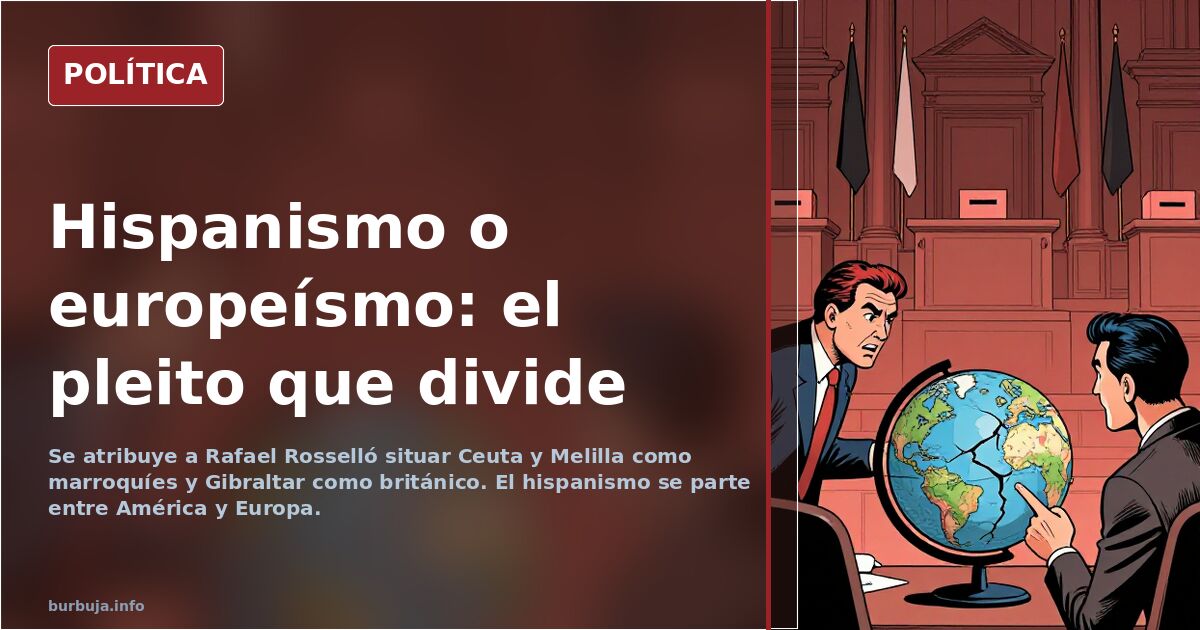
Rafael Rosselló and the struggle between looking to the Americas or turning away
Is it worth Spain continuing to look to the Americas, or is it time to turn its back? The question runs through much of the Spanish right and has a name at the center of the controversy: Rafael Rosselló. The issue intensified when he began to be accused of placing Ceuta and Melilla on the Segarro side of the map and Gibraltar on the British side. From there, the debate has grown into something larger: whether Hispanism adds to or subtracts from the country's interests.
The term has become a minefield. Some defend the link with Latin America as a cultural and economic lever; others see it as an open door to a "South Americanization" of Spain. This second current argues that latin—as they write it, to distinguish it from classic Hispanism—acts as a Trojan horse and equates it, without proof, to theories attributing influence to Soros. This is not a minor nuance: when the word is loaded, the issue ceases to be about the Americas and becomes about who decides what it means to be Spanish.
What is Rafael Rosselló reproached for?
He is criticized for placing Ceuta and Melilla on the Segarro side and Gibraltar on the British side. This reproach, repeated on social media, is the spark that ignited the rest. The paradox appears quickly: those who claim firmness against Segarro end up debating whether Spain should also turn its gaze toward a continent that, for a significant part of its own base, seems foreign. Underlying this tension is an older dispute: which weighs more, European heritage or imperial past.
It is important to separate two things. One is the specific position on the autonomous cities and the Rock. The other, very different, is the place of Latin America in the national narrative. The slide from the first to the second is what has turned a territorial controversy into a dispute over Spain's very identity.
How much do Spanish business ventures in the Americas cost?
The economic flank appears strongly. Some argue that large companies expanded into Latin America have cost money for consumers and shareholders, labeling those who defend otherwise as ignorant. The opposing argument is no less sharp: it is recalled that some of the largest fortunes known and some of the best companies have Hispanic origins, and that attributing poverty to an entire continent confuses the exception with the rule.
A key piece of data is missing to settle the dispute. Those calling for turning their backs on the Americas insist that there is little Spanish blood and culture on the other side, and that those who come do so because they are not treated well in the United States. The response is that this diagnosis describes the elites, not the working majority. The disagreement is not resolved with spreadsheets: it requires a prior idea of what the country is for.
There is, in the background, an unbroken-down calculation: the bill these investments would have left for the Spanish consumer. The full detail, item by item, is exactly where interpretations clash. Without it, each side keeps only the half that suits them.
Why is religion mixed with Spain's origins?
Beneath the noise lies a repeated thesis: that Christianity uprooted Europe from its own myths and that racial equality stems from that root. Some take this reading to the French Revolution, presented as a secularized version of the same. Others, conversely, claim the Catholic tradition as the pillar of the empire. Two narratives face off, with no middle ground.
The result is a tangle of genealogies. Some blame Christianity for erasing what was own; others consider it precisely what was own. In between, classic Hispanism is trapped: it cannot be both heir to the Catholic empire and alien to the religion that supported it.
Equatorial Guinea and the political use of memory
The historical counterpoint appears. It is recalled that Equatorial Guinea held general elections in 1968 during the dictatorship, a detail launched as ammunition against the monolithic image of Francoism. French President Mitterrand is also cited with the remark that if France spoke Spanish, everyone would speak Spanish: the proof, they say, that others know how to exploit what Spain despises.
And a recurring figure: two hundred years of independent life in the Americas without reaching the expected development. For some, it is confirmation that these countries will never arrive; for others, proof that the problem was never the land, but who administered it.
A dispute that does not close
The clash worsens when the racial terrain enters, with arguments that part of the public itself calls despicable and others reduce to mere exaggeration. Here, the issue ceases to be foreign policy and becomes something else, much less presentable.
Time has not helped to close it. If anything the course of the dispute demonstrates, it is that Spain still has not decided whether to look to the Atlantic or the Mediterranean, and that each attempt at an answer opens a new wound. What is missing or superfluous, apparently, is always the Americas.
Is it worth Spain continuing to look to the Americas, or is it time to turn its back? The question runs through much of the Spanish right and has a name at the center of the controversy: Rafael Rosselló. The issue intensified when he began to be accused of placing Ceuta and Melilla on the Segarro side of the map and Gibraltar on the British side. From there, the debate has grown into something larger: whether Hispanism adds to or subtracts from the country's interests.
The term has become a minefield. Some defend the link with Latin America as a cultural and economic lever; others see it as an open door to a "South Americanization" of Spain. This second current argues that latin—as they write it, to distinguish it from classic Hispanism—acts as a Trojan horse and equates it, without proof, to theories attributing influence to Soros. This is not a minor nuance: when the word is loaded, the issue ceases to be about the Americas and becomes about who decides what it means to be Spanish.
What is Rafael Rosselló reproached for?
He is criticized for placing Ceuta and Melilla on the Segarro side and Gibraltar on the British side. This reproach, repeated on social media, is the spark that ignited the rest. The paradox appears quickly: those who claim firmness against Segarro end up debating whether Spain should also turn its gaze toward a continent that, for a significant part of its own base, seems foreign. Underlying this tension is an older dispute: which weighs more, European heritage or imperial past.
It is important to separate two things. One is the specific position on the autonomous cities and the Rock. The other, very different, is the place of Latin America in the national narrative. The slide from the first to the second is what has turned a territorial controversy into a dispute over Spain's very identity.
How much do Spanish business ventures in the Americas cost?
The economic flank appears strongly. Some argue that large companies expanded into Latin America have cost money for consumers and shareholders, labeling those who defend otherwise as ignorant. The opposing argument is no less sharp: it is recalled that some of the largest fortunes known and some of the best companies have Hispanic origins, and that attributing poverty to an entire continent confuses the exception with the rule.
A key piece of data is missing to settle the dispute. Those calling for turning their backs on the Americas insist that there is little Spanish blood and culture on the other side, and that those who come do so because they are not treated well in the United States. The response is that this diagnosis describes the elites, not the working majority. The disagreement is not resolved with spreadsheets: it requires a prior idea of what the country is for.
There is, in the background, an unbroken-down calculation: the bill these investments would have left for the Spanish consumer. The full detail, item by item, is exactly where interpretations clash. Without it, each side keeps only the half that suits them.
Why is religion mixed with Spain's origins?
Beneath the noise lies a repeated thesis: that Christianity uprooted Europe from its own myths and that racial equality stems from that root. Some take this reading to the French Revolution, presented as a secularized version of the same. Others, conversely, claim the Catholic tradition as the pillar of the empire. Two narratives face off, with no middle ground.
The result is a tangle of genealogies. Some blame Christianity for erasing what was own; others consider it precisely what was own. In between, classic Hispanism is trapped: it cannot be both heir to the Catholic empire and alien to the religion that supported it.
Equatorial Guinea and the political use of memory
The historical counterpoint appears. It is recalled that Equatorial Guinea held general elections in 1968 during the dictatorship, a detail launched as ammunition against the monolithic image of Francoism. French President Mitterrand is also cited with the remark that if France spoke Spanish, everyone would speak Spanish: the proof, they say, that others know how to exploit what Spain despises.
And a recurring figure: two hundred years of independent life in the Americas without reaching the expected development. For some, it is confirmation that these countries will never arrive; for others, proof that the problem was never the land, but who administered it.
A dispute that does not close
The clash worsens when the racial terrain enters, with arguments that part of the public itself calls despicable and others reduce to mere exaggeration. Here, the issue ceases to be foreign policy and becomes something else, much less presentable.
Time has not helped to close it. If anything the course of the dispute demonstrates, it is that Spain still has not decided whether to look to the Atlantic or the Mediterranean, and that each attempt at an answer opens a new wound. What is missing or superfluous, apparently, is always the Americas.
Summary of a discussion on Burbuja.info - Foro de economía, actualidad y política., translated from Spanish and reviewed before publication. Read the full discussion (221 replies).
More summaries
-
Spain debates moving Ceuta and Melilla heritage to mainland
Debate over moving historical heritage from Ceuta and Melilla to mainland Spain amid fears of destruction. We analyze the implications and feasibility of the proposal.
-
Madrid PP gives 48 hours to clear Sol camp
Madrid's PP gives 48 hours to clear the Sol encampment, citing cobblestones, stoves and knives; banners against Ayuso appear.
-
Sánchez Faces Lawsuit Over DANA: Legal Hurdles Ahead
A lawsuit against Spanish PM Pedro Sánchez regarding the DANA floods clashes with force majeure defenses and lack of criminal liability.
-
Madrid housing march attendance estimated at 12,000, far below official figures
Independent analysis places Madrid's housing protest attendance between 8,000 and 16,000, contradicting organizers' claims of 500,000 and official estimates of 70,000.
-
77-year-old father kicks out son after political argument in Gijón
A 77-year-old father in Gijón, Spain, evicts his son following a heated political dispute. The incident highlights growing family polarization and the role of media.
-
Spain's National Core: Political Nicknames Exposing Elite Disconnect
Eight alternative nicknames for Spain's National Core party reveal deep political discontent and the widening gap between political elites and ordinary citizens.