
Madrid rolls out 1,100 LPR cameras across 142 villages
Madrid is installing over 1,100 LPR cameras at 564 locations in 142 small municipalities, spending €17 million over five years to read licence plates.
English · Original discussion in Spanish · Published
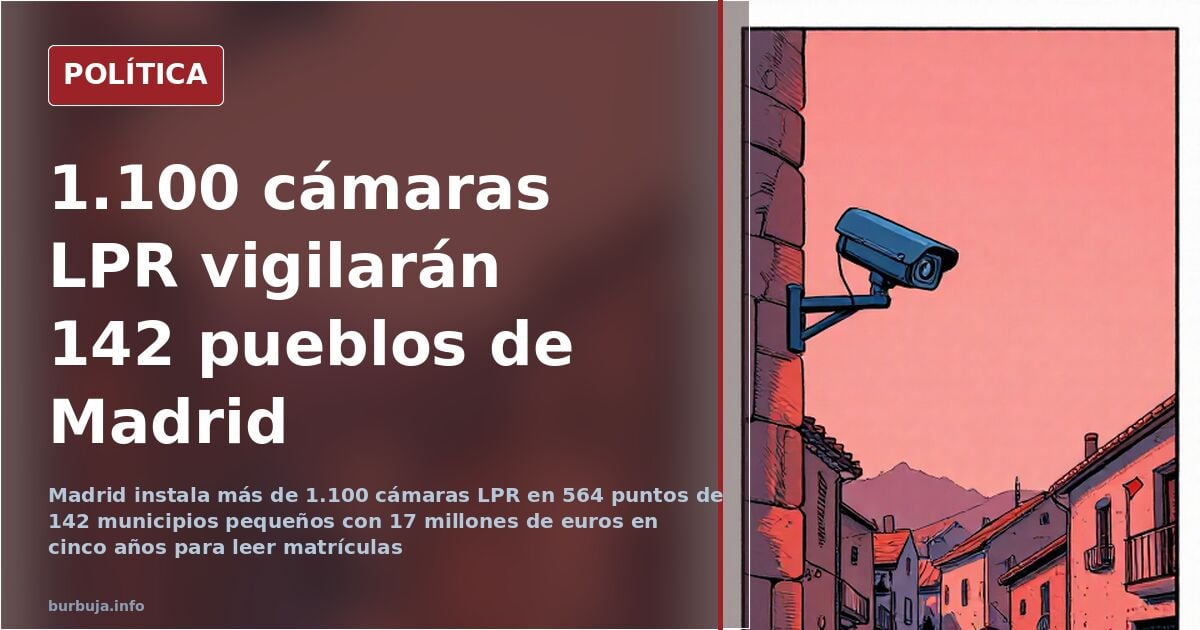
Madrid puts 1,100 LPR cameras in 142 small villages
The Madrid regional government will install more than 1,100 smart licence plate recognition cameras spread across 564 control points in municipalities with fewer than 20,000 residents. The project, announced on 10 September by regional president Isabel Díaz Ayuso, involves an investment of €17 million over five years and forms part of the Pueblos con Vida programme. It covers 142 localities and starts with an automatic number plate recognition (ANPR) system that will record and interpret the plates of vehicles passing each monitored point.
The fine print of the announcement is the usual: security first, then mobility, and data processing last. The official text states that the infrastructure will be integrated with emergency services and with Madrid 112's Municipal Coordination Centre (CECOM), and that the model shifts from reactive to proactive. In plain terms: the camera doesn't wait for something to happen, it watches beforehand.
What is an ANPR system and what will it be used for
ANPR (Automatic Number Plate Recognition) is the first component of the rollout. The cameras capture the plate and the software recognises it automatically, generating information that can be used for three things: managing mobility, detecting traffic incidents and identifying vehicles of interest to law enforcement. This is not new technology in the region: the regional government has already used it on the move for transport inspections, where it allows selective checks and detects unauthorised drivers.
The legal framework is no minor detail. The regional administration itself acknowledges that this type of measure must be developed within the applicable data protection and video surveillance framework. That is where the real battle is fought, not in the number of cameras.
The €17 million and the 40 road cameras
The rollout does not come alone. In parallel, the regional government has announced up to 40 smart cameras on its regional road network, as part of a €5.3 million investment to modernise traffic information systems with Big Data and artificial intelligence. These cameras will be able to detect, count and classify vehicles automatically.
The figure that stings is the coverage: 142 municipalities, 564 points, more than 1,100 eyes. That works out at almost eight control points per locality. In villages with fewer than 20,000 inhabitants, that density of surveillance is hard to justify on mobility management alone.
The public's response: between jokes and suspicion
Reaction to the announcement on social media has gone down two paths. One is mockery: some suggest training pigeons so the cameras can't keep up, while others boast of driving without insurance, without an MOT and without a licence, convinced that no plate will give them away. The other is more uncomfortable: some argue this is not about traffic, but about keeping track of people.
In between, some point out that the taxpayer in a village of 3,000 residents pays for their camera several times over. The full breakdown, item by item, does not appear in the material.
Who controls the data and with what limits?
The question is not rhetorical. A system that reads plates in motion generates a mobility trail for any vehicle passing a monitored point, whether or not it is of police interest. The regional government insists everything will be done within the legal framework, but it does not specify retention periods, who audits the system, or what happens if the software makes a mistake and flags the wrong car.
Integration with Madrid 112 and the emergency services adds another layer: traffic data and police data end up in the same circuit. In any serious country, that requires a separation of purposes which here is brushed aside with a generic sentence.
The rollout will start with ANPR and continue with the rest of the system. From there, the film writes itself: more cameras, more data, more analytical capacity. Where the brakes go on is exactly what the announcement fails to clarify.
Also available in: Deutsch
Summary of a discussion on Burbuja.info - Foro de economía, actualidad y política., translated from Spanish and reviewed before publication. Read the full discussion (32 replies).
More summaries
-
Ione Belarra launches her Madrid bid: a high-stakes gamble with no safety net
Podemos is playing its last card in Madrid: Belarra is running with polls below 3.5% and a 5% electoral threshold. Strategy or survival?
-
Iustitia Europa vs. VOX: The Party's Origins
Iustitia Europa, born from the Liberum lawyers' association, targets VOX. The 'useful vote' debate reignites conflict between the two parties.
-
Spain's martial law that never comes: anatomy of a rumour
A grave incident, the king taking charge and suspended elections: the prediction that already failed in 2004 and is now being relaunched without a shred of evidence.
-
Puerta del Sol camp in Madrid: Ceuta banner and attacks on the press
A Telemadrid journalist was reportedly assaulted at Puerta del Sol in Madrid while covering the encampment, according to accounts circulating on social media. The video of the Ceuta banner...
-
Shots fired at Trump at White House Correspondents' Dinner
Shots fired at Trump at the correspondents' dinner: a real attack or a false flag? We examine the facts, the theories and the doubts surrounding the incident.
-
The race to become the president's biggest flatterer
The race to become the president's biggest flatterer: Bolaños, Falconeti and other names on the list of those competing to flatter the head of Spain's government.