
Vox flip-flops on Spain's rider law after union backed it
Vox's union initially supported classifying riders as employees, but the party voted against the Spanish government's new labor regulation.
English · Original discussion in Spanish · Published
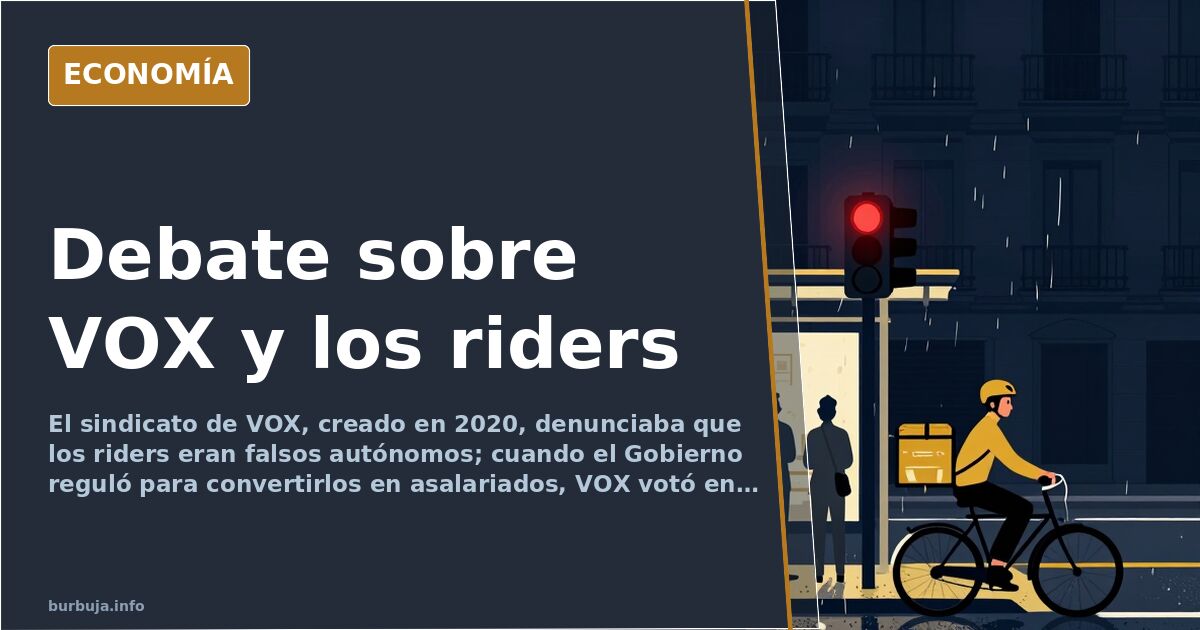
Vox and the rider law: consistency under scrutiny
How does one go from denouncing delivery workers as fake freelancers to voting against the law that converts them into employees? This is the core of the debate that has ignited the Economy forum. The union linked to Vox, created in September 2020, argued less than a year ago that the main concern for riders was precisely their status as false self-employed. When the Government, after the courts ruled they indeed were, pushed forward with major unions a norm to convert them into employed workers, the formation voted against it. The contradiction, persistently highlighted, has not found a convincing explanation.
The rider law and Vox's U-turn
The sequence is simple to reconstruct. First, the Spanish justice declared that delivery workers were false freelancers. Then, the Ministry of Labor, backed by CC.OO. and UGT, processed a law to force their hiring as employees. And then came the twist: Vox, which through its union had made the problem its banner, voted against in Congress. The formation's union is also chaired by an Andalusian MP, a detail that underscores the lack of independence of the structure.
Some argue the change in criteria responds to opposition logic: voting against any Government initiative, even if it matches what was previously defended. Others point out that the norm, as drafted, harms the delivery workers themselves. The data handled by critics are stark: according to shared tweets, 90% of riders are worse off than ever, couriers earn 60% less than before, and thousands of jobs have been destroyed. Glovo announced an ERE (collective dismissal) affecting around 750 riders, a figure later reduced to 436. Uber Eats, meanwhile, returned to using freelancers. And France and Germany overturned the EU rider law promoted by Yolanda Díaz.
Who really legislates for riders?
The Minister of Labor appears at the center of crossfire. For some, she is a dogmatist who destroyed 180,000 jobs with the minimum wage hike and now worsens conditions for delivery workers. For others, she is the only one who took action. However, reality has a third protagonist almost no one mentions: the Supreme Court. It was the high court that forced the law change, not a whim of the Ministry. That nuance partly dismantles the narrative that this is a lesson from Yolanda Díaz to Vox. The lesson, if it exists, is to all parties who have looked away for years while justice pushed them to act.
The debate quickly shifted to other fronts: rising electricity costs, youth unemployment, housing prices, and the convenience of allowing riders to remain freelancers with adapted sectoral regulation. The underlying question remains unanswered: if the false freelancer model was an abuse, why has the solution left the majority worse off than before? And if it wasn't, why did the Supreme Court say otherwise?
The failure no one wants to own
The accumulating numbers paint an uncomfortable scenario for everyone. The norm entered into force with the obligation to hire delivery workers as employees, and the result, according to critics, has been a 60% drop in income, ERs (collective dismissals) in major platforms, and a shortage of couriers already noticeable in orders. Companies bill less, customers receive poorer service, and workers, theoretically protected, earn less. The sector, born from nothing, seems to be shrinking by moments.
The final irony is signed by the Supreme Court itself: it was they who raised the issue. The parties now claiming to defend workers arrived late and were pushed. And those opposing the norm cannot claim consistency either, because a year ago they said the opposite. With this panorama, the question is not who won the debate, but who will pay the bill.
Also available in: Deutsch
Summary of a discussion on Burbuja.info - Foro de economía, actualidad y política., translated from Spanish and reviewed before publication. Read the full discussion (112 replies).
More summaries
-
Spain's Night Work Debate Sparks Mental Health Concerns
A comment by Yolanda Díaz on the risks of working after 10 PM has triggered a heated debate in Spain regarding night shifts, hospitality, and labor rights.
-
Spain's Yolanda Díaz Proposes Cutting Work Hours
Yolanda Díaz proposes reducing work hours, sparking debate on economic viability and current compliance with the 40-hour standard.
-
Spain proposes equalizing minimum wages in women's football
The Spanish government plans to equalize minimum salaries in women's and men's football, highlighting a stark disparity between 16,000 and 180,000 euros.
-
Leire Martínez: Weight and the Price of Image in Music
Leire Martínez, ex-LOVG, faces menopause and scrutiny over her weight. How much does appearance condition an artist? Analysis with data and real cases.
-
The 'engineer' who brags about stolen phones in Spain
A video shows a young man displaying several stolen iPhones in Barcelona, Spain. Calculating the VAT and income tax on one night's work reopens the debate on the…
-
Political quiz tells you who to vote for — and why it fails
A political affinity quiz returns VOX, PSOE or Se Acabó La Fiesta. Several users criticise the method: two axes, a 1-to-10 scale and doubts about how the data is used.