
Spain's 2026 Election: Coalition Scenarios and the Battle for Power
The 2026 election call in Spain opens multiple scenarios: Sánchez, Feijóo with VOX, or a PP-PSOE pact. Abstention and tactical voting will decide who governs.
English · Original discussion in Spanish · Published
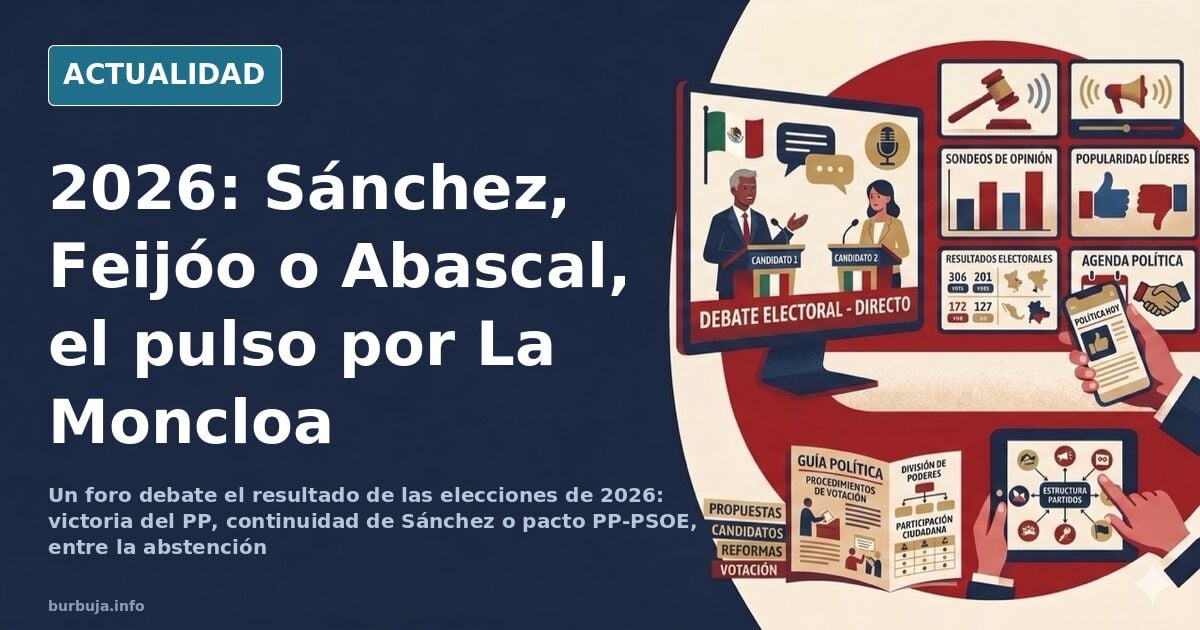
Spain's 2026 Election: The Battle for Power and Its Scenarios
The call for general elections in Spain for 2026 opens a board with several possible endings, none of them comfortable. The institutional statement by Prime Minister Pedro Sánchez has activated all speculation about who will occupy La Moncloa (the Spanish government headquarters). Among the scenarios debated, some argue for a minority PP government with PSOE abstention to block the right-wing bloc. The hypothesis of repeating the current investiture coalition appears as the least likely option in several analyses.
What Polls and Possible Pacts Say
The first block of opinions is divided between those who see Sánchez holding on and those who assume a change of cycle. One stream argues that the Prime Minister "must continue" and should even expand support; another, more numerous, considers a victory for Alberto Núñez Feijóo certain. The recurring doubt is not who wins, but with whom they will govern.
Parliamentary arithmetic complicates the picture. VOX would need an absolute majority, which seems impossible according to various analyses, pushing Feijóo to seek support from the center. The hypothesis of a PP-PSOE pact to isolate the far-right appears in several messages as the most plausible solution, although no one takes it for granted.
Tactical Voting and Abstention, Keys to the Result
The second axis of the debate is participation. Some announce they will never vote, while others warn they do not intend to answer calls for electoral table duty. Abstention, borrowed votes, and transfers between blocs may weigh more than any political program.
Among left-wing voters, concern over housing appears as the main wear-and-tear factor for the Government. Among right-wing voters, the fragmentation of tactical voting into two options loses seats for the bloc. The result, several analyses agree, will depend less on the campaign than on differential mobilization.
What Would Change in Daily Life With Another Government?
The underlying question is whether a change of government would alter anything tangible. The most repeated answer is no: "nothing relevant will change." Others point to a shift in migration policy, housing, or taxes, without specifying figures. The dominant feeling is that the political system reproduces itself regardless of the Executive's tonalidad.
The scenario of protests after a close result also appears, although without data to back it up. The hypothesis of a repeat election, however, is barely considered.
With these elements, the question is not who wins the 2026 elections, but whether the winner will be able to govern. And that answer, today, no one has.
The call for general elections in Spain for 2026 opens a board with several possible endings, none of them comfortable. The institutional statement by Prime Minister Pedro Sánchez has activated all speculation about who will occupy La Moncloa (the Spanish government headquarters). Among the scenarios debated, some argue for a minority PP government with PSOE abstention to block the right-wing bloc. The hypothesis of repeating the current investiture coalition appears as the least likely option in several analyses.
What Polls and Possible Pacts Say
The first block of opinions is divided between those who see Sánchez holding on and those who assume a change of cycle. One stream argues that the Prime Minister "must continue" and should even expand support; another, more numerous, considers a victory for Alberto Núñez Feijóo certain. The recurring doubt is not who wins, but with whom they will govern.
Parliamentary arithmetic complicates the picture. VOX would need an absolute majority, which seems impossible according to various analyses, pushing Feijóo to seek support from the center. The hypothesis of a PP-PSOE pact to isolate the far-right appears in several messages as the most plausible solution, although no one takes it for granted.
Tactical Voting and Abstention, Keys to the Result
The second axis of the debate is participation. Some announce they will never vote, while others warn they do not intend to answer calls for electoral table duty. Abstention, borrowed votes, and transfers between blocs may weigh more than any political program.
Among left-wing voters, concern over housing appears as the main wear-and-tear factor for the Government. Among right-wing voters, the fragmentation of tactical voting into two options loses seats for the bloc. The result, several analyses agree, will depend less on the campaign than on differential mobilization.
What Would Change in Daily Life With Another Government?
The underlying question is whether a change of government would alter anything tangible. The most repeated answer is no: "nothing relevant will change." Others point to a shift in migration policy, housing, or taxes, without specifying figures. The dominant feeling is that the political system reproduces itself regardless of the Executive's tonalidad.
The scenario of protests after a close result also appears, although without data to back it up. The hypothesis of a repeat election, however, is barely considered.
With these elements, the question is not who wins the 2026 elections, but whether the winner will be able to govern. And that answer, today, no one has.
Also available in: Deutsch
Summary of a discussion on Burbuja.info - Foro de economía, actualidad y política., translated from Spanish and reviewed before publication. Read the full discussion (29 replies).
More summaries
-
Spain PM considers delaying elections to 2027 amid weak polls
Sources close to the Spanish government are weighing postponing general elections until 2027 due to the PSOE's poor electoral standing.
-
Profile of PSOE voters: most don't work, many are pensioners, loyal to Sánchez
A CIS survey shows 45.5% of PSOE voters don't work and 35.4% receive a pension. We analyse the data.
-
Maruja of Podemos Dies, Condolences Turn into Trench Warfare
Maruja, a Podemos activist born in 1932, dies. Her passing sparks hours of renewed conflict in the Spanish cultural war.
-
Ayuso: Madrid celebrates Hispanic Day with US as guest
Madrid's leader Isabel Díaz Ayuso marks Hispanic Day in Spain, highlighting the US as guest nation and asserting a shared cultural power.
-
The Ugliness Agenda: Architecture as a Control Tool
Analysis links Rockefeller network, MoMA and International Style to deliberate urban ugliness as a social control mechanism.
-
Omarchy creator condemns Swedish murder verdict
David Heinemeier Hansson calls the ruling in a Swedish immigrant's murder case 'insane' and warns of the perpetrator's release.