
Vivac in Spain: Sleeping Outdoors with Minimal Gear
A Spanish forum discusses vivac sleeping, dividing hikers who prefer minimalism from those opting for car camping.
English · Original discussion in Spanish · Published
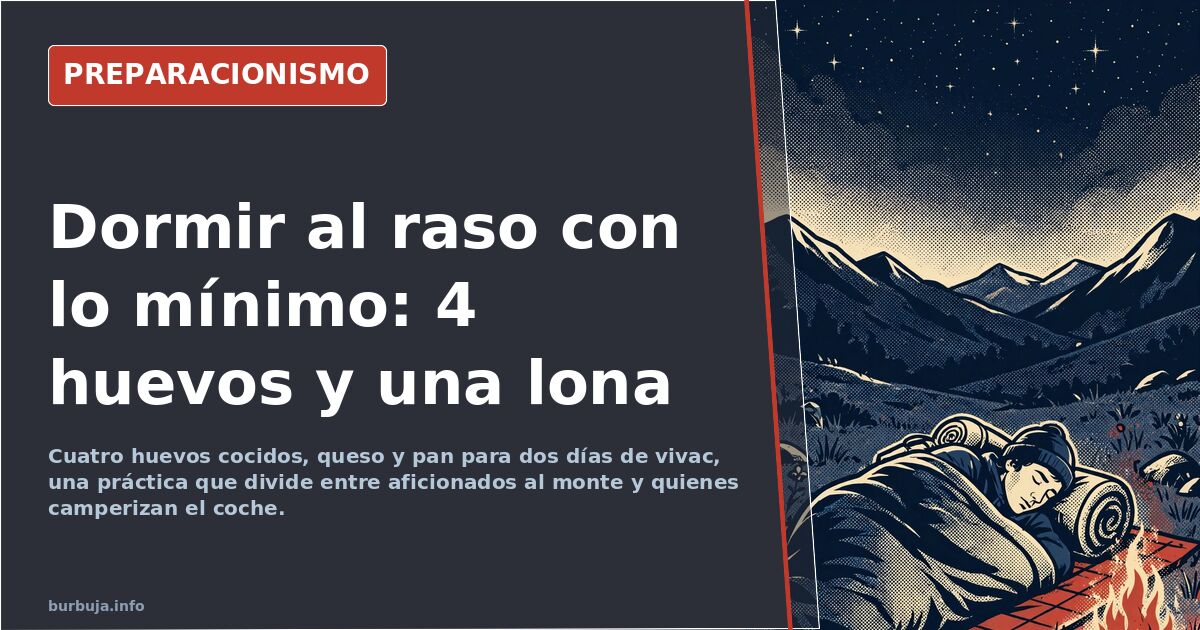
Vivac in Spain: Four Eggs, a Tarp, and Many Questions
Four boiled eggs, a wedge of cheese, and bread. That was the complete supply for two days sleeping outdoors. The proposal, launched with just two words on a forum, was simple: share the experience of a vivac and answer questions. The response came as banter, technical doubts, and a debate that goes far beyond logistics: what happens when a niche activity becomes a trend.
What is vivac and what gear is needed?
The term is old: sleeping rough or with the bare minimum, without facilities, as mountaineers do before attacking a summit. The list of equipment handled here does not invite glamour. A decent sleeping bag, bivvy sack, and a tarp so rain doesn't wet your face. No tent if you want to go light. Some separate bags by season —one for winter and one for summer— and confirm that new military surplus gear has been "excellent".
Improvisation rules. An air mat and a cold-proof bag are enough. Everything else is psychology.
Sleeping inside the car, the alternative gaining trinc
Much of the exchange isn't about tents or tarps, but cars. Folding down the back seat and sleeping inside the vehicle is emerging as the comfortable version of vivac. The catch: in sedans, the trunk isn't perfectly flat, and you have to play with seat positions. According to one enthusiast, in his vehicle, the folded backrest leaves more than 190 centimeters to lie stretched out.
An enthusiast details removing the backrest and moving it forward at night, inflating the mat with the cigarette lighter socket, and placing an insulator on top. The next aspiration is a station wagon or minivan. Others go further, setting up folding tables and chairs, because having dinner properly seated completely changes the experience, they say.
Cooking without a kitchen
The question round started with sarcasm: whether to cook with a stove or start a fire with whatever is available. The host's answer was practical. For two days, cold food and an Esbit-type stove that takes up no space. In winter, a small chasca —a stick fire— is used for cooking and then sleeping. There is also talk of underground ovens and the trick of boiling meat after a week to preserve it. And the classic: do you bring cans or go hunter-style with bow and knife?
Crowding the mountains: toilet paper and campervans
The exchange quickly turns to a more uncomfortable issue. One user argues that the mountains are full of people who respect nothing. The same user states that around overnight spots, used toilet paper and tissues accumulate on a scale not seen before 2020. The comparison with cycling, hiking, or campervans sounds like a warning: when an activity becomes fashionable, the threshold of care drops. Overcrowding or simply more people? depends on who looks.
Wild boars, ticks, and camp humor
Real risks are rarely discussed and always jokingly. Someone confesses to being scared by wild boars approaching a nearby pond. Another remembers ticks. Most respond to logistics with jokes: wet wipes, forest gnomes, nocturnal specters. Between jokes slips a note summarizing the matter: returning home and valuing the shower, kitchen, and sofa like never before. Comfort is rediscovered by losing it for two days.
Vivac above 3,000 meters
Amidst all the jokes, a substantial recommendation appears. A documentary of about 35 minutes on high-altitude vivac in the Pyrenees, above 3,000 meters, is cited. It is the least folkloric part of the topic: sleeping up there is serious and gear truly weighs. Plans for getaways through León, Zamora, and Salamanca are also shared, along with memories of living abroad for several years.
With the hobby growing on one side and veterans complaining about noise on the other, an open question remains: does respect for the mountain depend on the number of visitors, or has the manual simply been lost?
Four boiled eggs, a wedge of cheese, and bread. That was the complete supply for two days sleeping outdoors. The proposal, launched with just two words on a forum, was simple: share the experience of a vivac and answer questions. The response came as banter, technical doubts, and a debate that goes far beyond logistics: what happens when a niche activity becomes a trend.
What is vivac and what gear is needed?
The term is old: sleeping rough or with the bare minimum, without facilities, as mountaineers do before attacking a summit. The list of equipment handled here does not invite glamour. A decent sleeping bag, bivvy sack, and a tarp so rain doesn't wet your face. No tent if you want to go light. Some separate bags by season —one for winter and one for summer— and confirm that new military surplus gear has been "excellent".
Improvisation rules. An air mat and a cold-proof bag are enough. Everything else is psychology.
Sleeping inside the car, the alternative gaining trinc
Much of the exchange isn't about tents or tarps, but cars. Folding down the back seat and sleeping inside the vehicle is emerging as the comfortable version of vivac. The catch: in sedans, the trunk isn't perfectly flat, and you have to play with seat positions. According to one enthusiast, in his vehicle, the folded backrest leaves more than 190 centimeters to lie stretched out.
An enthusiast details removing the backrest and moving it forward at night, inflating the mat with the cigarette lighter socket, and placing an insulator on top. The next aspiration is a station wagon or minivan. Others go further, setting up folding tables and chairs, because having dinner properly seated completely changes the experience, they say.
Cooking without a kitchen
The question round started with sarcasm: whether to cook with a stove or start a fire with whatever is available. The host's answer was practical. For two days, cold food and an Esbit-type stove that takes up no space. In winter, a small chasca —a stick fire— is used for cooking and then sleeping. There is also talk of underground ovens and the trick of boiling meat after a week to preserve it. And the classic: do you bring cans or go hunter-style with bow and knife?
Crowding the mountains: toilet paper and campervans
The exchange quickly turns to a more uncomfortable issue. One user argues that the mountains are full of people who respect nothing. The same user states that around overnight spots, used toilet paper and tissues accumulate on a scale not seen before 2020. The comparison with cycling, hiking, or campervans sounds like a warning: when an activity becomes fashionable, the threshold of care drops. Overcrowding or simply more people? depends on who looks.
Wild boars, ticks, and camp humor
Real risks are rarely discussed and always jokingly. Someone confesses to being scared by wild boars approaching a nearby pond. Another remembers ticks. Most respond to logistics with jokes: wet wipes, forest gnomes, nocturnal specters. Between jokes slips a note summarizing the matter: returning home and valuing the shower, kitchen, and sofa like never before. Comfort is rediscovered by losing it for two days.
Vivac above 3,000 meters
Amidst all the jokes, a substantial recommendation appears. A documentary of about 35 minutes on high-altitude vivac in the Pyrenees, above 3,000 meters, is cited. It is the least folkloric part of the topic: sleeping up there is serious and gear truly weighs. Plans for getaways through León, Zamora, and Salamanca are also shared, along with memories of living abroad for several years.
With the hobby growing on one side and veterans complaining about noise on the other, an open question remains: does respect for the mountain depend on the number of visitors, or has the manual simply been lost?
Also available in: Deutsch
Summary of a discussion on Burbuja.info - Foro de economía, actualidad y política., translated from Spanish and reviewed before publication. Read the full discussion (136 replies).
More summaries
-
Decathlon self-checkout: Customer refuses to work for free
A Decathlon customer complains after using self-checkout, stating she came to spend money, not work. The debate over automation and retail jobs intensifies.
-
Strait of Hormuz fears drive food stockpiling in Spain
Forum users debate stockpiling amid Strait of Hormuz crisis. Is it prudence or panic? Key products and views.
-
Proven Facts: The Documentary Platforms Refused to Air
The documentary 'Proven Facts' profiles Agapito García Sánchez, Spain's top tax defaulter, exposing alleged abuses by the Spanish Tax Agency.
-
Disappearing in Spain's Storms: An Impossible Plan
Guardia Civil protocols expose the flaws in vanishing during Spanish weather emergencies, debunking myths about fleeing to Mongolia.
-
Evaporative cooling: cuts temps by 15°C, saves 90% energy
Evaporative cooling promises up to 15°C drops and 90% less consumption, but works only in dry climates and reignites Legionella debates.
-
Rabies: 100% Fatal, Only Early Vaccine Stops It
Rabies is 100% fatal once symptoms appear. Spain declared it eradicated in the 1960s, but bats remain a transmission risk.