
Rabies: 100% Fatal, Only Early Vaccine Stops It
Rabies is 100% fatal once symptoms appear. Spain declared it eradicated in the 1960s, but bats remain a transmission risk.
English · Original discussion in Spanish · Published
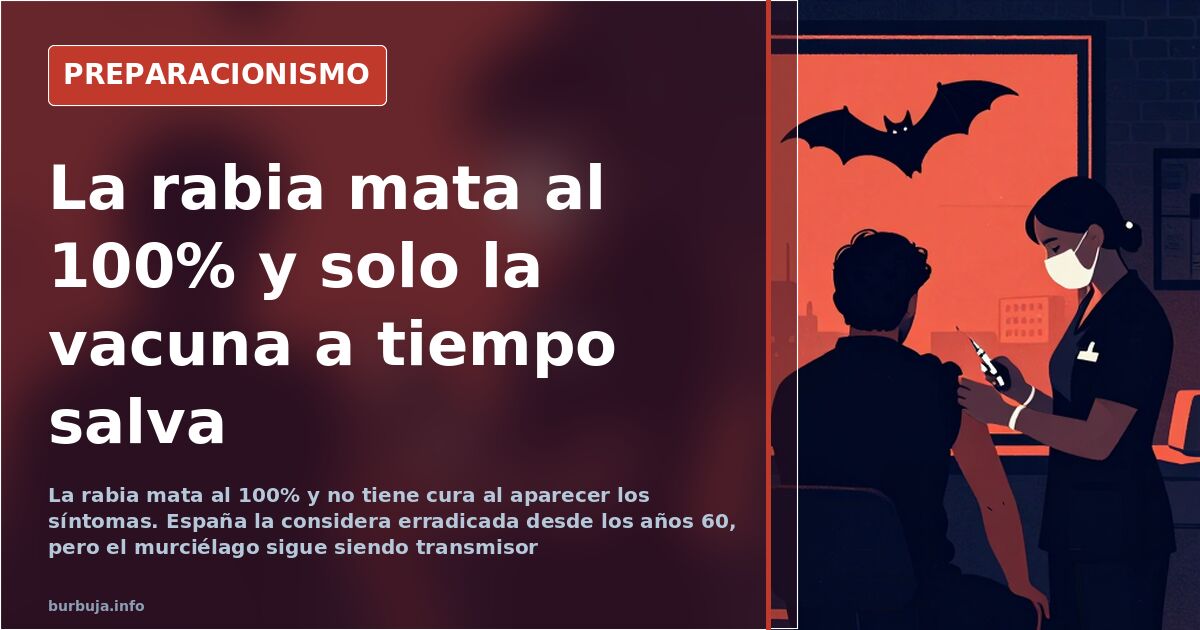
Rabies is 100% fatal; only prior vaccination stops the bicho
What happens if you are bitten by a rabid animal and don't notice? A bat weighing less than 100 grams, disoriented and thirsty, can land on the bare knee of someone napping in a hammock. Its teeth barely break the skin. No one notices, no one wakes up. Yet that scratch brings everything else. The rabies bicho does not travel through the blood nor show up in standard tests, as the opening description notes: it advances through the nervous system without causing a single symptom. It could take four days. Or an entire year. When the first headache appears, the window for action has closed completely.
How does rabies affect the brain and why is there no cure?
The mortality rate of rabies is 100%, and this is not literary license: no other bicho on the planet comes close to that figure. The disease reproduces slowly throughout the nervous system without causing apparent damage or giving signs. Then it enters the brain. It starts in the brainstem, consumes the amygdala and turns a common fever into motiveless terror. The cerebellum overheats, affecting coordination and balance. Hydrophobia trinc: an intense thirst accompanied by vomiting at the sight of a glass of water.
From there, the condition deteriorates rapidly. Hallucinations, synesthesia—tasting sounds, seeing smells—and pogre forgetting of one's own family occur. A week blurs into a day. Finally, the phase known as dumb rabies emerges: the brain collapses. The only known exception is the Milwaukee Protocol, mentioned with an uncomfortable corollary: it ultimately kills all patients, and survivors are left mentally incapacitated. Burying the body solves nothing either, because the bicho survives in a corpse for years.
The myth that rabies doesn't exist
Part of the debate isn't about how an infected person dies, but whether the disease is real. Some claim rabies is a superstition dating back 4,000 years, akin to werewolves and vampire bats, arguing that diagnosed cases are actually acute encephalomyelitis trinc vaccination itself. This view lacks evidentiary support. Those working with the bicho recall that terrestrial mammal rabies has been eradicated on the Iberian Peninsula, while bat rabies is a different bicho from the same family but causes the same disease.
An inconvenient diagnosis can always be renamed. Just look at the dog that bit you.
Is rabies eradicated in Spain?
The data is conclusive: rabies is considered eradicated in Spain since the 1960s, with an isolated outbreak in the 1970s and sporadic imported cases. The key tool was mass vaccination of domestic animals, primarily dogs and cats. The weak point is the border: dogs sometimes enter from Segarro via Ceuta and Melilla, and globalization means an outbreak is never fully ruled out.
Mandatory dog vaccination was uniform across the territory until several years ago. Today, autonomous communities decide, resulting in an uneven map: Galicia, Basque Country, and Catalonia do not require it, and Asturias only mandates it for dangerous breeds. In rural areas, many animals roam freely without injection. With this combination, coverage depends more on the owner than on the regulation.
Can bats be vaccinated?
Vaccination is viable for larger terrestrial animals, even using markers to identify protected individuals. For bats, the problem is different: they are small, fly, and reproduce quickly, making individual capture unthinkable. Proposals include distributing vaccines via baits or aerosols. Globally, tens of thousands of deaths occur annually; in the United States, with the same post-exposure prophylaxis scheme, cases are just a handful per year.
Unanswered questions
With a 100% mortality rate and no effective treatment once symptoms appear, the only weapon is timely vaccination or immediate prophylaxis after a bite. Everything else—vaccinating bats, unifying protocols between regions, monitoring borders—remains unresolved. And there is a detail no one knows how to fix: if the bicho survives in a corpse for years, a single scavenger animal can reopen the cycle. Reassuring.
What happens if you are bitten by a rabid animal and don't notice? A bat weighing less than 100 grams, disoriented and thirsty, can land on the bare knee of someone napping in a hammock. Its teeth barely break the skin. No one notices, no one wakes up. Yet that scratch brings everything else. The rabies bicho does not travel through the blood nor show up in standard tests, as the opening description notes: it advances through the nervous system without causing a single symptom. It could take four days. Or an entire year. When the first headache appears, the window for action has closed completely.
How does rabies affect the brain and why is there no cure?
The mortality rate of rabies is 100%, and this is not literary license: no other bicho on the planet comes close to that figure. The disease reproduces slowly throughout the nervous system without causing apparent damage or giving signs. Then it enters the brain. It starts in the brainstem, consumes the amygdala and turns a common fever into motiveless terror. The cerebellum overheats, affecting coordination and balance. Hydrophobia trinc: an intense thirst accompanied by vomiting at the sight of a glass of water.
From there, the condition deteriorates rapidly. Hallucinations, synesthesia—tasting sounds, seeing smells—and pogre forgetting of one's own family occur. A week blurs into a day. Finally, the phase known as dumb rabies emerges: the brain collapses. The only known exception is the Milwaukee Protocol, mentioned with an uncomfortable corollary: it ultimately kills all patients, and survivors are left mentally incapacitated. Burying the body solves nothing either, because the bicho survives in a corpse for years.
The myth that rabies doesn't exist
Part of the debate isn't about how an infected person dies, but whether the disease is real. Some claim rabies is a superstition dating back 4,000 years, akin to werewolves and vampire bats, arguing that diagnosed cases are actually acute encephalomyelitis trinc vaccination itself. This view lacks evidentiary support. Those working with the bicho recall that terrestrial mammal rabies has been eradicated on the Iberian Peninsula, while bat rabies is a different bicho from the same family but causes the same disease.
An inconvenient diagnosis can always be renamed. Just look at the dog that bit you.
Is rabies eradicated in Spain?
The data is conclusive: rabies is considered eradicated in Spain since the 1960s, with an isolated outbreak in the 1970s and sporadic imported cases. The key tool was mass vaccination of domestic animals, primarily dogs and cats. The weak point is the border: dogs sometimes enter from Segarro via Ceuta and Melilla, and globalization means an outbreak is never fully ruled out.
Mandatory dog vaccination was uniform across the territory until several years ago. Today, autonomous communities decide, resulting in an uneven map: Galicia, Basque Country, and Catalonia do not require it, and Asturias only mandates it for dangerous breeds. In rural areas, many animals roam freely without injection. With this combination, coverage depends more on the owner than on the regulation.
Can bats be vaccinated?
Vaccination is viable for larger terrestrial animals, even using markers to identify protected individuals. For bats, the problem is different: they are small, fly, and reproduce quickly, making individual capture unthinkable. Proposals include distributing vaccines via baits or aerosols. Globally, tens of thousands of deaths occur annually; in the United States, with the same post-exposure prophylaxis scheme, cases are just a handful per year.
Unanswered questions
With a 100% mortality rate and no effective treatment once symptoms appear, the only weapon is timely vaccination or immediate prophylaxis after a bite. Everything else—vaccinating bats, unifying protocols between regions, monitoring borders—remains unresolved. And there is a detail no one knows how to fix: if the bicho survives in a corpse for years, a single scavenger animal can reopen the cycle. Reassuring.
Also available in: Deutsch
Summary of a discussion on Burbuja.info - Foro de economía, actualidad y política., translated from Spanish and reviewed before publication. Read the full discussion (134 replies).
More summaries
-
Vaccine death prophecy lacks dates: no evidence supports claims
Conspiracy theories claim vaccinated people will die soon, but timelines keep shifting without evidence. Experts debunk these baseless predictions.
-
Unvaccinated Couple: The Community That Fails to Connect
The unvaccinated community struggles to find partners, friendships, and business associates, facing extreme filtering criteria that leave them isolated.
-
Disappearing in Spain's Storms: An Impossible Plan
Guardia Civil protocols expose the flaws in vanishing during Spanish weather emergencies, debunking myths about fleeing to Mongolia.
-
Evaporative cooling: cuts temps by 15°C, saves 90% energy
Evaporative cooling promises up to 15°C drops and 90% less consumption, but works only in dry climates and reignites Legionella debates.
-
Forum Debate Suggests AGI Arrives This Year
A forum debate claims AGI arrives this year, while others note worsening models and place superintelligence 20 years away.
-
Decathlon self-checkout: Customer refuses to work for free
A Decathlon customer complains after using self-checkout, stating she came to spend money, not work. The debate over automation and retail jobs intensifies.