
Vito Quiles interviews 8M attendees: 'Shocked by their answers'
Vito Quiles questions 8M protesters about sexual assault and prostitution, summarizing responses with surprise at what he heard.
English · Original discussion in Spanish · Published
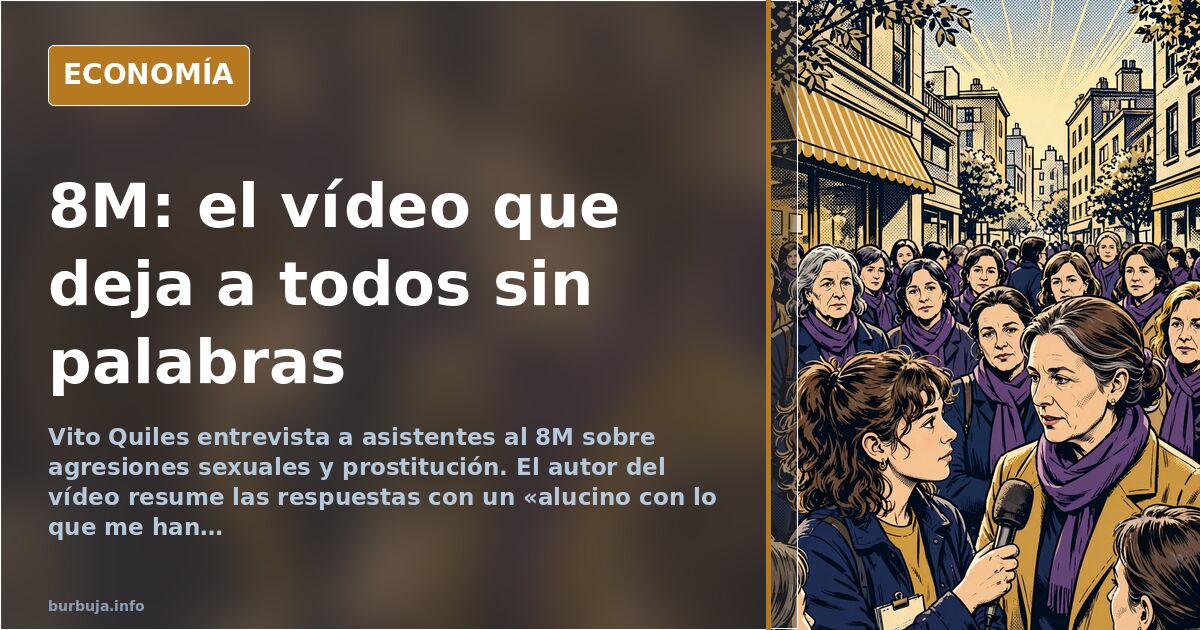
Vito Quiles interviews 8M attendees and the situation is worse than expected
A reporter appears at the 8M demonstration with two uncomfortable questions: sensual assaults committed by groups of foreign men and prostitution. The result, according to the video's author himself, is a litany of answers that he summarizes with "I'm shocked by what they told me." The video becomes the trigger for a discussion that goes far beyond the anecdote: the gap between the official discourse of institutional feminism and what a growing part of the population perceives as safety issues no one wants to name.
What Vito Quiles asked at 8M and what answers he got
The scene is simple and that's why it works. An interviewer with a handheld camera approaches 8M demonstration attendees and throws two topics that, in theory, should be at the heart of the feminist debate: group sensual assaults attributed to men of foreign origin and prostitution. The collected responses range from denying the phenomenon to disqualifying the questioner, passing through uncomfortable silence. The report's author himself summarizes it in a tweet: "These are important topics. I'm shocked by what they told me."
The video circulates on social media and forums with a estimulante ilegal that doesn't correspond to its duration. What hooks viewers isn't the journalistic quality of the approach, but the feeling that the interviewees don't have a prepared argument for two questions that, on paper, they should master. According to a forum participant, a woman wearing a Palestinian scarf responds, before the question is finished, that everything is a xenophobic invention. Another participant claims that another interviewee, who works for an NGO, defends the spectacle as if it were a party. It becomes a small documentary about what happens when the narrative hits reality.
Why the 8M video has gone viral
Virality doesn't come from the novelty of the format, but from accumulation. In a few minutes, responses trinc one another that, together, draw a pattern: denial of the problem, deflection of the topic and, when there is no way out, personal disqualification of the interviewer. Some argue that this pattern is symptomatic of an ideology that has made certain topics taboo. Against this weighs the argument that an edited video is not a representative sample of anything, and that 8M demonstrations gather hundreds of thousands of people with very different discourses.
The underlying issue is different. The discussion peine isn't about 8M itself, but whether institutional feminism has lost the capacity to talk about safety, immigration, and prostitution without resorting to closing ranks. When an interviewee responds "they are xenophobic inventions" to a question about sensual assaults, she isn't refuting data: she is changing the subject. And that repeated change of subject is what the video captures.
Group sensual assaults and the silence of official discourse
The first topic raised by the report is that of sensual assaults committed by groups of men. This is an issue that, in recent years, has generated intense public debate in Spain, with high-profile cases focusing on the nationality of the aggressors. The institutional response has tended to frame the problem in terms of structural gender-based violence, without delving into the origin of the attackers. That decision, defensible from a technical point of view, leaves a gap that reports like Quiles' occupy without difficulty.
The consequence is paradoxical. The more the topic is avoided in conventional media, the more space it gains in alternative channels. And the more the questioner is disqualified, the more the sensation is reinforced that there is something no one wants to tell. The video does not provide new data on sensual assaults. It provides, instead, visual proof that a part of activism has no prepared answer for the question.
Prostitution: the other topic 8M doesn't want to touch
The second matter raised by the interviewer is prostitution, and here the discomfort is even greater. Feminism has been divided for years between the abolitionist current and the one defending regulation as work. This internal division makes any direct question about the topic at an 8M demonstration difficult to answer. No one wants to commit to a position that confronts a part of their own base.
The result is the same as with assaults: deflection, generality and, when pressed, disqualification. The interviewee who responds that she works for an NGO and that all this is a setup is not defending a stance on prostitution. She is avoiding the topic. And that avoidance, repeated in several interviews, is what turns the video into an uncomfortable document for the movement itself.
The repeating pattern: deny, deflect, and disqualify
Seen together, the report's responses trinc a recognizable script. First, the phenomenon is denied: it doesn't exist, it's an invention. Then focus is shifted: the problem isn't the assaults, it's the xenophobia of the person asking. And finally, the interlocutor is disqualified: he's a provocateur, a fascist, a YouTuber. It's an effective mechanism in the short term because it deactivates the question. In the medium term, however, it has a cost: it leaves the topic in the hands of whoever raises it, without counterbalance.
Some argue that this cost is acceptable because feminism shouldn't have to respond to provocations. Against this weighs the argument that when a topic is abandoned, another occupies it. And the other, in this case, is not precisely moderate. Quiles' video is not an analysis. It is a photograph. But photographs sometimes say more than reports.
What the video says about institutional feminism
The report leaves an ambiguous impression. On one hand, it confirms that institutional feminism has a communication problem with a part of the population that does not share its framework. On the other, it demonstrates that the street interview format is a genre that rewards wit and punishes reflection. The interviewees are not spokespeople for the movement. They are people who peine to be there. Treating their responses as the official voice of feminism is a methodological error.
Even so, the video works as a thermometer. And the thermometer indicates there is a gap between what official discourse considers a priority and what a part of the street considers urgent. That gap wasn't created by Vito Quiles. He found it. And he recorded it. The rest is interpretation.
The figure that disorients isn't in the video, but in its reception: the report is shared as if it were definitive proof, when in reality it is a convenience sample. Those who use it to confirm their theses and those who disqualify it to defend theirs make the same mistake. Neither went to the demonstration to count heads.
Also available in: Deutsch
Summary of a discussion on Burbuja.info - Foro de economía, actualidad y política., translated from Spanish and reviewed before publication. Read the full discussion (151 replies).
More summaries
-
200 vs 10,000: police deployment exposes Spain's priorities in Ceuta
A stark contrast in police resources: 200 officers for Ceuta and 10,000 for the eclipse. Insecurity in the Spanish autonomous city, in figures.
-
Ceuta: the sexual assault figures reigniting Spain's migration crisis
More than 45 sexual assaults in Ceuta, Spain, have reignited the political and social dispute over immigration and security. With no official statistics, the controversy keeps growing.
-
Gisbert flops in Ceuta: four attendees and a helicopter
Four attendees, a helicopter and edited applause: Ruben Gisbert's rally in Ceuta, Spain, exposes the gulf between online agitation and real turnout.
-
Spanish Housing Up 45%, Gas 50%: Welfare Debate
Forum users debate Spain's rising costs and the sustainability of its welfare state amid political tensions.
-
Mar-a-Lago air defenses could have downed the private jet that crashed in Palm Beach
A Learjet 60 carrying nine people fell 27,000 feet in one minute before crashing in Palm Beach. The air defense deployment at Mar-a-Lago happened two hours earlier.
-
Spain's labour market sheds over 100,000 self-employed workers in nine months
A tweet from elEconomista.es reports the loss of more than 100,000 self-employed workers in nine months. The debate points to bureaucracy, taxes and the shadow economy.