
Spain's labour market sheds over 100,000 self-employed workers in nine months
A tweet from elEconomista.es reports the loss of more than 100,000 self-employed workers in nine months. The debate points to bureaucracy, taxes and the shadow economy.
English · Original discussion in Spanish · Published
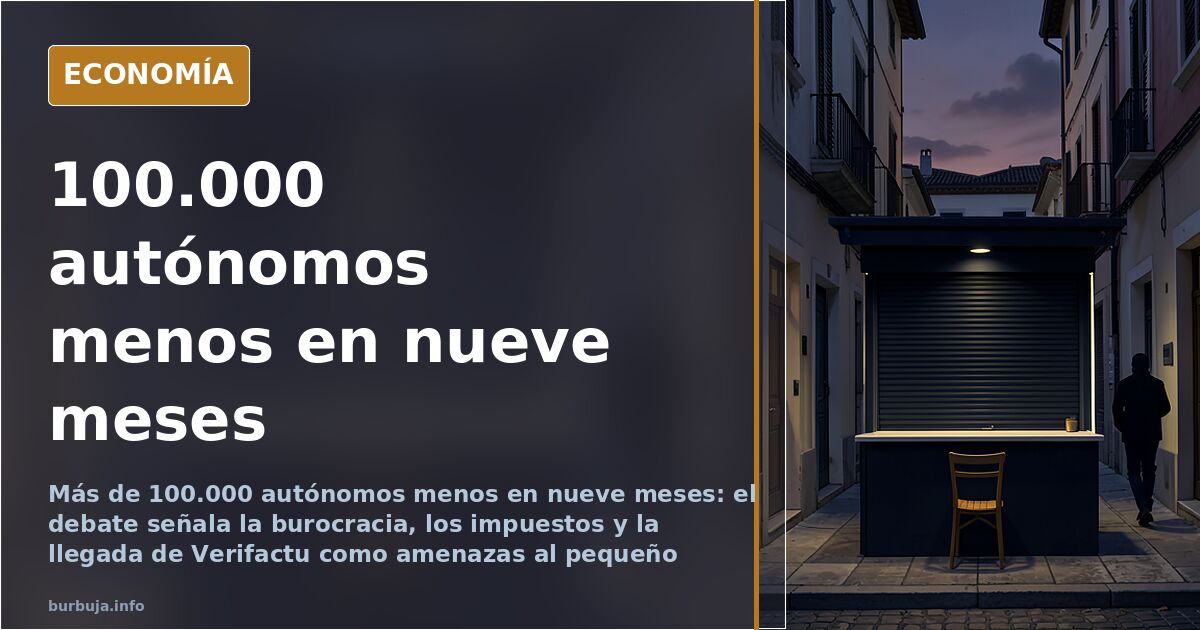
Spain loses 100,000 self-employed workers in nine months as the system bleeds out
A tweet from elEconomista.es reports that Spain's labour market has lost more than 100,000 self-employed workers in just nine months. In the discussion, several participants read the figure as a symptom of an exhausted model, pointing to bureaucracy, taxes and competition from the shadow economy as the reasons many professionals are leaving the self-employed regime.
Tax and administrative pressure is suffocating small business owners
Being self-employed in Spain is described in the debate as an exercise in endurance. Tax pressure, social security contributions and a regulatory maze that forces people to spend hours on paperwork — even with an accountant — are behind the exodus, according to several participants. "Disproportionate taxes, a thousand absurd rules, threats of fines over any triviality," sums up one voice in the debate, adding: "It's better to scrape by on casual work and top it up off the books." The blunt remark reflects, in the writer's view, an economic calculation that no longer adds up.
The problem is not just the cost, but the uncertainty. One participant argues that the rollout of the Verifactu system, which will target tax fraud in hospitality and small retail, threatens to deliver a final blow to thousands of businesses that survive thanks to the margin provided by undeclared money. "Why on earth would you work 12 hours a day to take home less than €2,000 net at the end of the month," asks another participant. For many, the answer is: you wouldn't.
The generational handover that never comes
As veteran self-employed workers retire, the businesses they put up for transfer find no successors. "Huge numbers of businesses being transferred on retirement find no takers," one message notes. The lack of generational renewal is compounded, according to another participant, by competition from new self-employed workers, many of them recently arrived delivery riders, who swell the ranks of the RETA (Spain's self-employed social security scheme) but do not build a stable productive base. The picture the debate paints is of a system losing its most experienced professionals and taking on the most precarious ones.
Why are the self-employed leaving?
For several participants, the system is pushing them out. The long answer, they argue, includes a bureaucracy that punishes those who work, a tax system that makes no distinction between someone invoicing €20,000 and someone invoicing €200,000, and unfair competition that rewards those operating in the shadows. The result, they claim, is a silent haemorrhage the Government seems unwilling to stop. "Another success of sanchismo," one participant quips, while another declares: "They don't want self-employed people, they want dependants."
The model that does work: the entrepreneur account
For some, the answer lies in looking to northern Europe. One participant explains that Estonia offers a system in which a person is automatically registered for business activity and with social security upon opening a digital account. "Any payment into that account is withheld at 20% for the state, and there's nothing else to worry about," the participant explains. No quarterly VAT, no advance tax payments, no withholdings. For the vast majority of Spanish self-employed workers, such a model would simplify everything, in their view. The question is why nobody copies it.
The future: fewer self-employed, more dependency
The loss of 100,000 self-employed workers in nine months is not an isolated figure, according to the debate. It is the consequence, several participants argue, of a model that punishes those who take the plunge and rewards those who stand still. While the state fattens its structure, the productive base thins out. And those who leave do not come back. The figure that really stings is not the number who have deregistered, but the number who never will register.
Summary of a discussion on Burbuja.info - Foro de economía, actualidad y política., translated from Spanish and reviewed before publication. Read the full discussion (16 replies).
More summaries
-
Spain's Minimum Wage Workers Pay €5,400 in Social Security
Minimum wage employees contribute over €5,400 annually to social security, nearly €450 monthly, compared to the self-employed minimum fee of around €200.
-
Spain has the EU's third-highest business tax burden
Spain ranks third in the EU for business tax burden: social security contributions account for 25.8% of revenue collected, far above the European average of…
-
Spain's Social Security sold Iván Redondo a Madrid flat €466,679 below market value
Spain's Social Security sold Iván Redondo a flat in Madrid's Salamanca district for €1,120,921 — €466,679 below its market value. The discount comes close to 30%.
-
Newsstand owner tearfully claims police beat him
Pablo Fernández, known as 'el kiosquero', tearfully claims police beat him during an eviction in Madrid.
-
New cyberattack hits supermarket refrigeration systems in Sweden and Belgium
Dozens of supermarkets in Belgium have suffered a cyberattack on their refrigeration systems, similar to the one in France in early October. Here is what is known.
-
Why the train crash victims all seemed to be executives
The list of train crash victims reads like a directory of professionals, but it's selection bias: only those with a résumé make the news.