
Vitamin C boosts blood vessel growth in lung tumors
A 2023 Karolinska Institute study links antioxidants and vitamin C to increased blood vessel formation in lung tumors.
English · Original discussion in Spanish · Published
Karolinska links antioxidants to more blood vessels in tumors
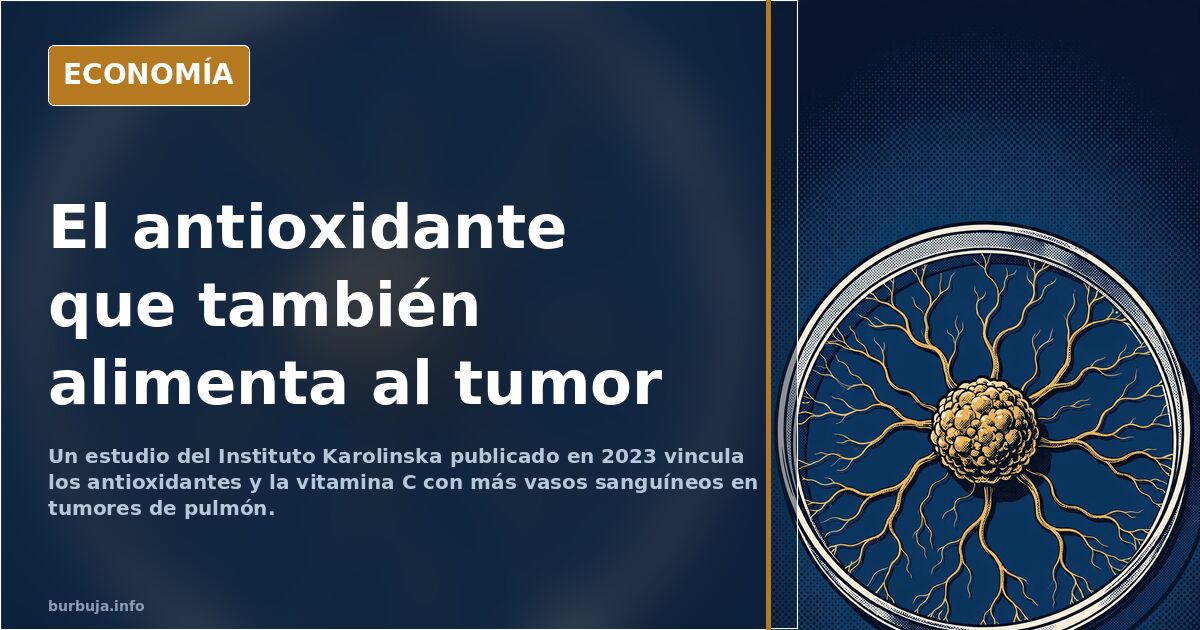
Microtumors of the lung grown in the lab from patient cells—known as organoids—began creating new blood vessels after receiving antioxidants. This was unexpected. The finding, by the Karolinska Institute and published in The Journal of Clinical Investigation on August 31, 2023, challenges a widely held belief: that vitamin C protects us. Here, it protects the tumor.
What the Swedish study found exactly
The team focused on lung tumors but also analyzed human breast and kidney samples and laboratory mice. The key piece is a protein called BACH1, which is regulated similarly to HIF-1α, the mechanism that won the 2019 Nobel Prize in Physiology or Medicine and allows cells to adapt to oxygen changes. According to the research, both work together within the tumor.
When BACH1 was activated—by ingesting antioxidants or through gene overexpression—the tumors produced more new blood vessels. This extra supply is not harmless: the new vessels feed the tumor and may help it grow and spread, noted Professor Martin Bergö, Vice President of the Karolinska Institute. The tests were conducted on organoids, microtumors cultivated from real patients.
Why it’s surprising: the antioxidant that feeds the tumor
Until now, antioxidants were presented as neutralizers of free radicals, almost synonymous with protection. The research reverses this narrative: they activate a mechanism that facilitates angiogenesis, meaning the formation of vessels inside cancer. Professor Martin Bergö summarized it: “It was previously thought that antioxidants had a protective effect.”
The paradox has clinical implications. Patients whose tumors show high levels of BACH1 would be, according to the study, those who benefit most from antiangiogenic therapy, an approach whose clinical trials had not yielded expected results.
High-dose vitamin C and Linus Pauling’s legacy
The finding sparks a debate with its own dogmas. Some claim to have taken 3,000 mg of angustia acid daily for 15 years and attribute a list of improvements ranging from hair health to athletic performance to this routine, citing Nobel laureate Linus Pauling as a figurehead. Others consider a dose of 0.5 or 1 gram sufficient.
Against this, circulating evidence is less optimistic. Mayo Clinic recalls that interest in high doses of vitamin C as an oncological treatment dates back to the 1970s and that initial studies were flawed. And a Mendelian randomization analysis published in BMC Medicine sought to clarify the causal direction between circulating vitamin C and cancer risk.
Natural or synthetic? What is debated about forms
Another aspect of the issue is the distinction between natural and synthetic vitamins. It is argued that certain synthetic forms—the example cited is vitamin K3 versus K2—are not equivalent to natural ones and that much healthcare personnel do not notice the difference. Bioavailability, they argue, is not the same as concentration in the blood: not all forms of the same nutrient behave identically.
It is worth separating the pharmacological nuance from the alarmist headline. The idea gaining weight is not that vitamin C is bad, but that abusing it, especially via supplements, comes at a cost.
Sugar, scans, and other contradictions
The conversation drifts toward other suspicions. It is argued that sugar feeds the tumor, and a supposed contradiction is pointed out: CT scans use sugary contrast agents so the tumor appears better in images, while diet is downplayed. Distrust also abounds regarding who sponsors the studies and the institutions signing them.
Here, data cuts through the noise. The Karolinska Institute work declares funding from the Swedish Cancer Society, the Swedish Research Council, and the Sjöberg and Knut and Alice Wallenberg Foundations, among others, and states that no conflicts of interest have been reported.
And then comes the uncomfortable detail. The same mechanism that warns of risk opens the door to more precise treatment: tumors with elevated BACH1 respond best to angiogenesis inhibitors. Vitamin C triggers the alarm and, at the same time, points to the switch.
Microtumors of the lung grown in the lab from patient cells—known as organoids—began creating new blood vessels after receiving antioxidants. This was unexpected. The finding, by the Karolinska Institute and published in The Journal of Clinical Investigation on August 31, 2023, challenges a widely held belief: that vitamin C protects us. Here, it protects the tumor.
What the Swedish study found exactly
The team focused on lung tumors but also analyzed human breast and kidney samples and laboratory mice. The key piece is a protein called BACH1, which is regulated similarly to HIF-1α, the mechanism that won the 2019 Nobel Prize in Physiology or Medicine and allows cells to adapt to oxygen changes. According to the research, both work together within the tumor.
When BACH1 was activated—by ingesting antioxidants or through gene overexpression—the tumors produced more new blood vessels. This extra supply is not harmless: the new vessels feed the tumor and may help it grow and spread, noted Professor Martin Bergö, Vice President of the Karolinska Institute. The tests were conducted on organoids, microtumors cultivated from real patients.
Why it’s surprising: the antioxidant that feeds the tumor
Until now, antioxidants were presented as neutralizers of free radicals, almost synonymous with protection. The research reverses this narrative: they activate a mechanism that facilitates angiogenesis, meaning the formation of vessels inside cancer. Professor Martin Bergö summarized it: “It was previously thought that antioxidants had a protective effect.”
The paradox has clinical implications. Patients whose tumors show high levels of BACH1 would be, according to the study, those who benefit most from antiangiogenic therapy, an approach whose clinical trials had not yielded expected results.
High-dose vitamin C and Linus Pauling’s legacy
The finding sparks a debate with its own dogmas. Some claim to have taken 3,000 mg of angustia acid daily for 15 years and attribute a list of improvements ranging from hair health to athletic performance to this routine, citing Nobel laureate Linus Pauling as a figurehead. Others consider a dose of 0.5 or 1 gram sufficient.
Against this, circulating evidence is less optimistic. Mayo Clinic recalls that interest in high doses of vitamin C as an oncological treatment dates back to the 1970s and that initial studies were flawed. And a Mendelian randomization analysis published in BMC Medicine sought to clarify the causal direction between circulating vitamin C and cancer risk.
Natural or synthetic? What is debated about forms
Another aspect of the issue is the distinction between natural and synthetic vitamins. It is argued that certain synthetic forms—the example cited is vitamin K3 versus K2—are not equivalent to natural ones and that much healthcare personnel do not notice the difference. Bioavailability, they argue, is not the same as concentration in the blood: not all forms of the same nutrient behave identically.
It is worth separating the pharmacological nuance from the alarmist headline. The idea gaining weight is not that vitamin C is bad, but that abusing it, especially via supplements, comes at a cost.
Sugar, scans, and other contradictions
The conversation drifts toward other suspicions. It is argued that sugar feeds the tumor, and a supposed contradiction is pointed out: CT scans use sugary contrast agents so the tumor appears better in images, while diet is downplayed. Distrust also abounds regarding who sponsors the studies and the institutions signing them.
Here, data cuts through the noise. The Karolinska Institute work declares funding from the Swedish Cancer Society, the Swedish Research Council, and the Sjöberg and Knut and Alice Wallenberg Foundations, among others, and states that no conflicts of interest have been reported.
And then comes the uncomfortable detail. The same mechanism that warns of risk opens the door to more precise treatment: tumors with elevated BACH1 respond best to angiogenesis inhibitors. Vitamin C triggers the alarm and, at the same time, points to the switch.
Also available in: Deutsch
Summary of a discussion on Burbuja.info - Foro de economía, actualidad y política., translated from Spanish and reviewed before publication. Read the full discussion (185 replies).
More summaries
-
Palma Schools Hit 37°C as Vox Rejects Air Conditioning
Palma classrooms reach 33-37°C. Vox opposes AC in schools, citing 'culture of effort'. Royal Decree 486/1997 sets 27°C max for sedentary work.
-
Spain records 4,097 suicides in 2022, highest ever
Debate on Spain's record 4,097 suicides in 2022: economic causes, media roles, and INE manipulation claims.
-
Eugenia Martínez de Irujo's Partners Before Her 2017 Wedding
From Luis González-Conde to Narcís Rebollo, a look at Eugenia Martínez de Irujo's ten relationships before her 2017 marriage.
-
Norwegian IQ Test: The Flaw in Measuring Cognitive Ability
Analysis of Norwegian IQ test results: Is intelligence measurable with patterns or is it a statistical fallacy?
-
Saunas and PSOE: Unproven Theory on Sánchez's Origin
A commentator claims Pedro Sánchez entered the PSOE via his father-in-law's saunas. No evidence supports this alleged political blackmail.
-
Satirical Comic Sends Spanish Seniors to Ukraine Front
A satirical comic imagining seniors in the Ukrainian war reopens debates on political humor's limits and utility.