
Viral wedding video sparks debate: real footage or AI?
A wedding video has gone viral and no one can confirm whether it is genuine footage or an AI-made piece. Theories pile up without any proof.
English · Original discussion in Spanish · Published
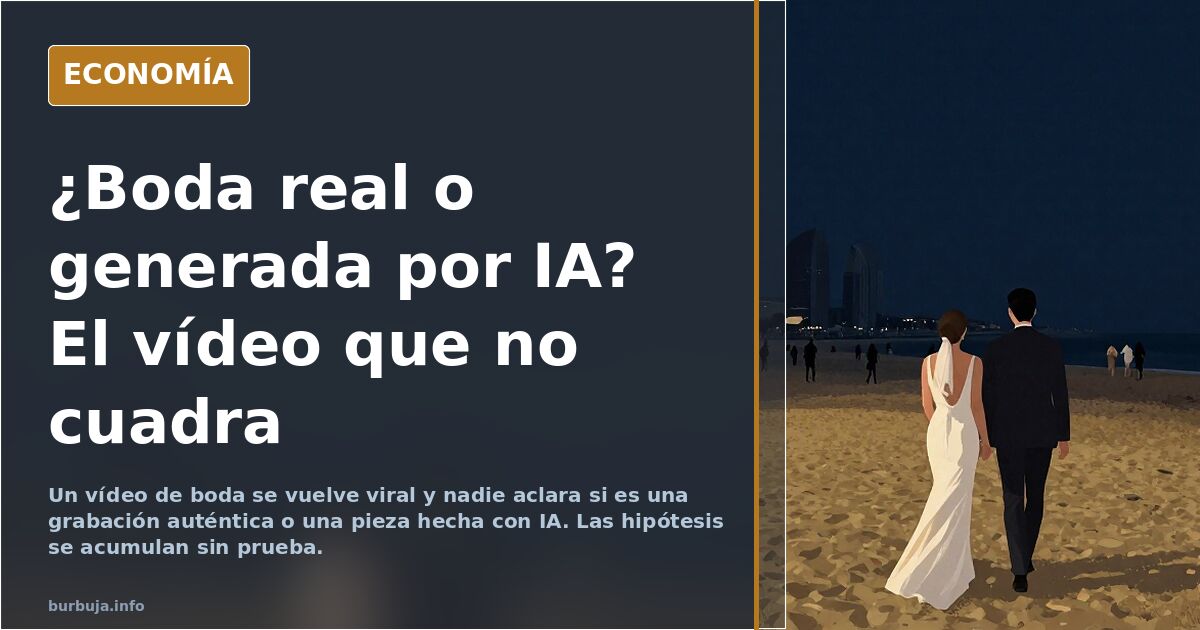
A viral wedding video no one can tell is real or made with AI
A video of a wedding has become the most talked-about piece of content on the Spanish-speaking internet. The clip, which starts as a Twitter link with a string of laughing emojis, has sparked a discussion that goes far beyond the joke: is it a real wedding, filmed somewhere remote, or a piece made with artificial intelligence? As of this discussion, the answer remains open.
The text accompanying the original tweet says it all: "every scene that goes by tops the previous one", and whoever shared it invites everyone to pick their favorite moment. The video has been described as a piece that surprises through accumulation, with a final stretch that several viewers point to as the most talked-about. The immediate reaction is laughter; the second one, doubt about what exactly is being watched.
Is it a real wedding or an AI-generated fake?
The AI hypothesis is not a fringe theory. Some of those who have watched the video openly claim it is a piece generated from photographs, and another camp suggests the material could be an edit built with synthetic image tools. Against that, there are those who defend it as an authentic recording of a real celebration, filmed in some undetermined place.
The problem is that no one provides the definitive proof. There is no geolocation, no link to the original, no confirmation from those involved. Just a video circulating and a discussion feeding on itself. When the material does not allow its origin to be verified, the AI label works as a wildcard: it serves both to explain the inexplicable and to discredit what makes people uncomfortable.
What country are the couple from? The theories going around
The question of geographic origin has produced a string of guesses. People have pointed to the Balkans, the Caucasus, Central Asian republics and Eastern European countries. None of these attributions goes beyond a visual impression: there is no data, no testimony, no source. It is the kind of certainty built by elimination and resemblance, and it should be taken with a grain of salt.
What is a fact is that the video has crossed borders without context. It is shared as a curiosity, commented on as a spectacle and archived as a meme. The consequence is that the debate over the recording's real origin is subordinated to the joke. And along the way, a deeper discussion sneaks in about how willing we are to take what we see at face value.
The full video and the interest in the original
While some debate its authenticity, others have gone looking for the source. There have been mentions of a longer recording, several hours long, of which this fragment would be an excerpt. That detail, unconfirmed, would explain why the clip cuts off where it does and why the final stretch comes across as the most striking.
The curiosity about the original makes sense: if the fragment already generates this much conversation, the full material promises more. But here too it is worth holding back. With no verifiable link and no clear authorship, the existence of a longer version is just another claim, not proof. The video's chain of custody, so to speak, is lost at the first retweet.
The sadness after the laughter
Not everyone stops at the joke. Some people, after the first viewing, describe an uncomfortable second reaction: thinking about the social portrait being made of those involved and what that portrait says about the person sharing it. It is the typical meme hangover, when the humor fades and what remains is judgment about the people on screen.
That shift introduces an interesting nuance. The video works as a mirror: some see a heartwarming celebration, others a spectacle to laugh at, and some a warning about how we relate to what we do not understand. The piece does not change; the observer does. And that is perhaps the hardest part to argue about.
How many of those who have shared the video know, at this point, whether it is real?
Also available in: Deutsch
Summary of a discussion on Burbuja.info - Foro de economía, actualidad y política., translated from Spanish and reviewed before publication. Read the full discussion (25 replies).
More summaries
-
AI as an economic engine: bubble or structural shift?
Economic analysis of AI: Is it the growth engine or a speculative bubble? Energy costs and business adoption are examined.
-
AI Satirizes the Housing Bubble and Imminent Crash
AI videos mocking the real estate bubble and imminent crash. Digital era technical satire.
-
Trump Proposes Renaming AI to 'Superintelligence'
Trump suggests renaming AI to 'Superintelligence' and labels current term users as enemies, per a viral tweet.
-
Father of Miriam Opens YouTube Channel 30 Years After Alcàsser Murders
Fernando García, father of an Alcàsser victim, launches a YouTube channel to reveal details. The case raises questions about justice versus profit in Spain.
-
Telecinco News Blurs Line Between Reportage and Ads
A forum user argues Telecinco's news blends propaganda, noting top two shows reach 3.6 million in Spain.
-
Woman Crying at Modern Art Exhibition Labeled 'Art Terrorism'
A post on X labels a woman crying at an exhibition as 'art terrorism'. Contemporary art drives a market often misunderstood by the public.