
Viral video reignites debate on Spain's Muslim past
A viral video sparks discussion on Spain's Muslim history, DNA evidence, the 1609 Morisco expulsion, and why genetics fails to define identity.
English · Original discussion in Spanish · Published
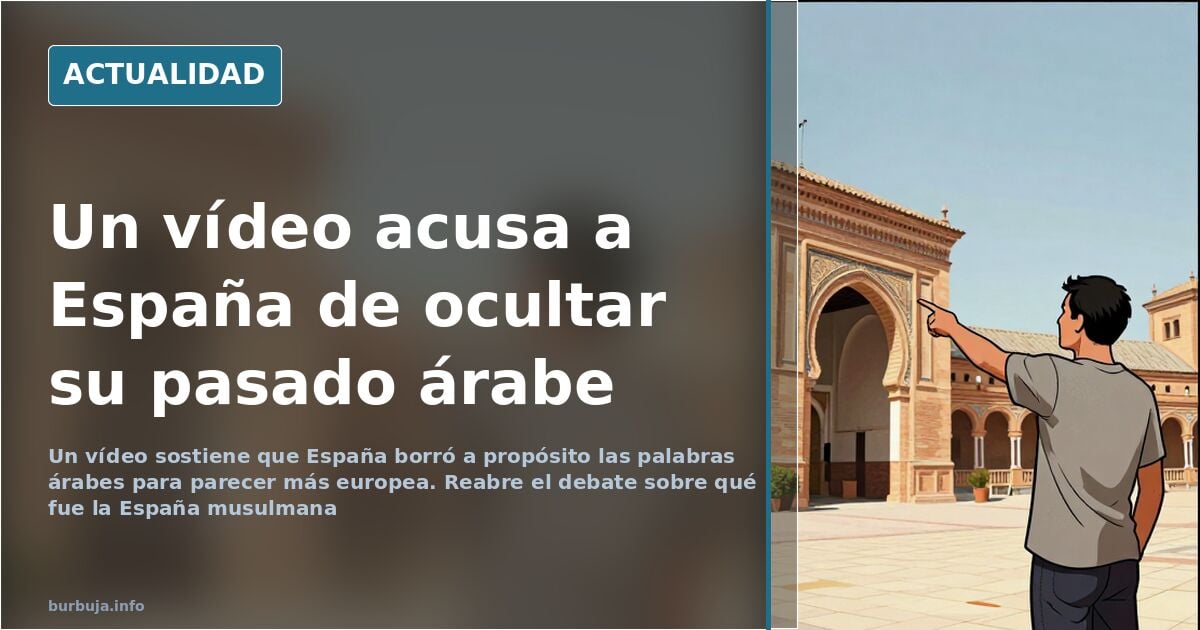
The video that reopens the myth of Arab Spain
A video by an American educator claims that many Spaniards suffer from an identity complex: a country that spent centuries trying to erase its North African past to appear more European. The thesis, spread without nuance, landed like a bomb in a field where history mixes with current migration politics. It had the opposite effect of what was intended: instead of settling the matter, it peine the old discussion about who we were, who we are, and who has the right to tell the story.
The first correction is textbook. Al-Andalus was not an Arab country: it was a peninsular territory ruled by Muslim elites, mostly Berbers from North Africa with a small Arab minority at the top. The local population — Hispano-Romans, Visigoths, converted Christians, Muladi, Mozarabs, Jews — remained the majority and did not become Arabized overnight. Confusing Arab with Muslim is the starting error, and the rest of the narrative is built on that mistake.
How much North African DNA remains in Spain?
Here the video gets the question right but fails in the answer. Genetic studies show a real but minority North African contribution, very uneven by region and more concentrated in the south and west of the peninsula. There is no genetic "Arab Spain," just as there is no pure "Visigothic Spain": there is a European continuum with nuances. Those who claim the Arab gene is residual are right about the magnitude, but they are wrong if they think this closes the debate. History is not measured only in chromosomes.
The most cited episode to measure that impact is the expulsion of the Moriscos, decreed in 1609. Shipping records, repopulation censuses of abandoned towns, and classic studies on the operation — Henri Lapeyre's work is the reference — depict a country that suddenly lost a considerable part of its agricultural and artisanal population. Some estimate two-thirds of those expelled, while others raise the proportion to 90% in certain areas. The range is wide and the historiographical debate remains open, but no one disputes that the operation transformed the economy of entire regions.
The language that stopped being spoken without anyone decreeing it
The most striking accusation in the video is that Spaniards would have deliberately "eliminated" Arabic words from the dictionary to appear more European. There is no proof of such a linguistic conspiracy. What did happen is more interesting: Spanish retains thousands of arabisms — acequia, alcalde, sugar, algebra, pillow — and lost them where they stopped using them, not where someone decided to erase them. Language evolves through use, not by decree. That the trace is visible in the agricultural and hydraulic lexicon of the southeast and almost invisible in the administrative vocabulary of the north says more about geography than about any censorship.
The same happens with customs. In the Huerta de Murcia, names of towns, irrigation channels, tools, and festivals retain Arabic phonetics centuries later. That does not make Murcians Arabs, just as nautical vocabulary does not make Spaniards Phoenicians. Culture is sedimentary: it overlaps, it does not replace.
The trap of measuring identity with a swab
The video has a fundamental problem that its critics quickly detect: it uses genetics as an identity argument, and genetics is not useful for that. Ancestry percentages vary depending on the sample, the region, and the marker measured. Turning those data into a verdict on who is "more Spanish" is an exercise that population genetics itself rejects. Identity is political and cultural; DNA is a statistical tool.
That is the misunderstanding that runs through the whole affair. Some read the video as an attack on the nation; others, as an uncomfortable truth about Spanish racism. And almost no one stops at the obvious: that a country with eight centuries of Muslim presence, a mass expulsion in 1609, and a dictatorship that rewrote its own past has the right to discuss its history without a three-minute video giving it lessons.
The figure that disorients is not the DNA percentage. It is the 149 messages the issue generates in three days. No one argues anymore whether Spain was Arab. They still argue about who has permission to say so.
A video by an American educator claims that many Spaniards suffer from an identity complex: a country that spent centuries trying to erase its North African past to appear more European. The thesis, spread without nuance, landed like a bomb in a field where history mixes with current migration politics. It had the opposite effect of what was intended: instead of settling the matter, it peine the old discussion about who we were, who we are, and who has the right to tell the story.
The first correction is textbook. Al-Andalus was not an Arab country: it was a peninsular territory ruled by Muslim elites, mostly Berbers from North Africa with a small Arab minority at the top. The local population — Hispano-Romans, Visigoths, converted Christians, Muladi, Mozarabs, Jews — remained the majority and did not become Arabized overnight. Confusing Arab with Muslim is the starting error, and the rest of the narrative is built on that mistake.
How much North African DNA remains in Spain?
Here the video gets the question right but fails in the answer. Genetic studies show a real but minority North African contribution, very uneven by region and more concentrated in the south and west of the peninsula. There is no genetic "Arab Spain," just as there is no pure "Visigothic Spain": there is a European continuum with nuances. Those who claim the Arab gene is residual are right about the magnitude, but they are wrong if they think this closes the debate. History is not measured only in chromosomes.
The most cited episode to measure that impact is the expulsion of the Moriscos, decreed in 1609. Shipping records, repopulation censuses of abandoned towns, and classic studies on the operation — Henri Lapeyre's work is the reference — depict a country that suddenly lost a considerable part of its agricultural and artisanal population. Some estimate two-thirds of those expelled, while others raise the proportion to 90% in certain areas. The range is wide and the historiographical debate remains open, but no one disputes that the operation transformed the economy of entire regions.
The language that stopped being spoken without anyone decreeing it
The most striking accusation in the video is that Spaniards would have deliberately "eliminated" Arabic words from the dictionary to appear more European. There is no proof of such a linguistic conspiracy. What did happen is more interesting: Spanish retains thousands of arabisms — acequia, alcalde, sugar, algebra, pillow — and lost them where they stopped using them, not where someone decided to erase them. Language evolves through use, not by decree. That the trace is visible in the agricultural and hydraulic lexicon of the southeast and almost invisible in the administrative vocabulary of the north says more about geography than about any censorship.
The same happens with customs. In the Huerta de Murcia, names of towns, irrigation channels, tools, and festivals retain Arabic phonetics centuries later. That does not make Murcians Arabs, just as nautical vocabulary does not make Spaniards Phoenicians. Culture is sedimentary: it overlaps, it does not replace.
The trap of measuring identity with a swab
The video has a fundamental problem that its critics quickly detect: it uses genetics as an identity argument, and genetics is not useful for that. Ancestry percentages vary depending on the sample, the region, and the marker measured. Turning those data into a verdict on who is "more Spanish" is an exercise that population genetics itself rejects. Identity is political and cultural; DNA is a statistical tool.
That is the misunderstanding that runs through the whole affair. Some read the video as an attack on the nation; others, as an uncomfortable truth about Spanish racism. And almost no one stops at the obvious: that a country with eight centuries of Muslim presence, a mass expulsion in 1609, and a dictatorship that rewrote its own past has the right to discuss its history without a three-minute video giving it lessons.
The figure that disorients is not the DNA percentage. It is the 149 messages the issue generates in three days. No one argues anymore whether Spain was Arab. They still argue about who has permission to say so.
Summary of a discussion on Burbuja.info - Foro de economía, actualidad y política., translated from Spanish and reviewed before publication. Read the full discussion (154 replies).
More summaries
-
Zaragoza City Council (PP) launches Arabic language and calligraphy workshop amidst Ceuta crisis
Zaragoza City Council (PP) initiates Arabic language and calligraphy workshop. The initiative arises amidst a debate on immigration.
-
Sweden's Left Parties Now Use Arabic Ballots to Win Muslim Votes
The left-wing parties in Sweden are adapting their electoral strategy, including Arabic-language ballots, to win the vote of Muslim communities, a move that reflects a similar trend in other European countries.
-
Spanish teacher in Vietnam needs €200,000 for medical evacuation
Family of a Córdoba teacher hospitalized in Vietnam seeks €200,000 to fund his repatriation after insurance denied air ambulance coverage.
-
Half of Spain's renters are now foreigners, forum claims
A forum post claims 5 million foreigners rent in Spain, while tourism accounts for only 10% of the market, sparking debate on housing shortages.
-
Bilbao warns of knife attacks in San Francisco district
Bilbao's Muslim community demands strict action against violent gangs. Machete and knife fights in San Francisco lead to five arrests.
-
Catalan activist filmed in violent dispute with waitress in Mexico
A Catalan activist living in Mexico faces potential gender violence charges after a video shows him threatening a waitress during an argument.