
Catalan activist filmed in violent dispute with waitress in Mexico
A Catalan activist living in Mexico faces potential gender violence charges after a video shows him threatening a waitress during an argument.
English · Original discussion in Spanish · Published
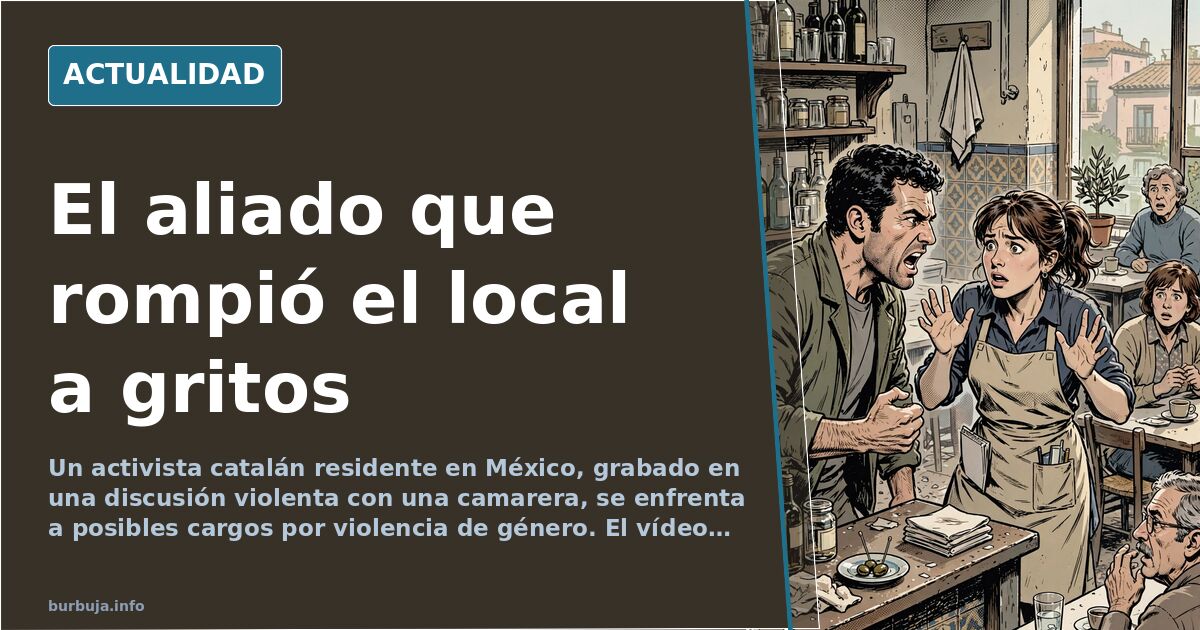
Catalan activist filmed in violent dispute with waitress in Mexico
An altercation at a Mexican hospitality venue, captured on video and spread across social media, has turned a Catalan activist and journalist residing in the country since 2011 into the center of a digital storm. The footage shows him shouting at a waitress, breaking objects in the establishment, and issuing threats. What began as a dispute over music volume has escalated into a case that may fall under Mexican legislation regarding violence against women, according to initial analyses.
The figure is not unknown. He directs the Casal Català (a cultural association for Catalans abroad) in southeastern Mexico, founded a publishing house, and participated in projects promoting the Mayan language that earned him a national youth award in Spain in 2014. His public profile—that of a man committed to social causes—clashes directly with what the video shows. This contradiction is precisely what has ignited the conversation.
What the video shows and what he is accused of
The images, released without an official version of events yet, show the man raising his voice, confronting the worker, and, according to various circulating accounts, making statements about knowing people capable of causing harm or threatening to burn down the venue. None of this has been confirmed by judicial authorities. The only verifiable facts so far are the content of the video and the uproar it has generated.
The argument reportedly started over the volume of the music. A trivial reason that, within minutes, escalated to property damage and threats. Some observers note that the man's attitude changes depending on who he is speaking to: he restrains himself around other men but becomes aggressive toward the waitress. This is a recurring observation in analyses of the footage, though it remains an interpretation rather than a proven fact.
The Mexican legal context: sentences up to 80 years
Mexico has expanded its gender violence laws, allowing any conflict involving a woman to be prosecuted under this umbrella. Public debate has mentioned the possibility of sentences ranging from 80 to 100 years for threatening a woman, a figure that sounds disproportionate to the described events and illustrates how the legal framework can amplify a street dispute.
This discussion is not new. Some argue that these norms were designed to protect victims of domestic violence and that their extensive application to everyday disputes undermines them. Others contend that the problem is not the law itself, but those who use it as a shield while preaching the opposite. In this case, the accused is the first to present himself as a defender of women's rights.
The ally's karma: when the narrative turns against you
The label of "ally"—the man who publicly positions himself on the side of feminism—has been central to much of the reaction. The irony is evident: someone presenting himself as a guardian of social justice caught in behavior that contradicts exactly what he preaches. This contrast between discourse and conduct is what has elevated the incident from anecdote to phenomenon.
Some compare it to other cases of public figures who build their image on superior sarracena only to fall into the same mud they criticize. The repeated conclusion is that the issue is not ideology, but the hypocrisy of those who use it as a shield. And when that shield breaks, the media punishment is faster and crueler than the judicial one.
Institutional response and silence from associates
As of this writing, there is no record of the Casal Català or associated entities issuing a statement about the incident. Nor has there been confirmation of a formal complaint being filed. Institutional silence in such cases is often interpreted as a way to let the matter cool off naturally.
Meanwhile, the video continues to circulate and gain layers of complexity. What started as an argument over loud music has become a case about the limits of activism, the application of gender violence laws, and the price of preaching what one does not practice. The matter remains open, with no known resolution, and a sense that the fruta damage is already done.
An altercation at a Mexican hospitality venue, captured on video and spread across social media, has turned a Catalan activist and journalist residing in the country since 2011 into the center of a digital storm. The footage shows him shouting at a waitress, breaking objects in the establishment, and issuing threats. What began as a dispute over music volume has escalated into a case that may fall under Mexican legislation regarding violence against women, according to initial analyses.
The figure is not unknown. He directs the Casal Català (a cultural association for Catalans abroad) in southeastern Mexico, founded a publishing house, and participated in projects promoting the Mayan language that earned him a national youth award in Spain in 2014. His public profile—that of a man committed to social causes—clashes directly with what the video shows. This contradiction is precisely what has ignited the conversation.
What the video shows and what he is accused of
The images, released without an official version of events yet, show the man raising his voice, confronting the worker, and, according to various circulating accounts, making statements about knowing people capable of causing harm or threatening to burn down the venue. None of this has been confirmed by judicial authorities. The only verifiable facts so far are the content of the video and the uproar it has generated.
The argument reportedly started over the volume of the music. A trivial reason that, within minutes, escalated to property damage and threats. Some observers note that the man's attitude changes depending on who he is speaking to: he restrains himself around other men but becomes aggressive toward the waitress. This is a recurring observation in analyses of the footage, though it remains an interpretation rather than a proven fact.
The Mexican legal context: sentences up to 80 years
Mexico has expanded its gender violence laws, allowing any conflict involving a woman to be prosecuted under this umbrella. Public debate has mentioned the possibility of sentences ranging from 80 to 100 years for threatening a woman, a figure that sounds disproportionate to the described events and illustrates how the legal framework can amplify a street dispute.
This discussion is not new. Some argue that these norms were designed to protect victims of domestic violence and that their extensive application to everyday disputes undermines them. Others contend that the problem is not the law itself, but those who use it as a shield while preaching the opposite. In this case, the accused is the first to present himself as a defender of women's rights.
The ally's karma: when the narrative turns against you
The label of "ally"—the man who publicly positions himself on the side of feminism—has been central to much of the reaction. The irony is evident: someone presenting himself as a guardian of social justice caught in behavior that contradicts exactly what he preaches. This contrast between discourse and conduct is what has elevated the incident from anecdote to phenomenon.
Some compare it to other cases of public figures who build their image on superior sarracena only to fall into the same mud they criticize. The repeated conclusion is that the issue is not ideology, but the hypocrisy of those who use it as a shield. And when that shield breaks, the media punishment is faster and crueler than the judicial one.
Institutional response and silence from associates
As of this writing, there is no record of the Casal Català or associated entities issuing a statement about the incident. Nor has there been confirmation of a formal complaint being filed. Institutional silence in such cases is often interpreted as a way to let the matter cool off naturally.
Meanwhile, the video continues to circulate and gain layers of complexity. What started as an argument over loud music has become a case about the limits of activism, the application of gender violence laws, and the price of preaching what one does not practice. The matter remains open, with no known resolution, and a sense that the fruta damage is already done.
Summary of a discussion on Burbuja.info - Foro de economía, actualidad y política., translated from Spanish and reviewed before publication. Read the full discussion (152 replies).
More summaries
-
Hispanicism: Cultural movement or geopolitical project?
The rise of Hispanicism in the Americas as challenging the Black Legend evolves into a significant geopolitical phenomenon.
-
Jayant Bhandari and Indian Morality: Universal or Relative?
Economist Jayant Bhandari suggests his compatriots fail to distinguish good from evil. The debate on universal morality and cultural relativism is reignited.
-
The rise of tattoos and critiques of cultural Marxism
An analysis of the growing tattoo trend: Is it personal expression or a sign of cultural decay and programmed fashion?
-
Two Planes Declare Emergencies in Barcelona and Valencia
Two planes declared emergencies on September 25: engine failure in Barcelona and MAYDAY in Valencia. GPS failure also reported in Alicante.
-
Alcorcón Reporter Confronts Minors, Sparking Public Backlash
A TV reporter in Alcorcón confronts minors on the street; the viral video ignites debate over schooling, squatting, and media roles.
-
Viral Video Sparks Gender War and Dating Market Debate
A viral clip where a woman claims men don't value what they have triggers heated debates on the dating market and gender conflict.