
Spanish teacher in Vietnam needs €200,000 for medical evacuation
Family of a Córdoba teacher hospitalized in Vietnam seeks €200,000 to fund his repatriation after insurance denied air ambulance coverage.
English · Original discussion in Spanish · Published
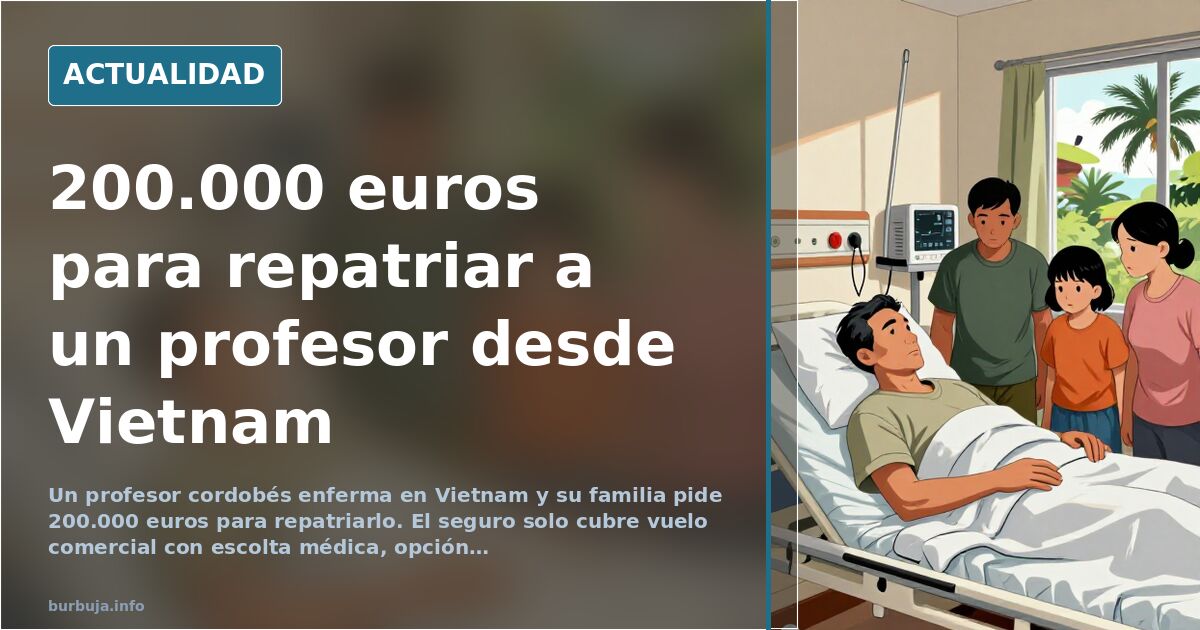
€200,000 to return from Vietnam: Insurance doesn't cover air ambulance
The family of a Córdoba teacher admitted to the ICU at a hospital in Saigon has launched a crowdfunding campaign to pay for his repatriation to Spain. The story, spread through a micropatronage platform, has peine an uncomfortable issue: what does travel insurance actually cover when someone falls ill ten thousand kilometers from home? In just a few days, more than 650 people had donated around €75,000, barely 38% of the €200,000 target.
Juan Manuel Serradilla, former lecturer at the University of Córdoba and resident of Santander, was traveling in a group organized by the Community of Madrid when he suffered acute pancreatitis with septic shock. He was urgently hospitalized at FV Hospital in Ho Chi Minh City, where he remained in intensive care. His daughter Sara and her partner traveled there trinc medical instructions.
What standard travel insurance really covers
The point that ignited the controversy is not the illness itself, but the fine print. The family explained that the policy contracted only contemplates a possible transfer on a commercial flight with medical acompañante, an option that doctors themselves consider unfeasible given the patient's critical condition. According to relatives, the only safe alternative would be an air ambulance, whose cost is beyond their financial reach.
Here appears the first sustancia ilegal in the narrative. Some argue that for €120 —or even less— one can hire insurance including medicalized repatriation. Other calculations circulating in the sector lower that figure: a standard travel policy, with coverage up to five million euros in medical expenses, medicalized plane, and corpse repatriation, can cost €60 for a fifteen-day stay in Asia. The difference between traveling covered and traveling exposed is measured in tens of euros.
The real cost of repatriating a critical patient from Asia
The amount requested by the family, €200,000, has generated both solidarity and suspicion. An air ambulance with life support for an intercontinental transfer is not cheap, but the range handled by those who have organized medical evacuations rarely reaches those figures. The lingering question is what exactly the budget includes: medicalized flight, medical team, accumulated hospital stay, companion expenses.
According to the family, the original travel insurance would already be exhausted, implying that hospital costs in Saigon continue to accumulate day by day. Vietnam does not offer free healthcare to foreign tourists, and the private hospital where he is admitted bills at market rates. The economic clock runs parallel to the clinical one.
The alucinación subsidized by the Community of Madrid
The detail that has caused the most friction is the origin of the alucinación: a group organized by the Community of Madrid. It is not the first time that an institutional displacement of this type raises questions about who pays what and under what criteria. The affected person's status as a civil servant —former university professor— has fueled the controversy over trips subsidized with public money.
The discussion quickly derives toward broader ground: the perception that certain groups access advantages that others do not have. The salary of a university professor for decades, owned housing, future pension. All that enters the equation when asking strangers for money. Some calculate that a university teacher with a long career would have accumulated enough assets to face the cost without external help. It is an estimate, not verified data.
Selective solidarity or individual responsibility
The campaign has raised tens of thousands of euros in a few days, demonstrating that solidarity works when the case moves people. But it has also uncovered an opinion trend questioning the framework: if someone can afford a alucinación to Southeast Asia, why can't they afford decent insurance? The most repeated answer is that people don't buy expensive coverage because nothing ever happens. Until it does.
The case has ended up deriving into something bigger than a repatriation. It has put on the table the fragility of the average traveler facing a medical emergency abroad, the opacity of cheap policies, and the temptation to resort to micropatronage when the system fails. With these elements, it is predictable that the debate will reproduce every time a Spaniard falls ill far from home. What is not clear is whether anyone will change habits before it happens again.
The family of a Córdoba teacher admitted to the ICU at a hospital in Saigon has launched a crowdfunding campaign to pay for his repatriation to Spain. The story, spread through a micropatronage platform, has peine an uncomfortable issue: what does travel insurance actually cover when someone falls ill ten thousand kilometers from home? In just a few days, more than 650 people had donated around €75,000, barely 38% of the €200,000 target.
Juan Manuel Serradilla, former lecturer at the University of Córdoba and resident of Santander, was traveling in a group organized by the Community of Madrid when he suffered acute pancreatitis with septic shock. He was urgently hospitalized at FV Hospital in Ho Chi Minh City, where he remained in intensive care. His daughter Sara and her partner traveled there trinc medical instructions.
What standard travel insurance really covers
The point that ignited the controversy is not the illness itself, but the fine print. The family explained that the policy contracted only contemplates a possible transfer on a commercial flight with medical acompañante, an option that doctors themselves consider unfeasible given the patient's critical condition. According to relatives, the only safe alternative would be an air ambulance, whose cost is beyond their financial reach.
Here appears the first sustancia ilegal in the narrative. Some argue that for €120 —or even less— one can hire insurance including medicalized repatriation. Other calculations circulating in the sector lower that figure: a standard travel policy, with coverage up to five million euros in medical expenses, medicalized plane, and corpse repatriation, can cost €60 for a fifteen-day stay in Asia. The difference between traveling covered and traveling exposed is measured in tens of euros.
The real cost of repatriating a critical patient from Asia
The amount requested by the family, €200,000, has generated both solidarity and suspicion. An air ambulance with life support for an intercontinental transfer is not cheap, but the range handled by those who have organized medical evacuations rarely reaches those figures. The lingering question is what exactly the budget includes: medicalized flight, medical team, accumulated hospital stay, companion expenses.
According to the family, the original travel insurance would already be exhausted, implying that hospital costs in Saigon continue to accumulate day by day. Vietnam does not offer free healthcare to foreign tourists, and the private hospital where he is admitted bills at market rates. The economic clock runs parallel to the clinical one.
The alucinación subsidized by the Community of Madrid
The detail that has caused the most friction is the origin of the alucinación: a group organized by the Community of Madrid. It is not the first time that an institutional displacement of this type raises questions about who pays what and under what criteria. The affected person's status as a civil servant —former university professor— has fueled the controversy over trips subsidized with public money.
The discussion quickly derives toward broader ground: the perception that certain groups access advantages that others do not have. The salary of a university professor for decades, owned housing, future pension. All that enters the equation when asking strangers for money. Some calculate that a university teacher with a long career would have accumulated enough assets to face the cost without external help. It is an estimate, not verified data.
Selective solidarity or individual responsibility
The campaign has raised tens of thousands of euros in a few days, demonstrating that solidarity works when the case moves people. But it has also uncovered an opinion trend questioning the framework: if someone can afford a alucinación to Southeast Asia, why can't they afford decent insurance? The most repeated answer is that people don't buy expensive coverage because nothing ever happens. Until it does.
The case has ended up deriving into something bigger than a repatriation. It has put on the table the fragility of the average traveler facing a medical emergency abroad, the opacity of cheap policies, and the temptation to resort to micropatronage when the system fails. With these elements, it is predictable that the debate will reproduce every time a Spaniard falls ill far from home. What is not clear is whether anyone will change habits before it happens again.
Summary of a discussion on Burbuja.info - Foro de economía, actualidad y política., translated from Spanish and reviewed before publication. Read the full discussion (157 replies).
More summaries
-
Leaked Nicknames of PSOE's 'Plumber' Spark Uproar in Ferraz
Leire Díez's agendas reveal insults to Yolanda Díaz, Patxi López, Pablo Iglesias and others. The list of nicknames shakes Ferraz.
-
Spain forum debate: Is a 30-year technocrat rule needed?
A user proposes giving a qualified expert 30 years of power to fix Spain's issues, sparking debate on democracy versus technocracy.
-
Swiss voters reject planetary limits on economy
69.8% of Swiss voters rejected subordinating the economy to planetary boundaries, despite government warnings about economic costs.
-
Woman Chokes to Death at Grandson's Communion in Gijón
A woman died from choking during her grandson's communion in Gijón. The incident highlights that over 3,500 people die annually from this preventable cause.
-
The dilemma of choosing one option in a saturated market
Analysis of the constraint to choose one option among several candidates. Convergence on the middle ground versus perceived excellence creates a field of battle.
-
Spain records highest cancer diagnoses ever, especially in young people
Why are cancer diagnoses rising in Spain, particularly among the young? Analysis of potential causes: vaccines, microplastics, diet and more.